
The Truth About Dye
Dye carries the worst reputation of any material in window film, and the full story is more interesting than the reputation — in both directions.
Why old film turned purple. The mechanism is documented precisely in patent literature. Gray-toned films are produced by blending red, blue, and yellow organic dyes in proportion. Under prolonged light exposure, the yellow component degrades faster than the red and blue — its chromophore structure breaks down under UV — and as the yellow decomposes, the surviving red and blue dominate. The film does not fade to nothing; it fades to purple. A generation of purpled rear windows was a blend-chemistry failure, not a law of nature.
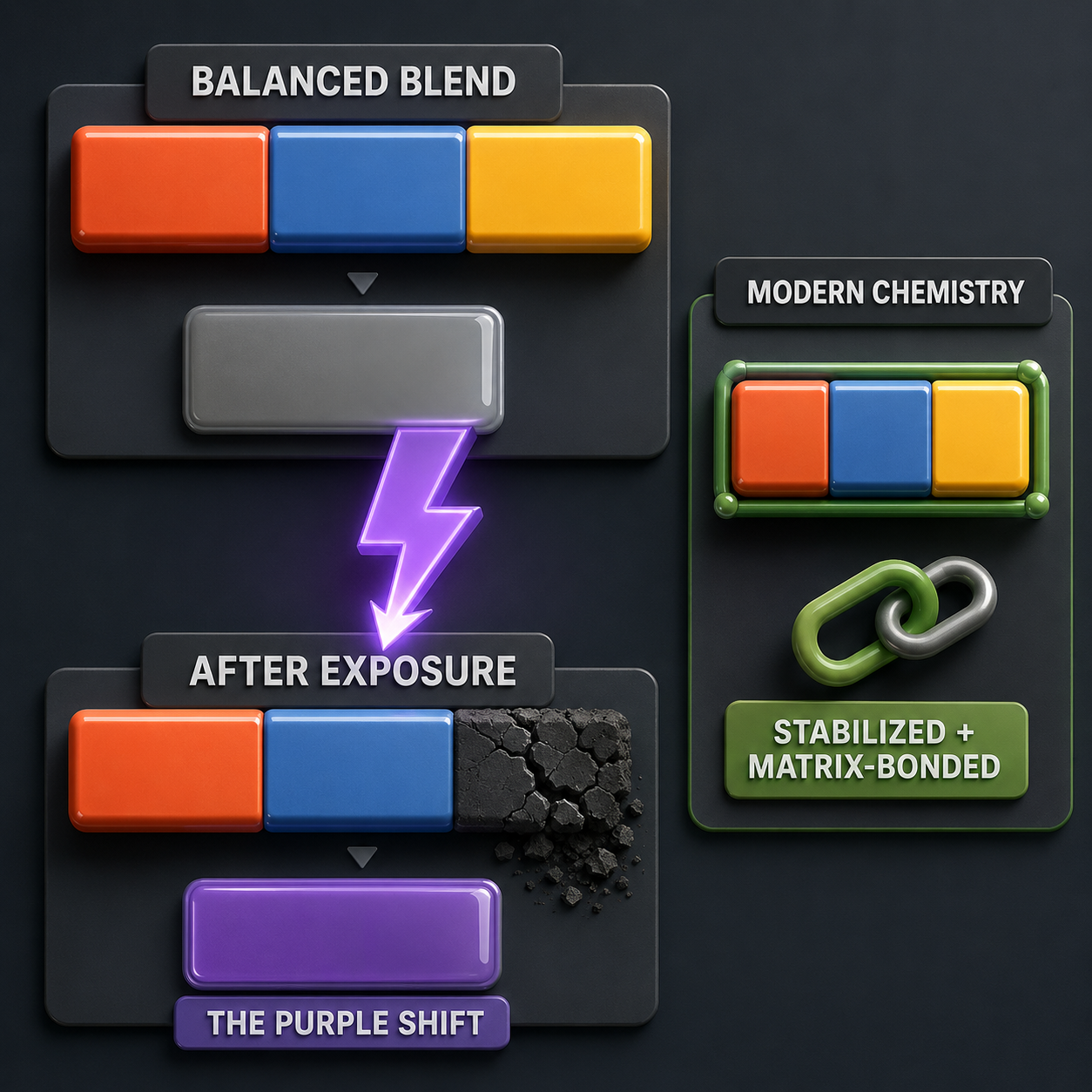
Why the stereotype is outdated. Modern dye chemistry is documented in current patents: UV-stabilized organic dyes, metal complex dyes, and reactive dyes that bond into the polyester matrix itself, with fade resistance demonstrated at high cumulative UV exposure — patent claims specify minimal color shift and minimal transmission change after hundreds of megajoules per square meter of UV dosage. The categorical claim "dyed film fades" is a fight against chemistry that has since been re-engineered.
The part marketing omits. Virtually all film types use dye somewhere in the stack — including many products marketed as ceramic or carbon. Dye serves three documented purposes: color tuning, because functional particles have natural color signatures that miss commercial targets; VLT control, because hitting precise darkness levels through particle loading alone is difficult; and cost efficiency, because supplementing expensive functional material with inexpensive dye is straightforward economics. The notable exception is true sputtered TiN film, whose color is the material's own.
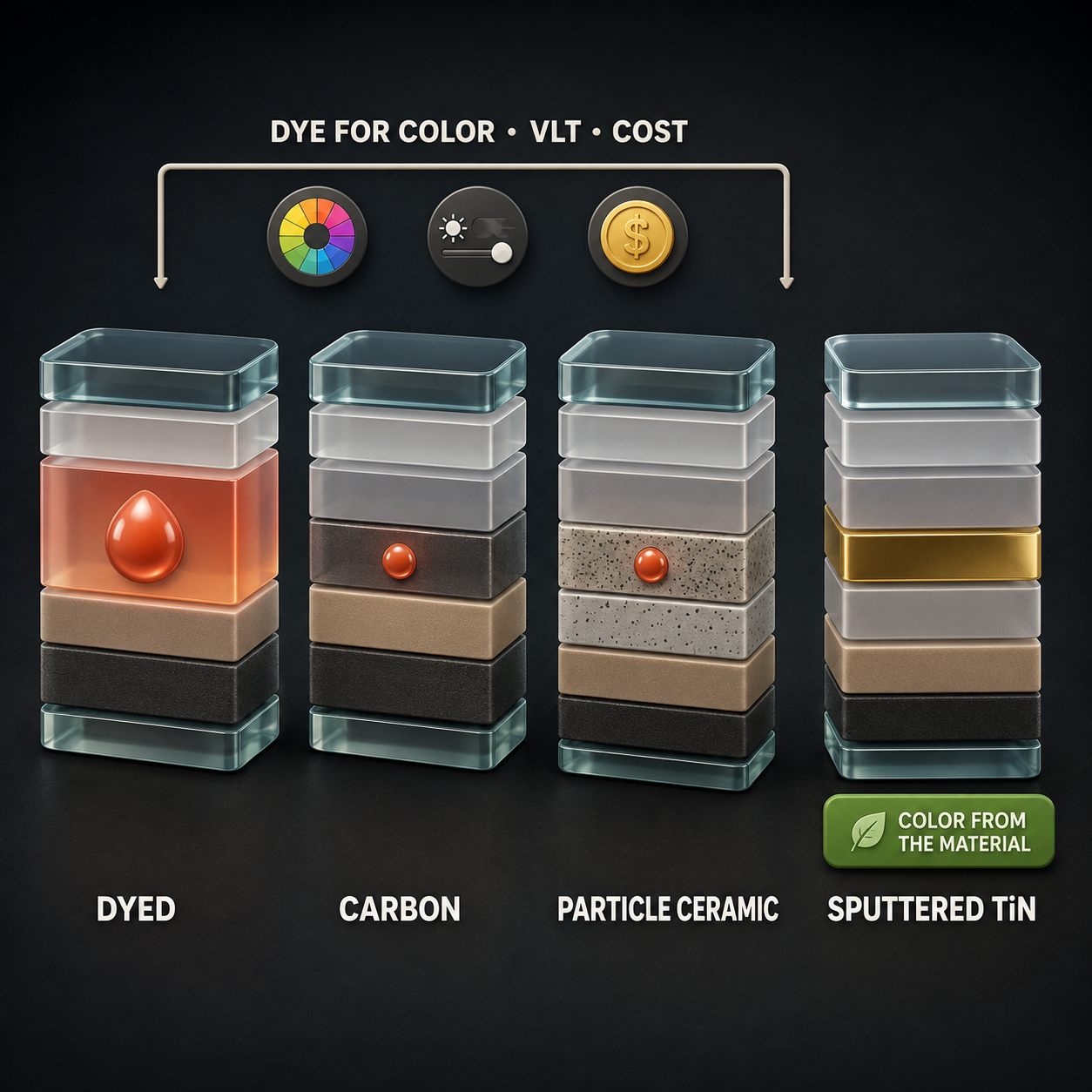
Dye, in short, is neither the villain of the old stereotype nor absent from the products that claim to have transcended it.
If you're just finding this page, here's the quick context: our focus is sharing the science behind the sun's energy and how window film actually affects it. This is one chapter in an ongoing series — to see more, visit our page or give us a follow to keep window film and sun's energy facts coming to your feed.