
The Patents Behind Modern Film
No high-performance film entered the market unclaimed. The intellectual property behind modern solar-control film is not a single document but several distinct families, held by different companies, each protecting a different physical mechanism. Four are worth knowing — and seen together, they make the same point the rest of this series has made about construction: the label "ceramic" or "high-performance" hides a roster of genuinely different engineering, owned by genuinely different firms.
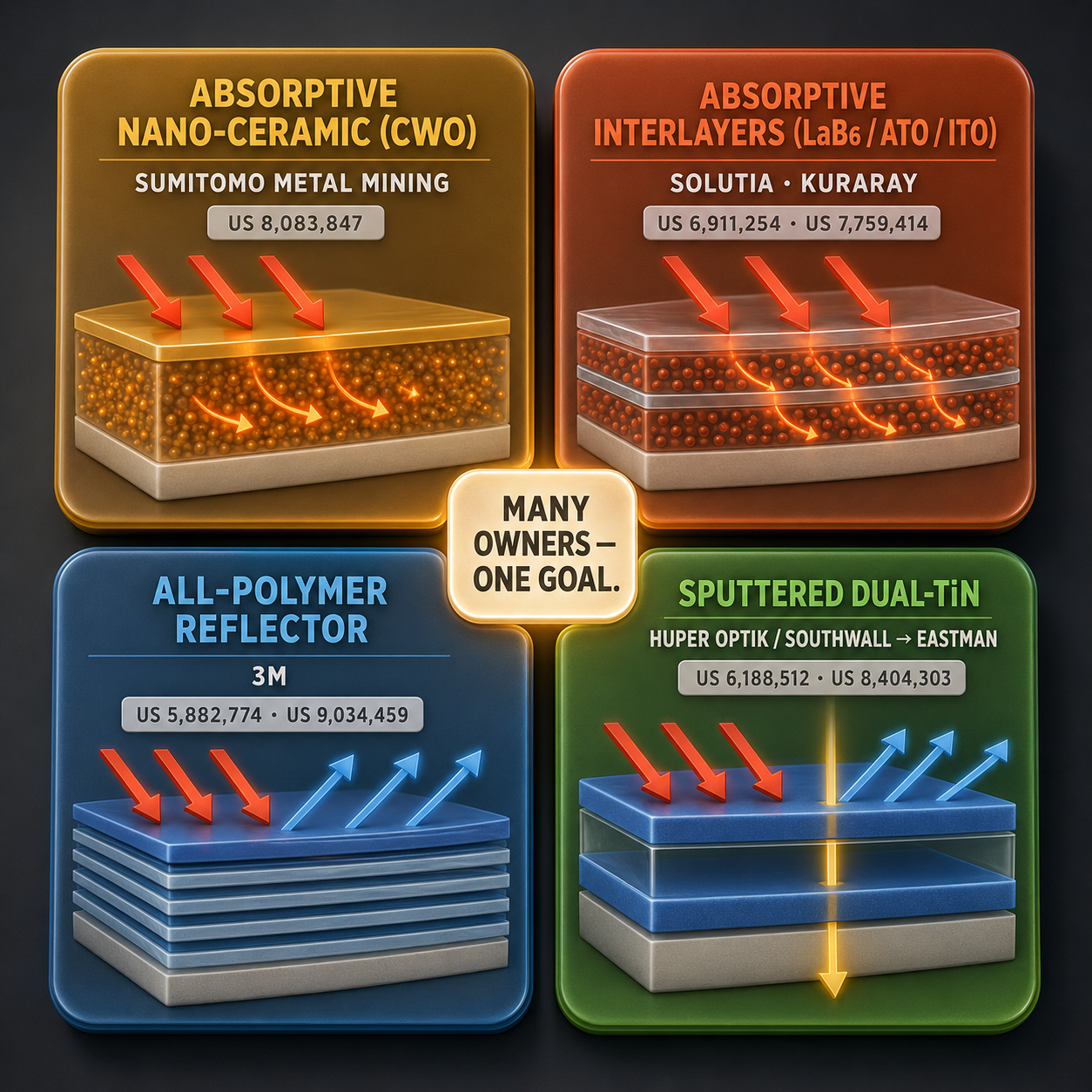
Absorptive nano-ceramic particles. Much of the film marketed as "nano-ceramic" rests on absorptive particle chemistry pioneered by Sumitomo Metal Mining. Cesium tungsten oxide (CWO) — a conductive tungsten-bronze nanoparticle the company developed in 2004 — absorbs strongly in the energy-dense near-infrared. It appears in patents such as US 8,083,847 ("Fine particle dispersion of infrared-shielding material…"), which covers the hexagonal Cs₀.₃₃WO₃ particle at the heart of the technology. These are the absorbers mapped in Chapters 4.3 and 4.4, here with their intellectual-property roots attached.
Absorptive interlayers. Getting those particles — and others — into a usable laminate is a separate body of IP, held by separate companies. Dispersing lanthanum hexaboride (LaB₆), antimony tin oxide (ATO), and indium tin oxide (ITO) into polymer interlayers is documented in Solutia's US 6,911,254 ("Infrared absorbing compositions and laminates," LaB₆ in a polyvinyl butyral matrix) and Kuraray's US 7,759,414 ("Nanoparticulate solar control compositions"). The particle and the interlayer are different inventions, owned by different firms — one reason "nano-ceramic" on a label tells you so little.
All-polymer reflective films. 3M patented a reflective route that uses no metal at all: hundreds of coextruded birefringent polymer layers whose stacked optical interference turns away a chosen infrared band. The foundational birefringent-multilayer patent is US 5,882,774 ("Optical film"), and the solar-specific application is US 9,034,459 ("Infrared reflecting films for solar control and other uses"). Because nothing in the stack conducts, this is reflection without signal interference — a fundamentally different architecture from the sputtered routes.
Sputtered dual-layer titanium nitride. US 6,188,512 ("Dual titanium nitride layers for solar control") describes a solar-control member built on two spaced-apart reactive-sputtered TiN layers — the spacing engineered specifically to suppress the visible-light interference (rainbow shimmer) of poorly spaced optical stacks. The related US 8,404,303 ("Separated gray metal and titanium nitride solar control members") extends the family. The ownership trail is itself the brand story: the patent was filed by GMX Associates and Southwall Technologies; GMX Associates was renamed Globamatrix Holdings, and the patent was assigned to Huper Optik International in 2006, with the Southwall side and the Huper Optik line both ultimately folding into Eastman Chemical. This is the dual-layer TiN sold as "nano-ceramic" film under the Huper Optik name — the plasmonic behavior of Chapter 4.5, industrialized, and one of these four routes rather than the origin of the category.
The timeline is where the patent record becomes market analysis. United States patents of this era carry a 20-year term, and the foundational filings are now lapsing: US 5,882,774 long expired, US 6,188,512 expired in November 2018, US 6,911,254 in 2021, and Sumitomo's US 8,083,847 in 2024. As each foundational patent expires, the technology it protected becomes available to additional manufacturers without licensing exposure — even as newer refinements stay covered (US 7,759,414 into 2027, US 9,034,459 into 2030, US 8,404,303 into 2032). A market shift visible on today's shelves, across several film technologies at once, has these filing dates as its root cause.
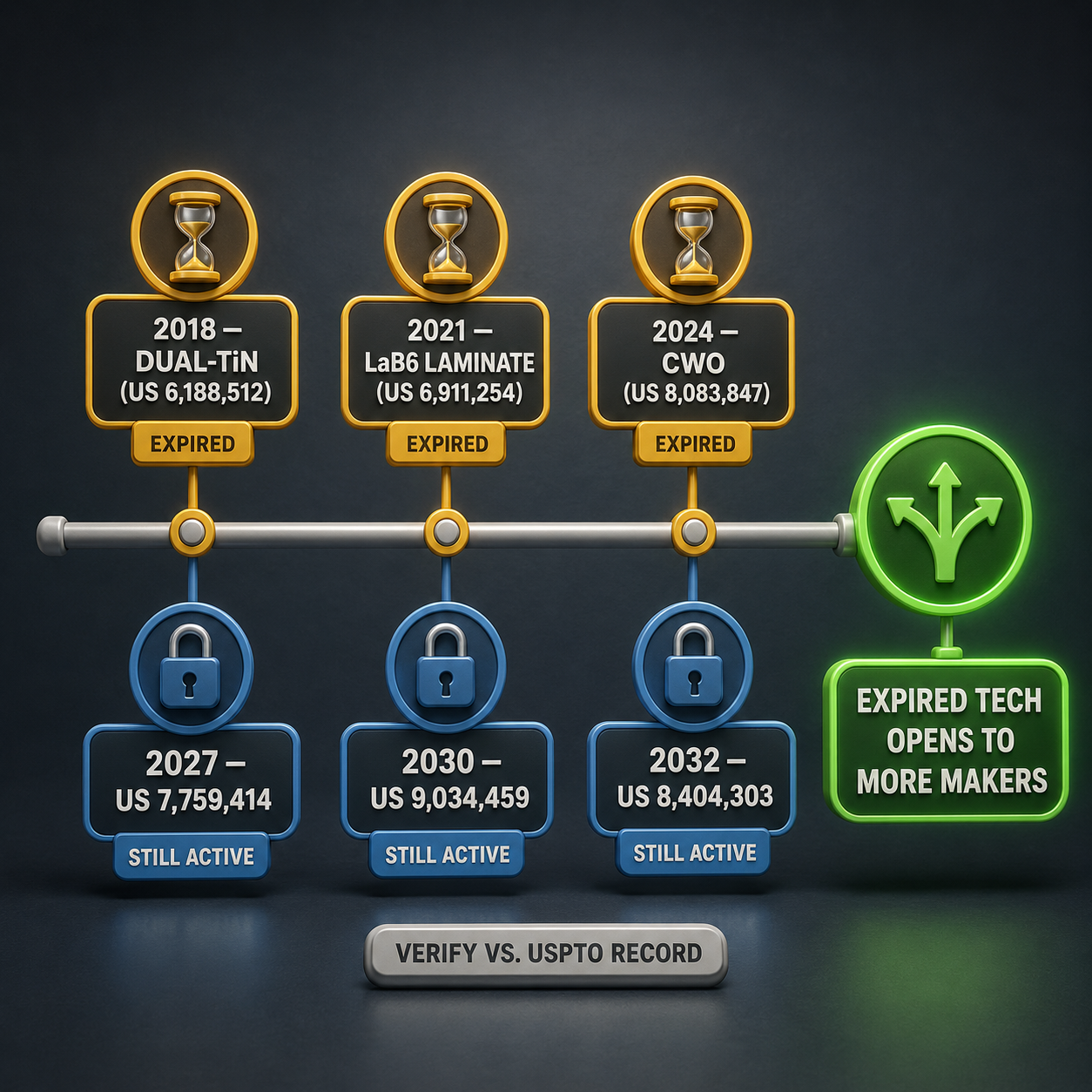
One craft caveat, in the spirit of the rest of this series: the numbers, assignees, and dates above were checked against the public patent record, but exact expiration shifts with maintenance fees and term adjustments, and assignees change hands. Any specific claim should be verified against the live USPTO record before it is published.
If you're just finding this page, here's the quick context: our focus is sharing the science behind the sun's energy and how window film actually affects it. This is one chapter in an ongoing series — to see more, visit our page or give us a follow to keep window film and sun's energy facts coming to your feed.