
Selective Reflection: Turning Heat Away Without a Mirror
Chapter 4.4 established the disqualifier that haunts reflection: an ordinary metal layer turns away the whole spectrum at once, producing a mirror effect that is legally restricted in many jurisdictions, commercially unpopular, and — because the layer is conductive — prone to interfering with signals. The high end of the film category is defined by escaping that compromise: reflecting the infrared while leaving the visible light, and the signal, alone. The patent and manufacturing record documents three genuinely different routes to that result.
Route one — plasmonic ceramics. Titanium nitride escapes the mirror through materials physics rather than geometry. TiN is a plasmonic material: its free-electron density places its plasma frequency — the threshold beyond which its electrons can no longer respond to incoming radiation — in the near-infrared rather than in the visible, where ordinary metals sit. Below the threshold, in the near-infrared, the electrons respond and the material reflects; above it, in visible light, they cannot keep up and the material transmits. One compound, by its intrinsic electronic structure, turns away the invisible band carrying most of the heat while passing the band eyes need — spectral selectivity without a mirror, and without the signal interference of a conductive metal layer.
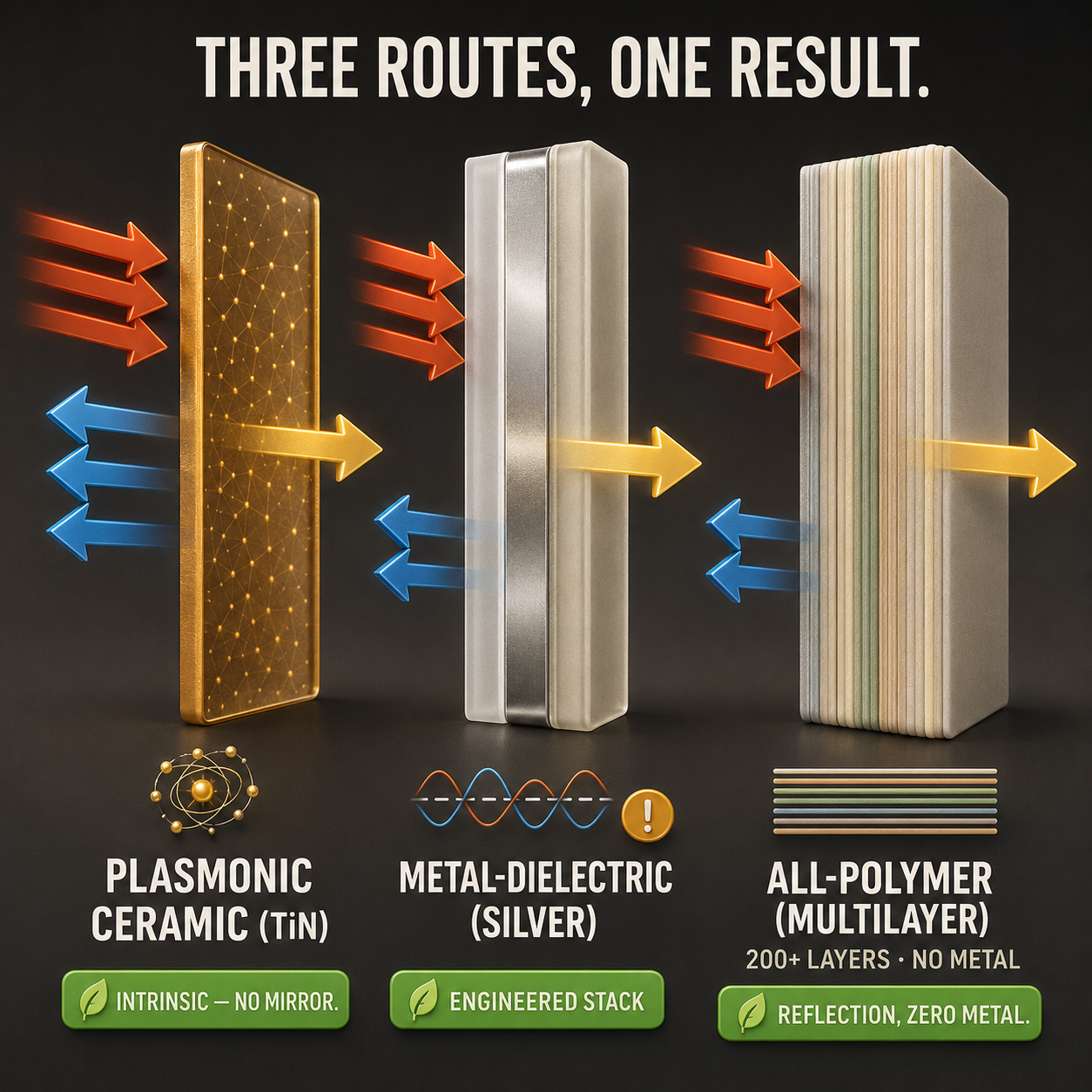
Route two — metal-dielectric stacks. A bare silver layer would reflect visibly like any metal; the escape here is engineered, not intrinsic. A very thin silver film is sandwiched between precisely tuned dielectric (anti-reflective) layers whose interference cancels the visible reflection while the silver still turns the infrared away. The result is reflective and spectrally selective — but the silver remains conductive, so signal interference is not eliminated, and the soft metal demands protective layers against corrosion. This is the spectrally-selective sputtered family, and the lineage behind the reflective films laminated into glass under names like Heat Mirror and XIR.
Route three — all-polymer interference stacks. The third route uses no metal at all. Hundreds of coextruded birefringent polymer layers, each a fraction of a wavelength thick, are tuned so their stacked optical interference reflects a chosen infrared band — Bragg reflection achieved by polymer alone. Because nothing in the stack conducts, the payoff is reflective infrared performance with zero signal interference and no metallic corrosion to design around.
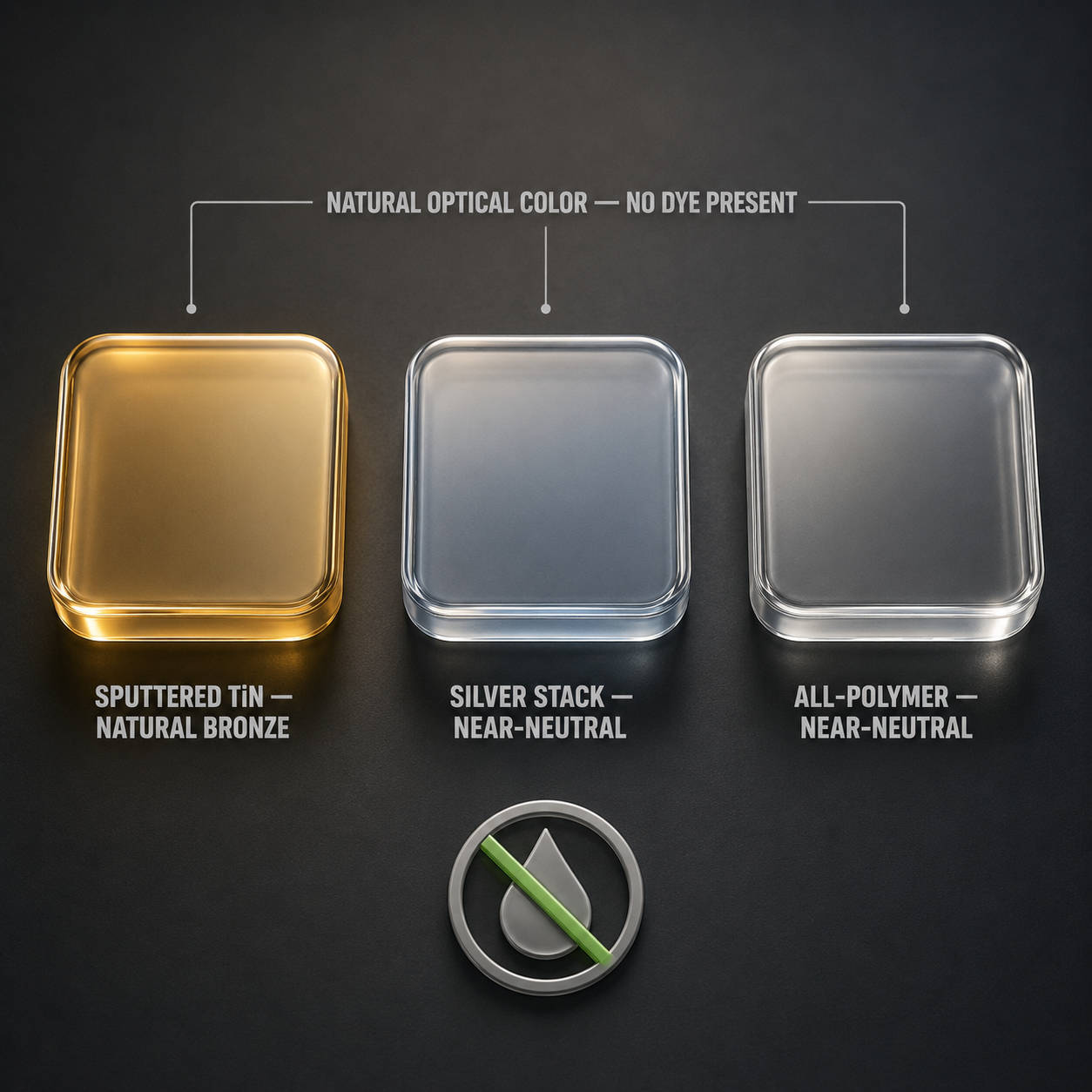
Each engine also signs its own work. Among these routes, the materials differ in their natural fingerprints. At the layer thicknesses used in film, titanium nitride carries a subtle warm bronze-gold optical color — a property of the compound itself, not a dye — while silver stacks and all-polymer stacks read closer to neutral. That difference in natural color, read at a product line's lightest shade, becomes a practical field diagnostic in Chapter 4.12.
A set of mechanisms this well-suited did not enter the market unclaimed. Each route traces to its own patent family, held by a different company — the subject of the next chapter.
If you're just finding this page, here's the quick context: our focus is sharing the science behind the sun's energy and how window film actually affects it. This is one chapter in an ongoing series — to see more, visit our page or give us a follow to keep window film and sun's energy facts coming to your feed.