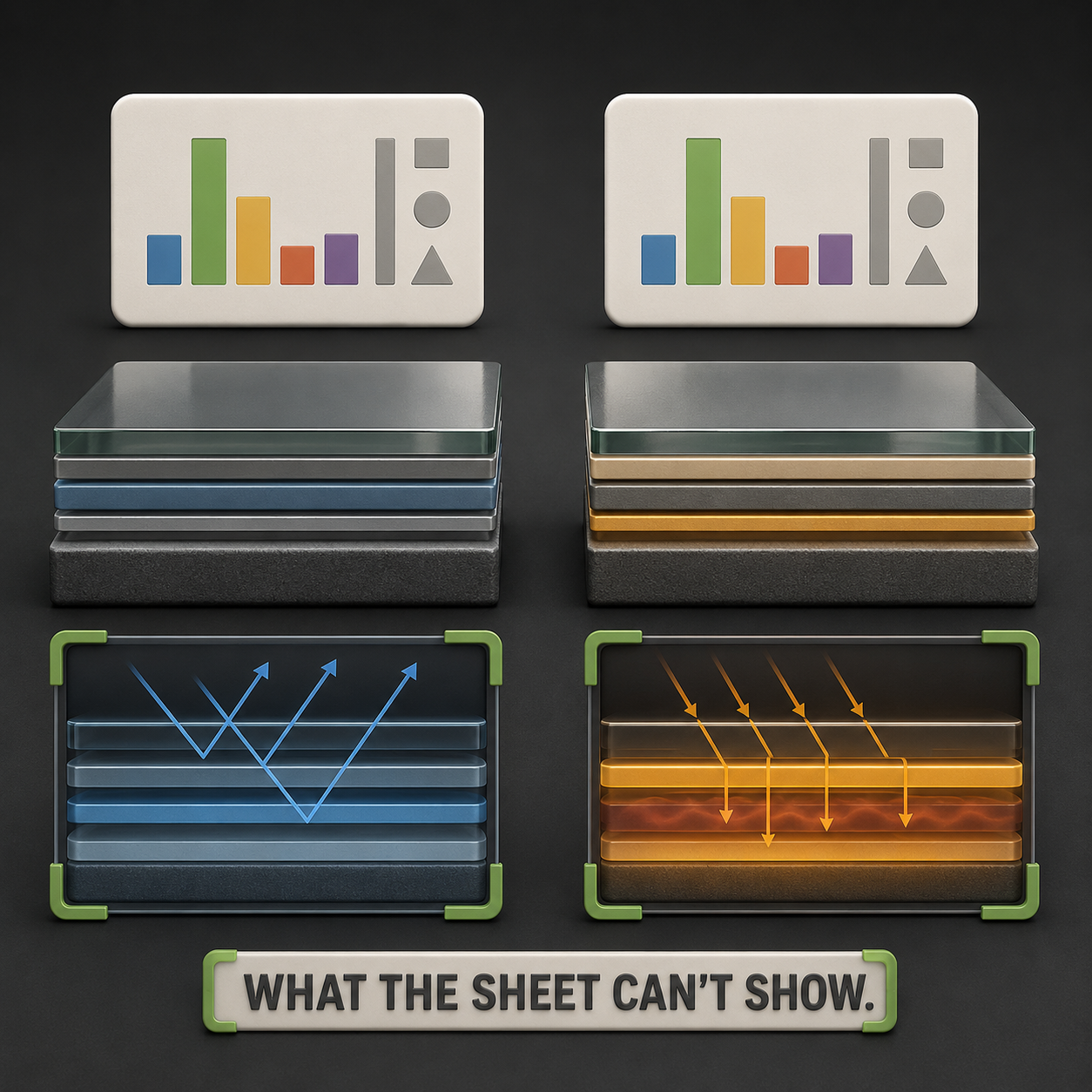
Mechanism by Material: Who Reflects, Who Absorbs
Series 2 established that reflection and absorption are profoundly different fates — one a closed door, one a door with a slow leak. This chapter maps those fates onto real construction.
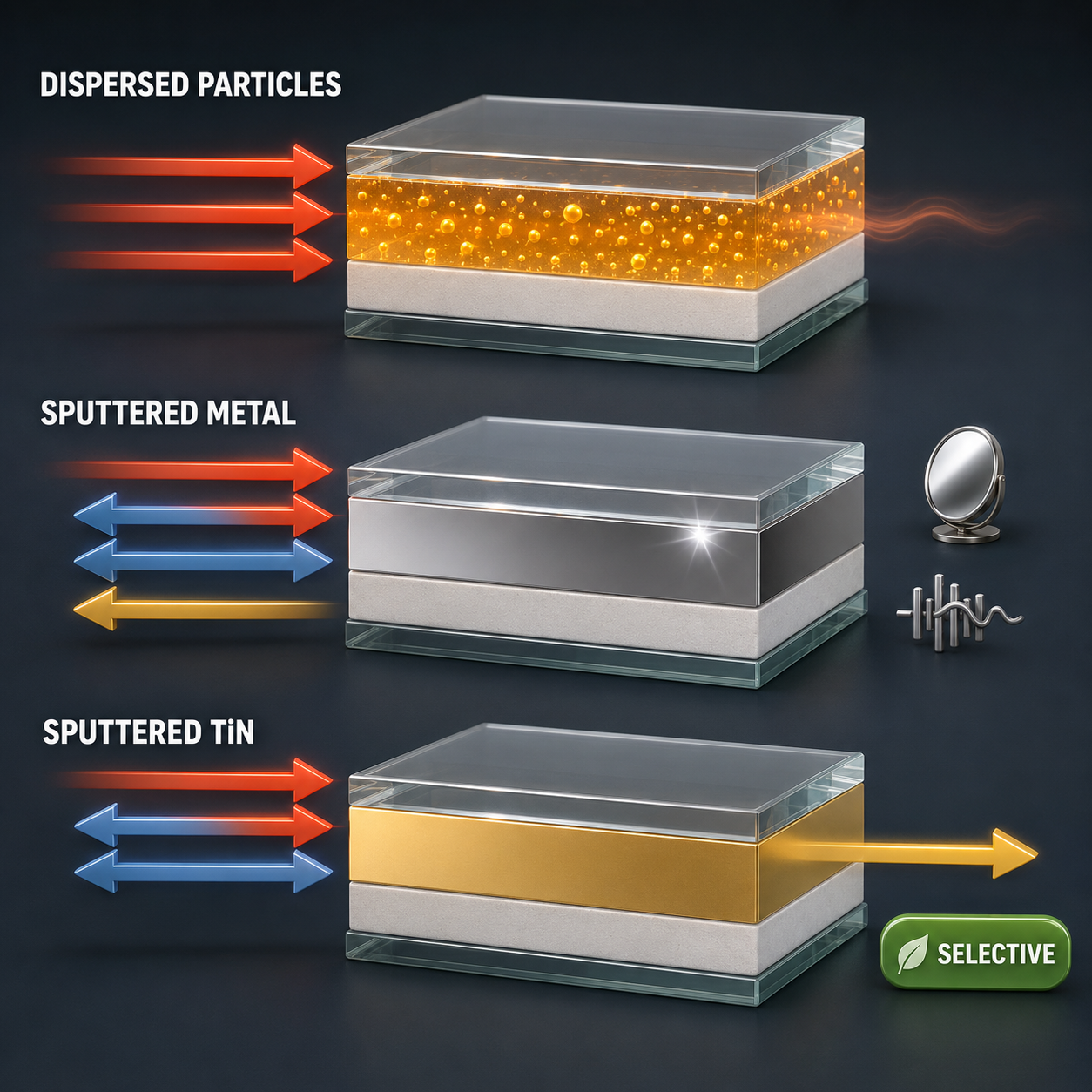
Dispersed-particle films absorb. Carbon black, SiC, Al₂O₃, ITO, ATO, LaB₆, CWO — the particle roster works overwhelmingly through capturing infrared energy within the film. The captured energy heats the film, and per the physics of Series 2, a portion re-radiates inward. Which sub-range gets absorbed is compound-specific: the patent record places ATO and ITO above 1,500 nanometers in the band's low-energy tail, and LaB₆, CWO, and TiN nanoparticles in the energy-dense zone near the peak. Two "ceramic" films can therefore differ twice over — in how much they absorb and in where on the spectrum the absorption does its work.
Sputtered metals reflect. Silver, aluminum, nickel-chrome, stainless — continuous metal layers turn infrared away at the surface. The cost is optical and electronic: broad visible reflection produces the mirror effect, and conductive layers interfere with signals.
Sputtered titanium nitride reflects selectively — one of several ways a film turns infrared away without a mirror, covered next chapter alongside the silver-stack and all-polymer routes.
The measurement connection completes the picture. Series 3 established that a transmission-based infrared number cannot distinguish reflection from absorption — both score as "blocked." This chapter is the reason that blindness matters in practice: the market's mid-tier is dominated by absorption-mechanism products whose published numbers are mechanically indistinguishable from reflection-mechanism products. The mechanism is real, consequential, and invisible on the sheet.
If you're just finding this page, here's the quick context: our focus is sharing the science behind the sun's energy and how window film actually affects it. This is one chapter in an ongoing series — to see more, visit our page or give us a follow to keep window film and sun's energy facts coming to your feed.