
Series 4 · Chapter 4.3
The Materials Map
The functional layer can be built from a surprisingly long roster of materials, and knowing the roster is the fastest route to reading past marketing labels. Patent and manufacturing literature documents two families.
Sputtered materials — deposited as continuous layers:
- Titanium nitride (TiN): a true ceramic compound with unusual optical behavior covered fully in Chapter 4.5; no signal interference; the flagship of non-metallic sputtered film.
- Silver: excellent infrared reflection, but visibly reflective (mirror effect), corrosion-prone, and signal-interfering.
- Nickel-chrome alloys: older, durable, less spectrally selective.
- Gold: very stable, expensive, largely a specialty architectural material.
- Aluminum: early-generation technology, largely superseded.
- Stainless alloys: mid-tier alternatives to silver.
- Carbon is also produced by deposition processes using a graphite source — its mechanism is the subject of Chapter 4.8.
Dispersed particles — suspended in carriers:
- Carbon black: an abundant, commodity-priced broadband absorber.
- Silicon carbide (SiC) and aluminum oxide (Al₂O₃): common, affordable ceramic particles.
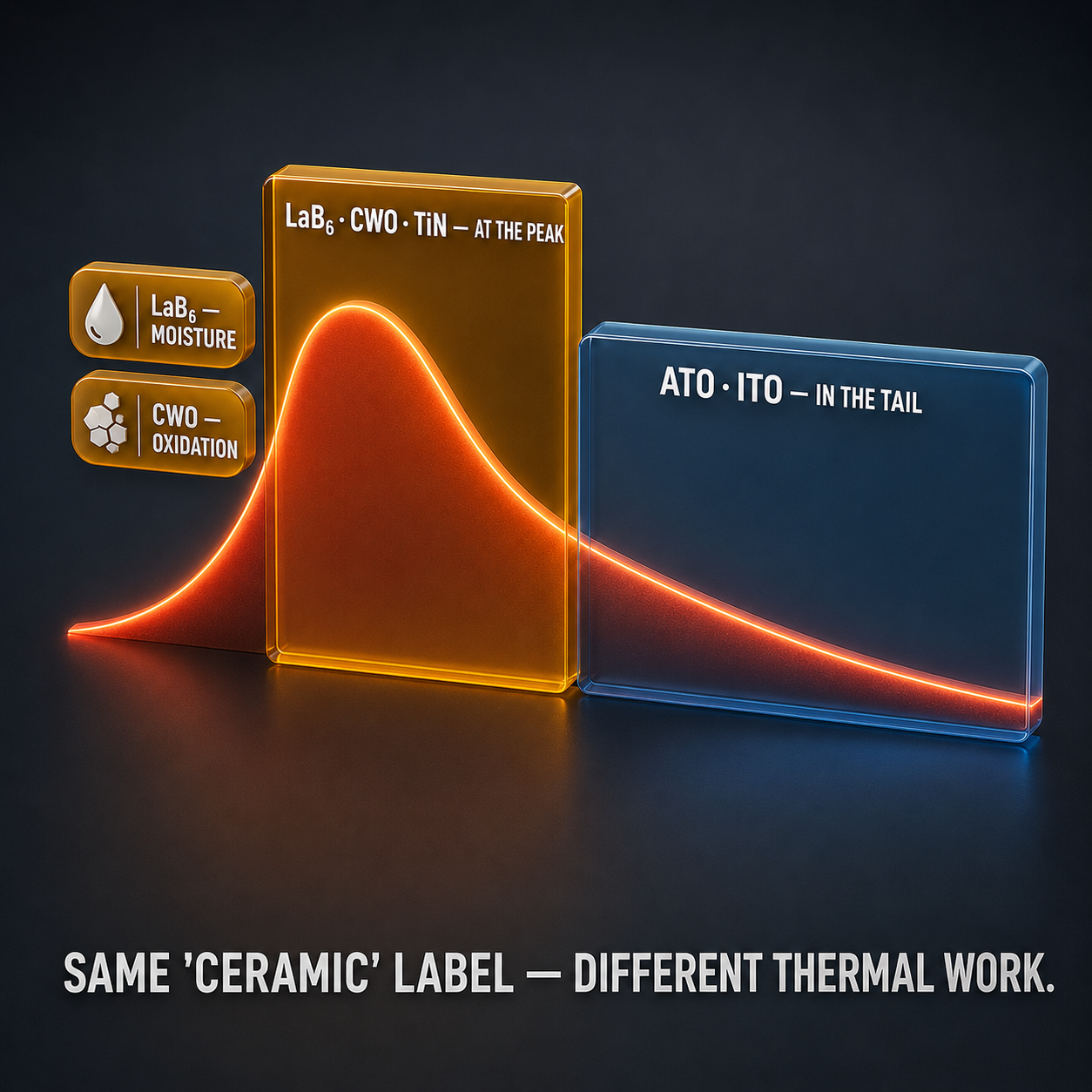
- Indium tin oxide (ITO) and antimony tin oxide (ATO): conductive ceramic absorbers, documented in patent literature as absorbing most strongly above 1,500 nanometers — the lower-energy stretch of the infrared band.
- Lanthanum hexaboride (LaB₆) and cesium tungsten oxide (CWO): documented as absorbing in the energy-dense range beginning near 950 nanometers — though patent literature also records their nanoscale stability challenges: LaB₆ is moisture-sensitive, and CWO degrades through oxidation.
- Titanium nitride appears here too, as dispersed nanoparticles — the same compound, a different construction.
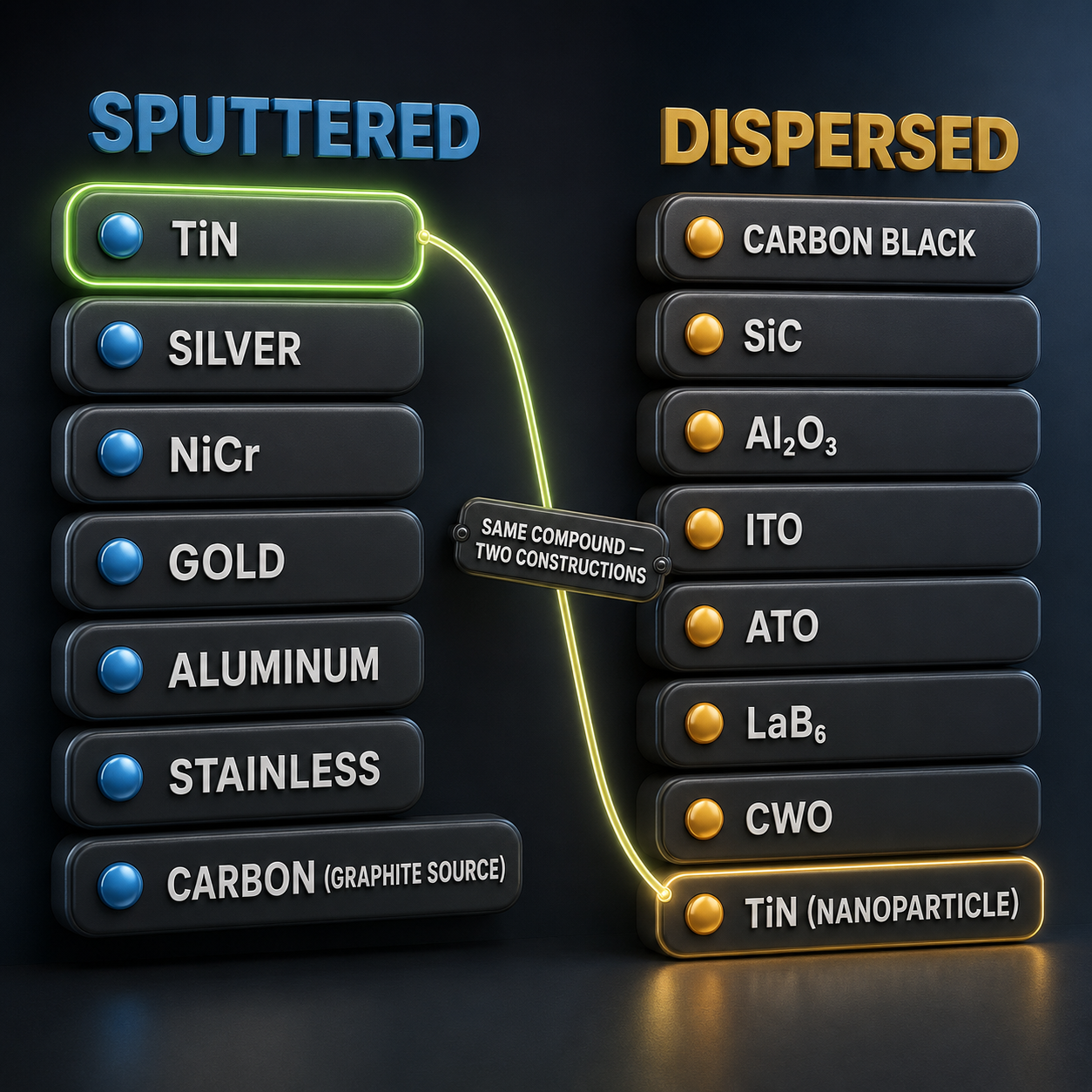
One compound, two constructions; many compounds, one label. The map is the prerequisite for everything that follows.
If you're just finding this page, here's the quick context: our focus is sharing the science behind the sun's energy and how window film actually affects it. This is one chapter in an ongoing series — to see more, visit our page or give us a follow to keep window film and sun's energy facts coming to your feed.