
Carbon Film, Honestly
Carbon film occupies a strange position in market mythology: praised as fade-proof, described as heat-reflective, marketed as a dye-free upgrade. The documented record supports a more precise — and more interesting — account.
Carbon absorbs. Carbon black is a broadband absorber across the visible and infrared — which is, physically, exactly why carbon appears black. A material that looks black is by definition absorbing broadly across the visible spectrum rather than reflecting it. Marketing copy describing carbon particles "bouncing heat back like a mirror" describes a mechanism the material does not have. In the framework of this series, carbon belongs with the absorbers: energy captured in the film, film heated, a share re-radiated inward.
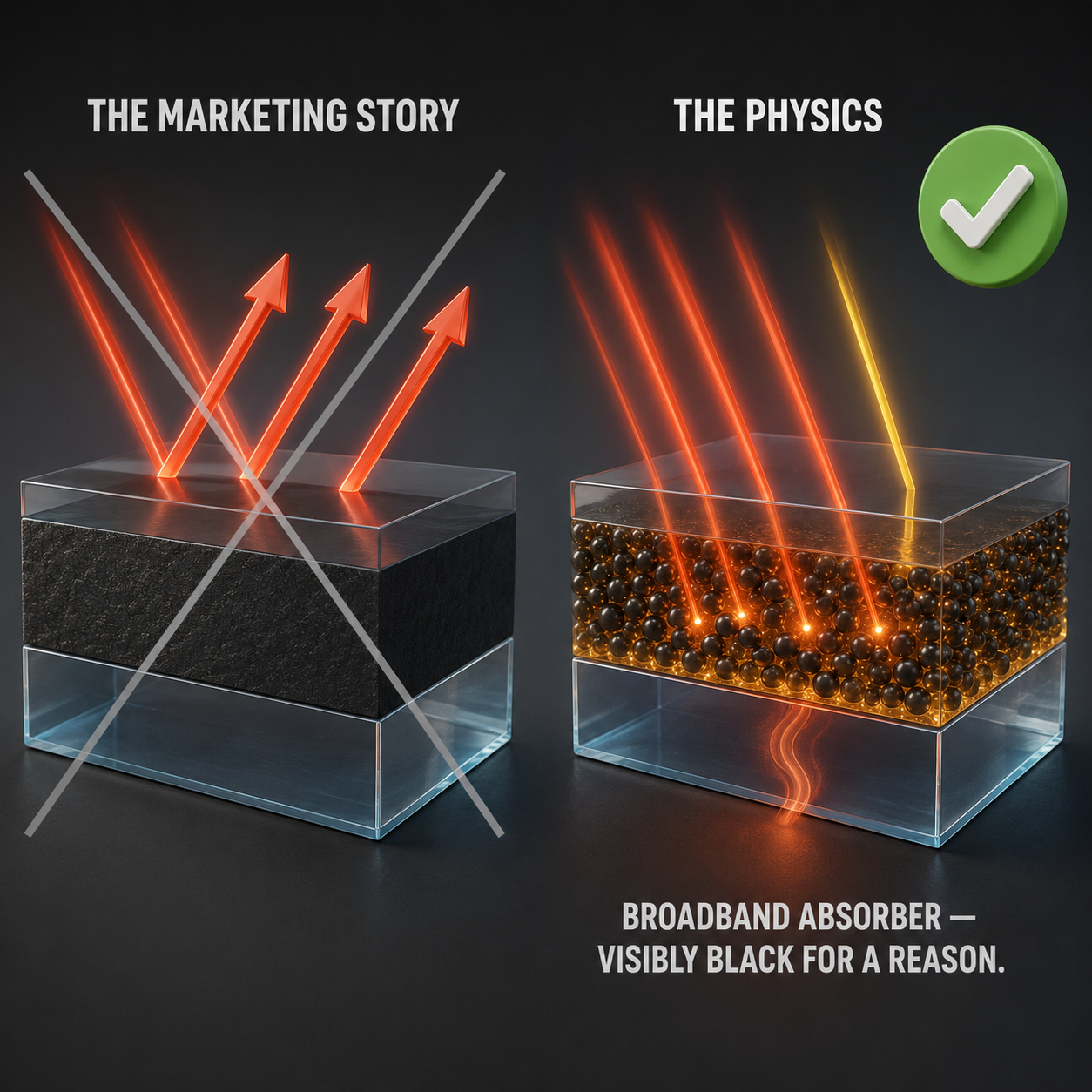
Carbon is built both ways. The patent record documents carbon deposition from graphite sources — sputtering processes in which the target material is graphite rather than a metal or ceramic compound — alongside the more common dispersed construction, where commodity carbon black particles ride in a coating or adhesive carrier.
The fade claim is about the particle, not the product. Carbon particles themselves are chemically stable and do not photo-degrade like organic dyes. But documented product constructions and industry sources confirm that many commercial carbon films incorporate dye alongside the carbon — for the same color-tuning, VLT-control, and cost reasons as Chapter 4.7 — and some carbon product lines are explicitly built on a dyed-film platform with carbon material added. When the dye in such a film degrades, the film's color shifts, carbon notwithstanding. "Carbon doesn't fade" is true of the element and conditionally true of the product — the condition being a construction the label does not disclose.
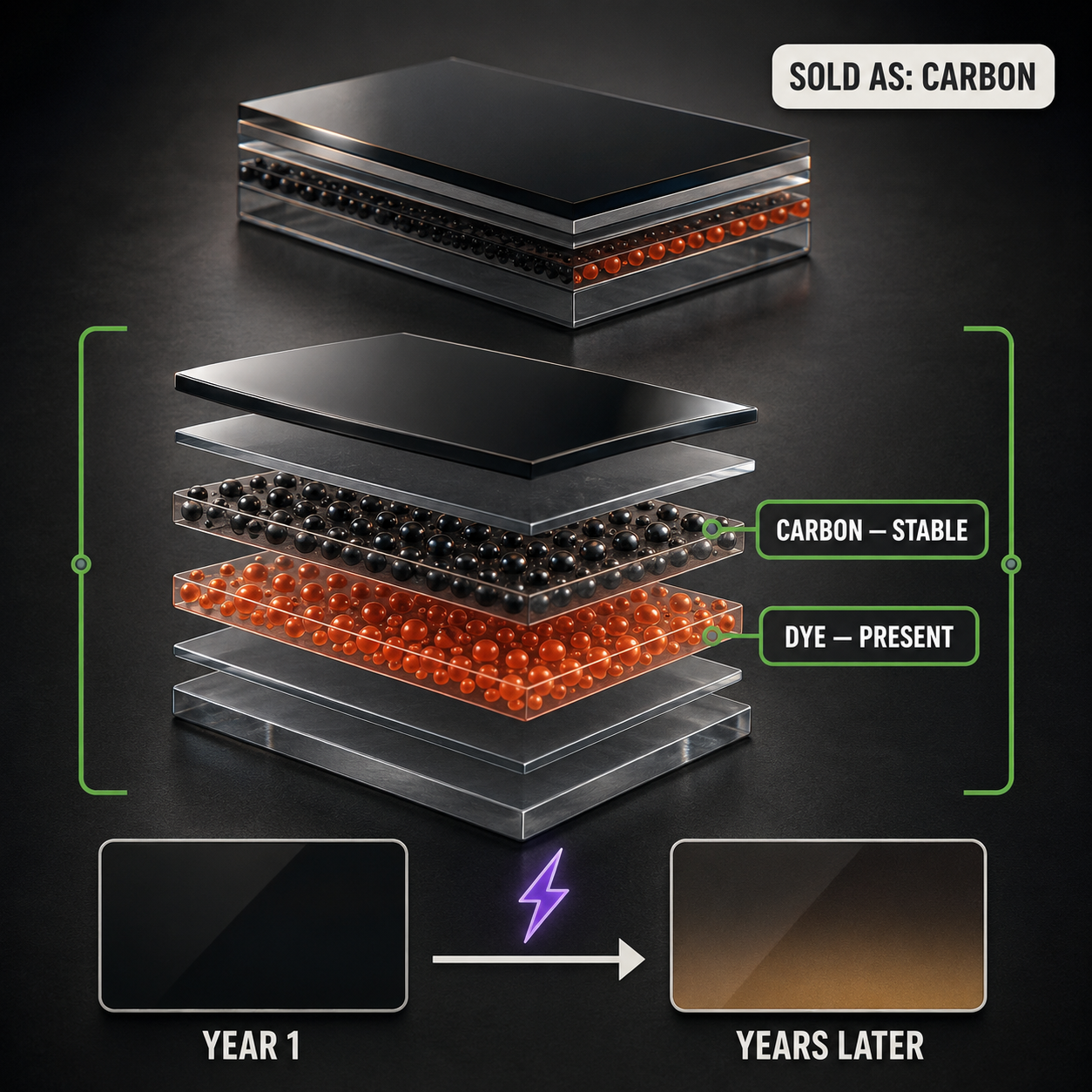
Carbon film is a legitimate technology with a real value position. It is simply not the technology its mythology describes.
If you're just finding this page, here's the quick context: our focus is sharing the science behind the sun's energy and how window film actually affects it. This is one chapter in an ongoing series — to see more, visit our page or give us a follow to keep window film and sun's energy facts coming to your feed.