
TSER: The Complete Accounting
Total Solar Energy Rejected — TSER — is the metric scoped to the entire solar budget, and its definition is established in technical literature with precision.
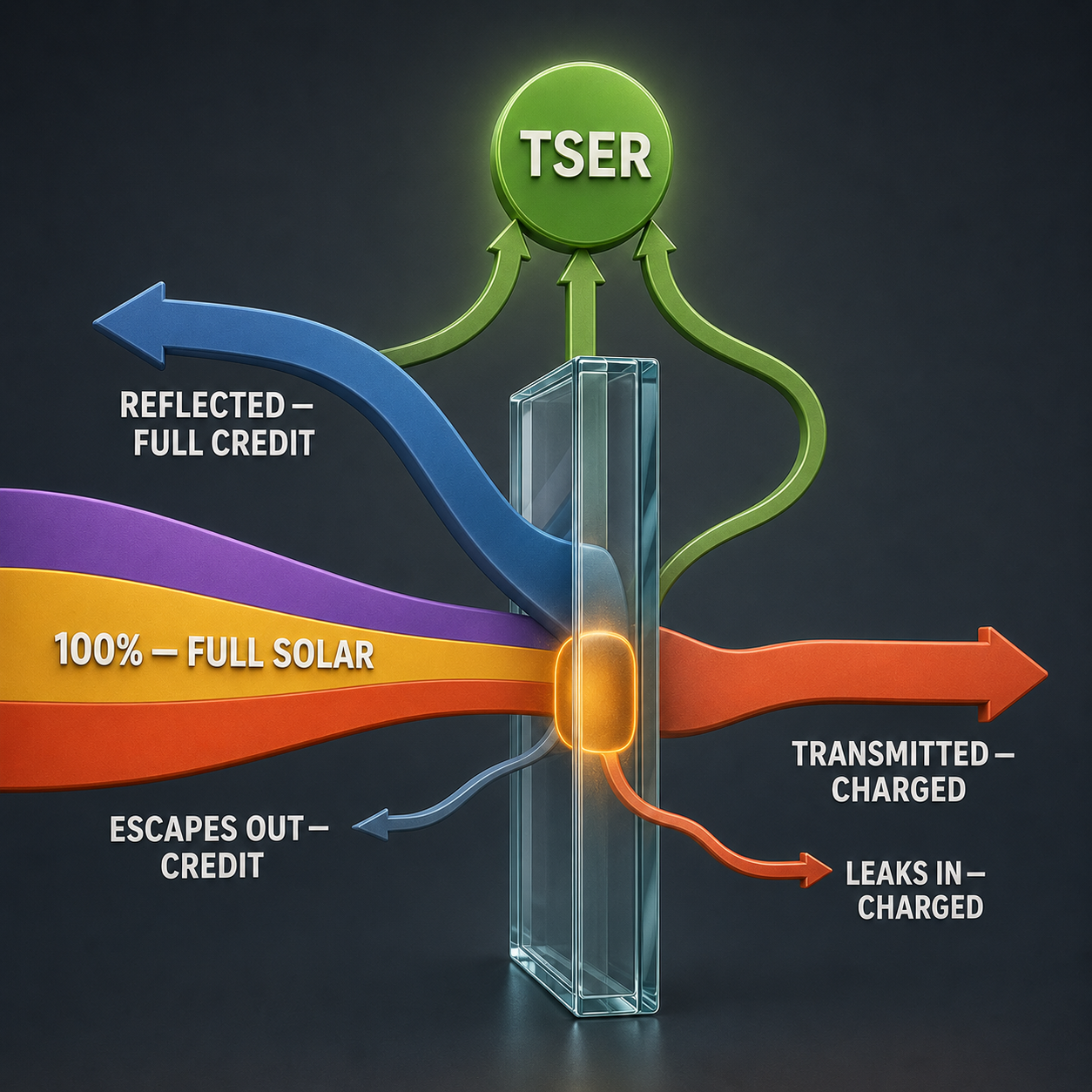
TSER describes the percentage of incident solar energy rejected by a glazing system relative to the incident solar radiation. The value equals the solar reflectance plus the portion of the solar absorption that is re-radiated and conducted or convected to the outdoors. Every element of this series converges in that sentence: full-spectrum scope across UV, visible, and NIR, weighted by the energy each wavelength carries; reflection credited in full; absorption credited only for the share that escapes outward, with the inward leak charged against the system.
TSER has an architectural twin. The Solar Heat Gain Coefficient — SHGC — measures the admitted share rather than the rejected share; the two describe the same physics from opposite sides and sum to one. SHGC methodology is governed by the National Fenestration Rating Council: NFRC 200 for solar heat gain, NFRC 300 for the solar-optical properties of glazing materials. TSER, in other words, is not a marketing invention — it is the rejection-side expression of a standardized, governed quantity.
The published record shows what complete accounting looks like beside partial accounting. One manufacturer's flagship automotive film at 69% visible light transmission lists 97% IRR alongside 50% TSER — the same product, the same sheet. Neither number is false. One describes a 100-nanometer window measured without charging the leak. The other describes the total solar load.
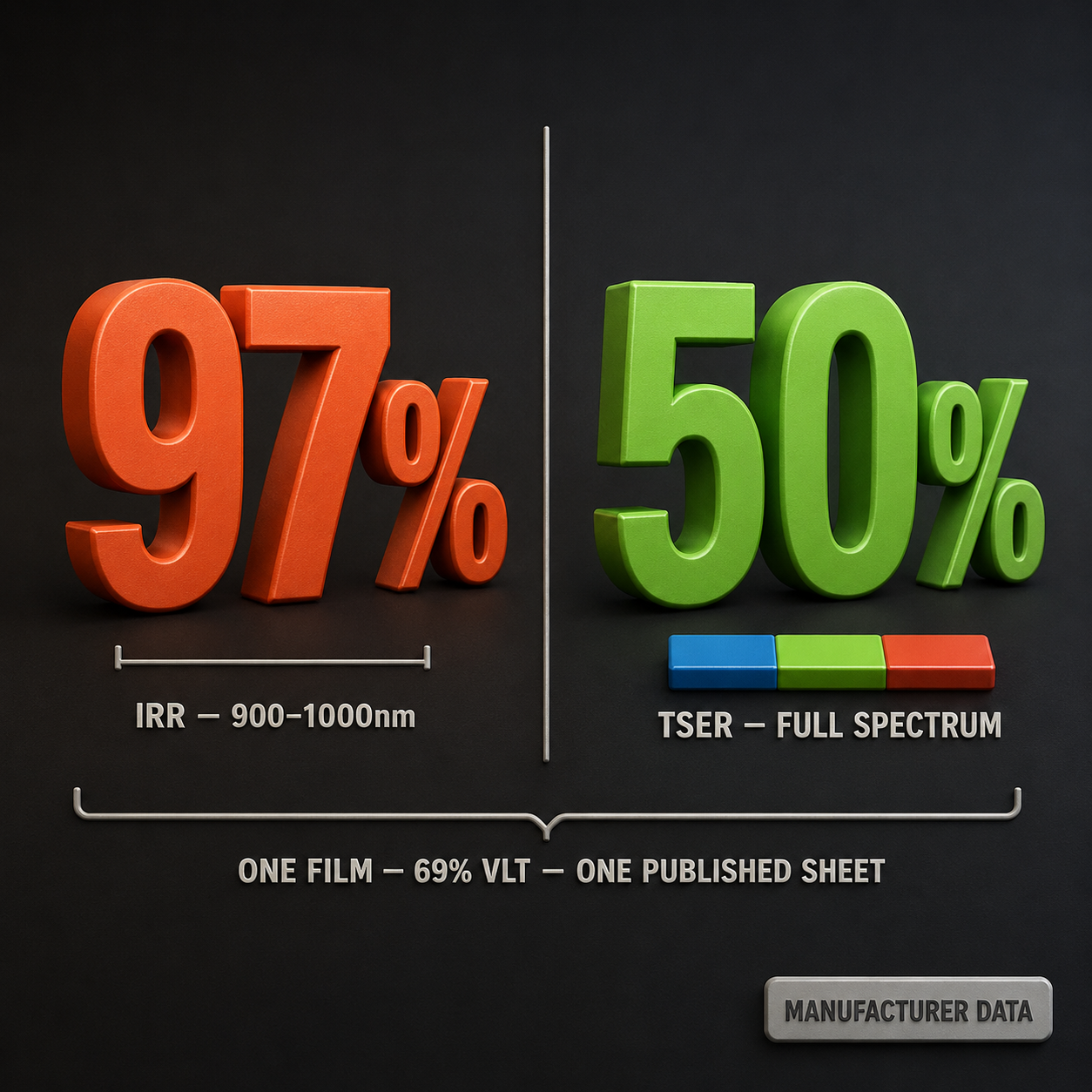
TSER is the first number to find on any specification sheet, and the standard against which every other claim on that sheet should be read.
If you're just finding this page, here's the quick context: our focus is sharing the science behind the sun's energy and how window film actually affects it. This is one chapter in an ongoing series — to see more, visit our page or give us a follow to keep window film and sun's energy facts coming to your feed.