
The 96% Myth — Case Closed
"Rejects up to 96% of heat." Every chapter of this series has built toward dissecting that sentence, and it can now be done completely — with the closing evidence supplied by the industry's own published record.
Step one: rename one band. Take near-infrared — roughly half of solar energy — and call it "heat." The visible band, which becomes heat at interior surfaces with full efficiency and carries roughly 44% of the budget, exits the conversation by vocabulary alone.
Step two: measure a window within the band. No universal standard dictates the range. The published record documents IRR measured from 900 to 1,000 nanometers — a 100-nanometer slice of a band spanning roughly 1,800.
Step three: count capture as rejection. Energy the sample absorbs — and partially re-radiates inward — scores identically to energy reflected cleanly away. The leak goes uncharged.
Step four: translate. The output of steps one through three is printed as "heat rejection." A slice of one band, measured without charging the leak, becomes a claim about the total.

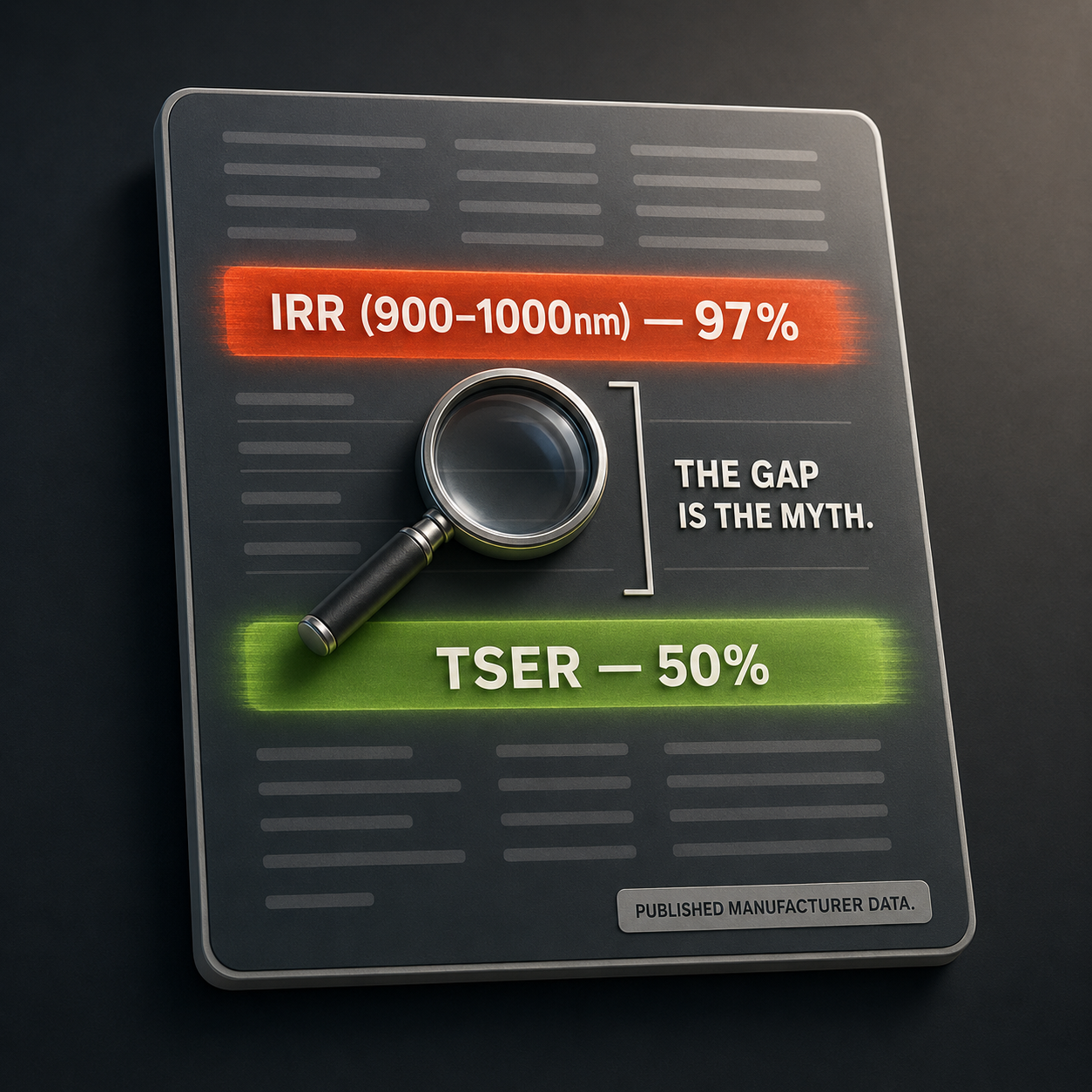
The closing evidence requires no estimation, because one manufacturer prints both answers on one sheet: a flagship film listing 97% IRR — and 50% TSER. Same product, same laboratory, both numbers side by side. The first describes the favorable question. The second describes the total solar load. The distance between them is the myth, quantified by the industry itself.
The corrective is not cynicism about film — it is precision about numbers. A product removing half of all solar energy through driving-legal glass is a real achievement that needs no inflation. The case for window film requires education, not exaggeration. Closing that gap is what this entire catalog exists to do.

If you're just finding this page, here's the quick context: our focus is sharing the science behind the sun's energy and how window film actually affects it. This is one chapter in an ongoing series — to see more, visit our page or give us a follow to keep window film and sun's energy facts coming to your feed.