The Parked Car: Full Soak
The parked vehicle in full sun is the harshest condition in everyday surface physics — the scenario where every mechanism in this series converges with nothing working in the cabin's favor.
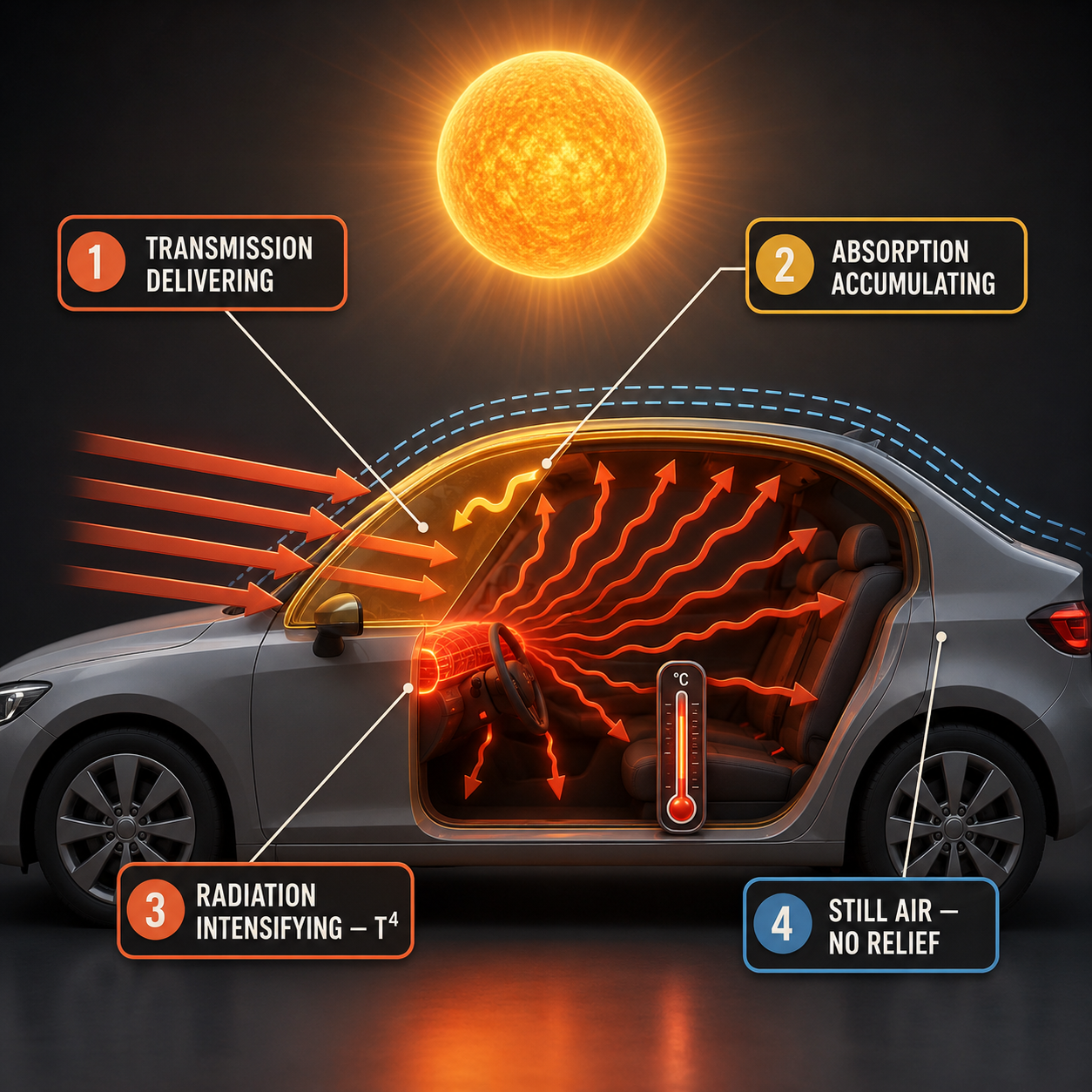
The inputs run at full strength: solar energy transmits through the glass and converts to heat at interior surfaces, while energy absorbed in the glass raises its temperature. The relief valves are all closed: no airflow exists to strip the boundary layer, so absorbed heat accumulates at the glass; interior surfaces climb, and through the fourth-power law their inward radiation intensifies as they do; warmed cabin air has nowhere to go. Energy enters faster than it leaves, and the cabin climbs.
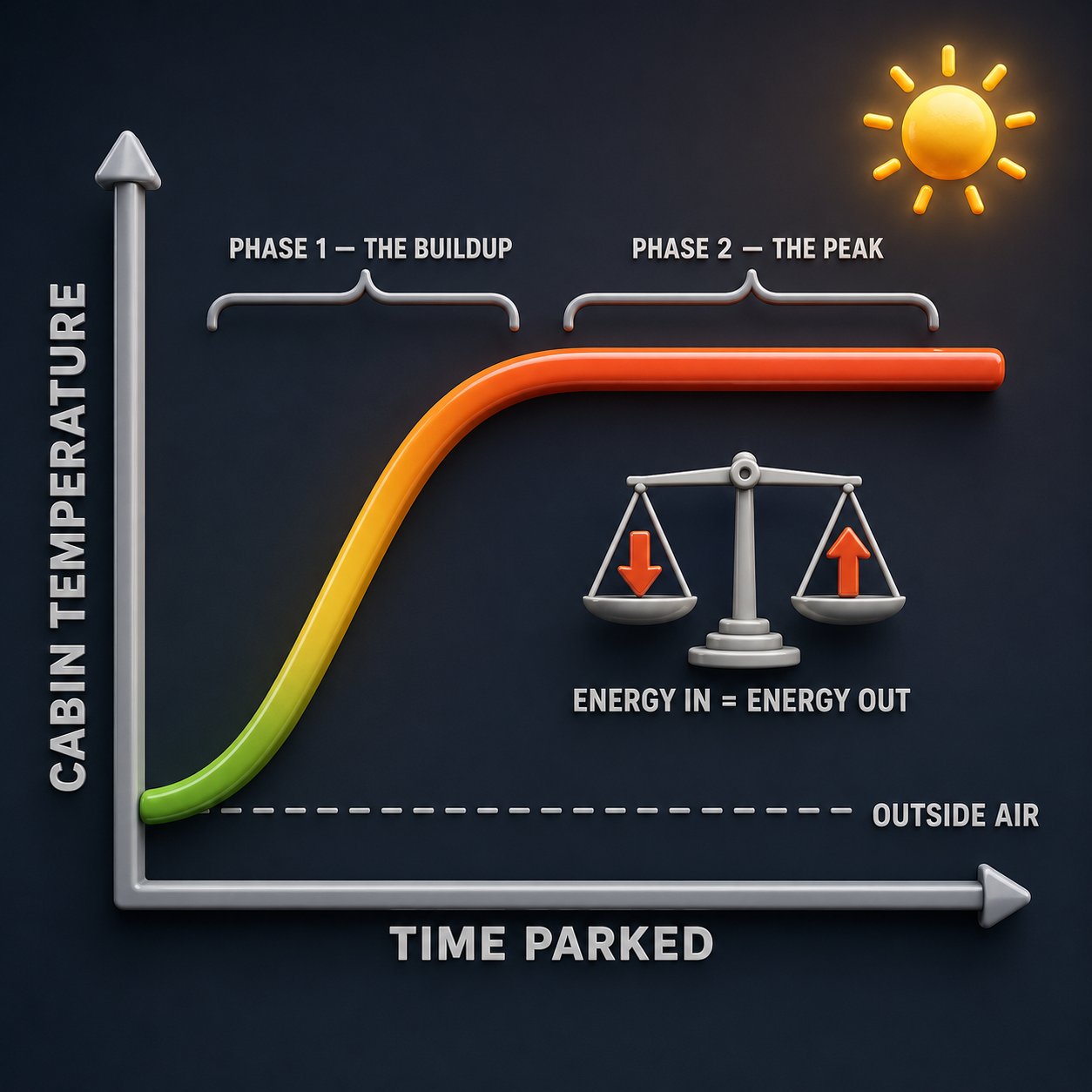
The climb — the thermal soak — has two distinct phases. The buildup phase is the race: how quickly the interior rises from ambient toward extreme. Its steepness is set by how much energy is entering per minute. The peak phase is the destination: the equilibrium temperature where heat escaping through every pathway finally balances heat arriving, leaving the interior to hover at its maximum. The two phases answer different questions — how fast it gets bad, and how bad it gets — and both are set by the surface physics this series has assembled.
Soak temperature is more than a comfort issue. Sustained extreme heat and repeated thermal cycling degrade interior plastics, leathers, adhesives, and electronics over time, and the UV arriving alongside the heat compounds the material damage. The parked-car soak is also the condition every solar control strategy must be judged against — because it is the one condition where the system gets no outside help at all.
If you're just finding this page, here's the quick context: our focus is sharing the science behind the sun's energy and how window film actually affects it. This is one chapter in an ongoing series — to see more, visit our page or give us a follow to keep window film and sun's energy facts coming to your feed.