
Still Air vs. Moving Air: Convection at the Glass
Radiation is not the only way a heated surface sheds energy. Touching air carries heat away too — and how much it carries depends enormously on whether that air is moving.
Every surface sitting in still air wears an invisible blanket: a thin layer of slow, clinging air called the boundary layer. Heat leaving the surface must first cross this layer, and still air is a poor conductor — so the blanket insulates, letting heat accumulate at the surface. This is established heat-transfer physics, the same in a laboratory as on a parking lot.
Moving air changes the system. Airflow thins and disrupts the boundary layer, continuously sweeping heated air off the surface and replacing it with cooler air. The faster and more turbulent the flow, the thinner the insulating blanket and the more aggressively heat is removed. It is the physics behind blowing on hot food: the food's temperature has not changed, but its insulating air layer has been stripped away, and heat escapes far faster.
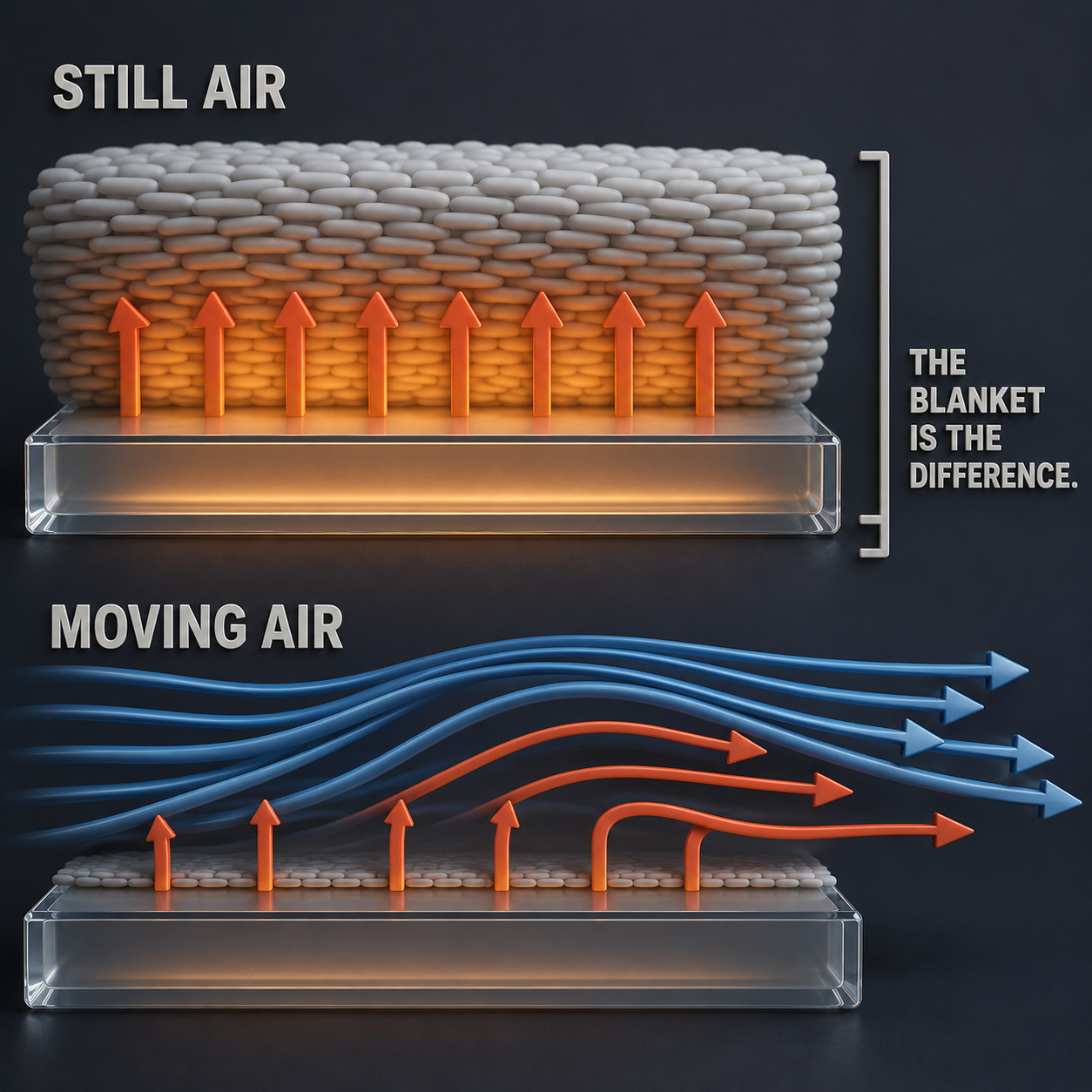
Applied to a vehicle, the implication is direct. Glass on a parked vehicle sits under the still-air blanket, holding its heat. The same glass at highway speed has air continuously scouring its outer surface, carrying away heat that would otherwise accumulate — including heat the glass absorbed from the sun. A surface that runs cooler radiates less inward, through exactly the fourth-power relationship from Chapter 2.5.
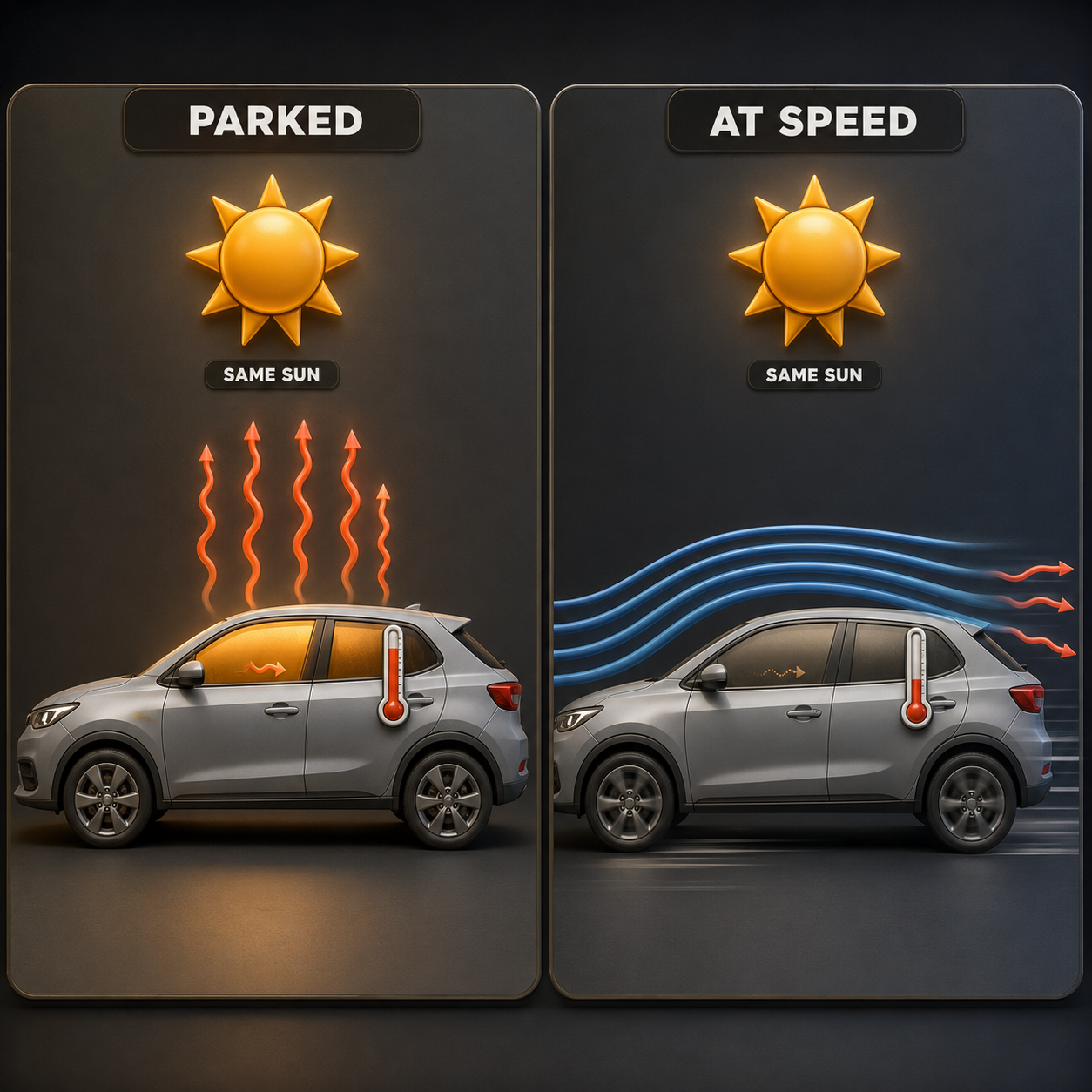
One honest caveat belongs in any factual treatment: while boundary-layer convection is settled physics, published studies quantifying its effect on automotive glazing specifically remain scarce. The mechanism is certain; the precise magnitudes in real vehicles are best established by direct measurement — which is exactly what one of the experiments in Series 5 is designed to do.
If you're just finding this page, here's the quick context: our focus is sharing the science behind the sun's energy and how window film actually affects it. This is one chapter in an ongoing series — to see more, visit our page or give us a follow to keep window film and sun's energy facts coming to your feed.