
The Greenhouse on Wheels
Series 2 closes by assembling its eight chapters into one continuous story: the complete thermal lifecycle of solar energy at a vehicle, from arrival to soak.
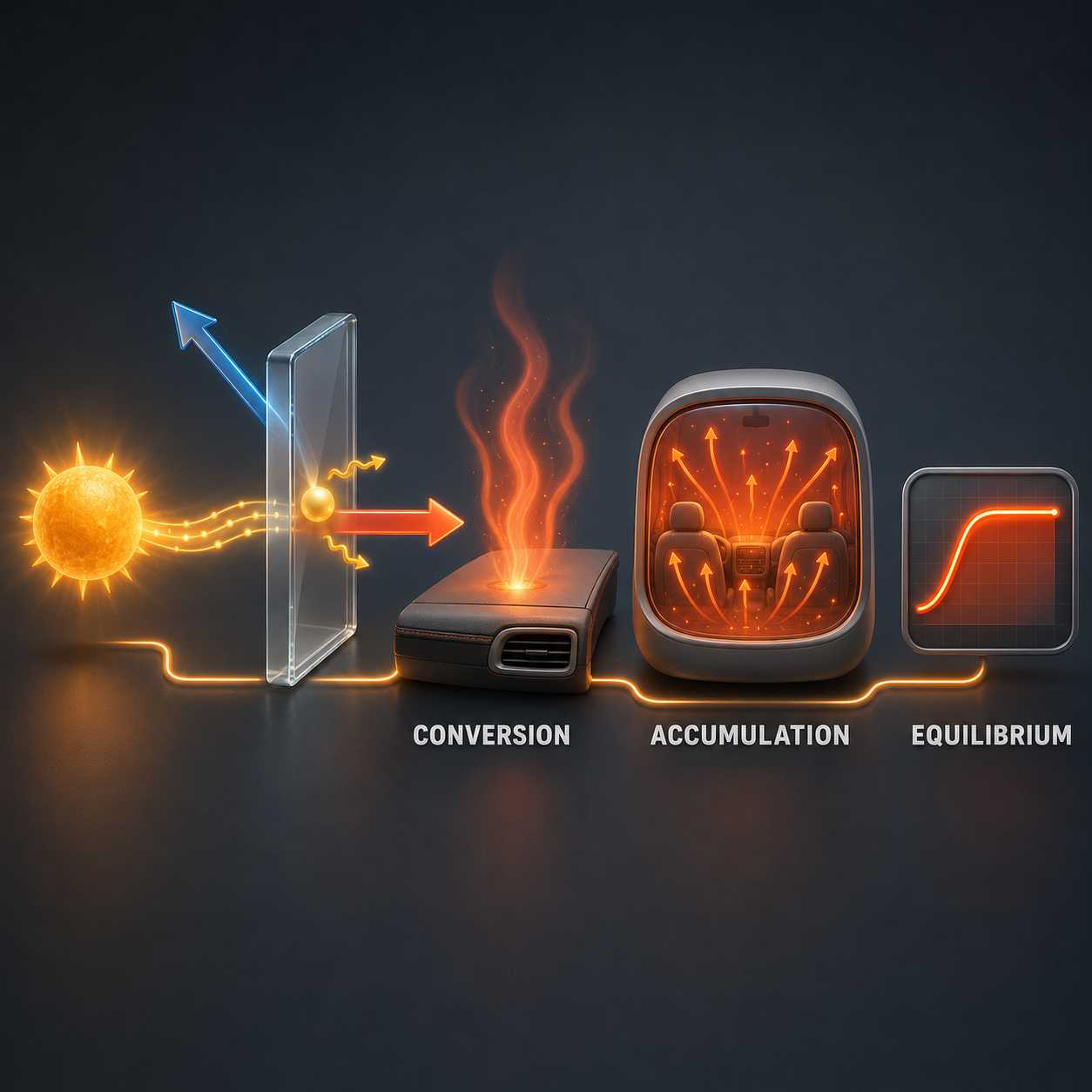
Solar radiation arrives at the glass carrying the three-band budget established in Series 1. At the surface, every photon meets one of three fates. A small share reflects — the closed door, gone with no aftermath. A share absorbs into the glass, heating it; the glass sheds that heat from both faces, with the inward share governed by its temperature through the fourth-power law and by the emissivity of its surfaces. The dominant share, through bare glass, transmits.
Transmitted energy crosses the cabin and converts to heat at the interior surfaces it strikes. Those surfaces climb, and as they climb they radiate with fourth-power aggression, heating the air and everything around them. The heat they produce is longwave radiation and warmed air — forms that escape back through glass far less readily than the original sunlight entered. Energy in fast, energy out slow: the greenhouse condition, on wheels.
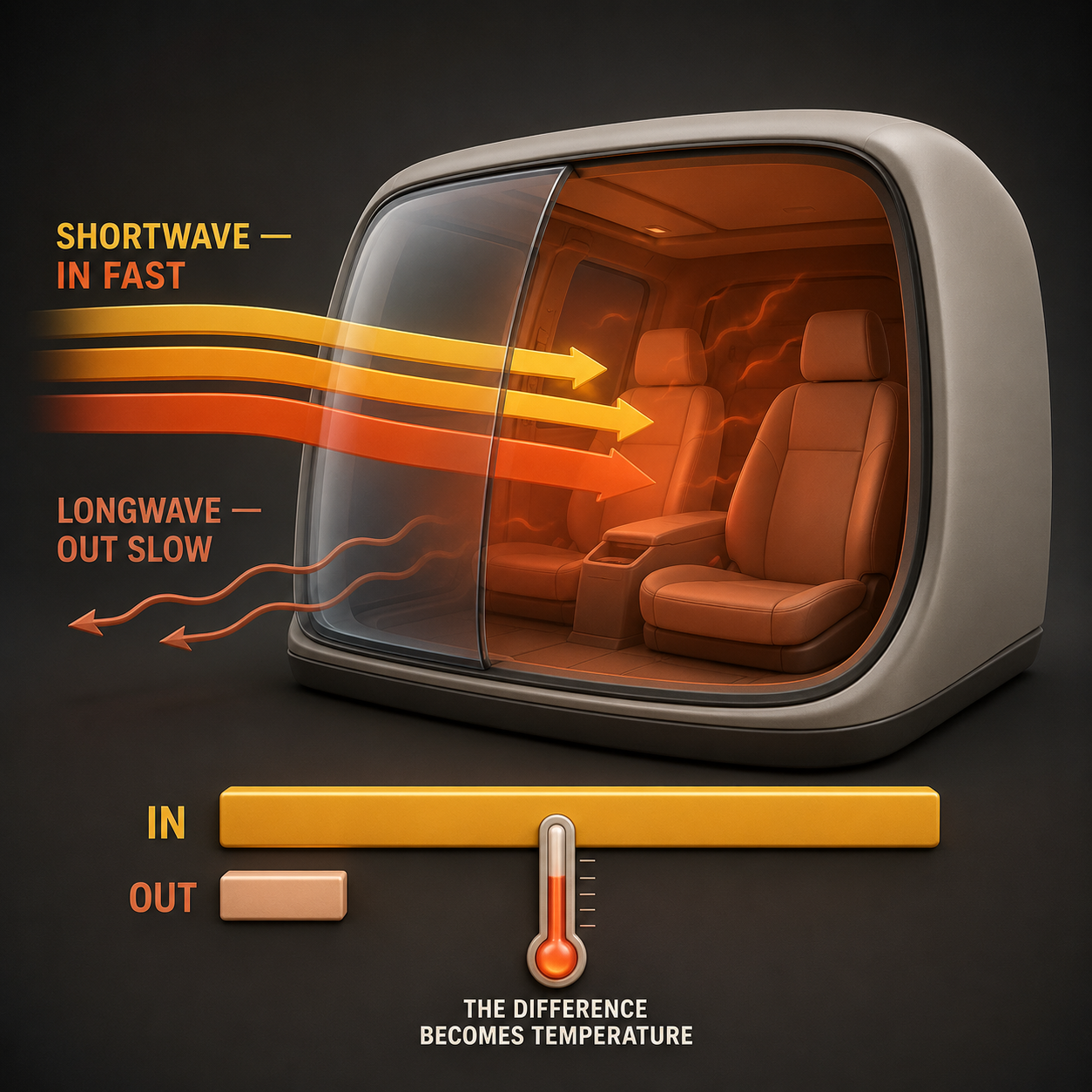
What happens next depends on the air outside. In motion, airflow strips the boundary layer from the glass and carries accumulated heat away, giving the system a relief valve. Parked, the blanket of still air seals the system, and the cabin climbs through its buildup phase toward its equilibrium peak — the full soak, where every mechanism converges unassisted.
That is the complete physics, told without a single product in the story. The natural next question — how each of these quantities is measured, standardized, and reported, and where reporting goes wrong — is the entire subject of Series 3.
If you're just finding this page, here's the quick context: our focus is sharing the science behind the sun's energy and how window film actually affects it. This is one chapter in an ongoing series — to see more, visit our page or give us a follow to keep window film and sun's energy facts coming to your feed.