
Can a Cheap Film Lose Its UV Protection Over Time?
Someone asked us a sharp question: if a film blocks 99.9% of UV, can a cheaper one lose that over time? Short answer — yes. But the real answer is hiding inside that one number, because "losing UV protection" and "the film fading" sound like the same event and they aren't. A film can do one without the other, and pulling those apart is the whole story.
That 99.9% is two layers stacked together, doing two different jobs. The polyester (PET) the film is built on blocks UV on its own — but only the short end. Below roughly 315 nm it stops UVC, UVB, and the bottom of UVA cold, and that protection is intrinsic and durable. It doesn't wear out. The trouble is the upper UVA band, 315 to 400 nm, which is most of the UVA energy actually reaching your skin, your floors, and your upholstery. Bare polyester gets leaky up there. To close that gap and reach "99.9%," the film leans on added UV absorbers, usually loaded into the adhesive or a face layer — the adhesive typically carries protection to about 380 nm, and better films push to 400 nm with high-performance absorbers. So the headline number is half intrinsic and durable, half additive and dependent.
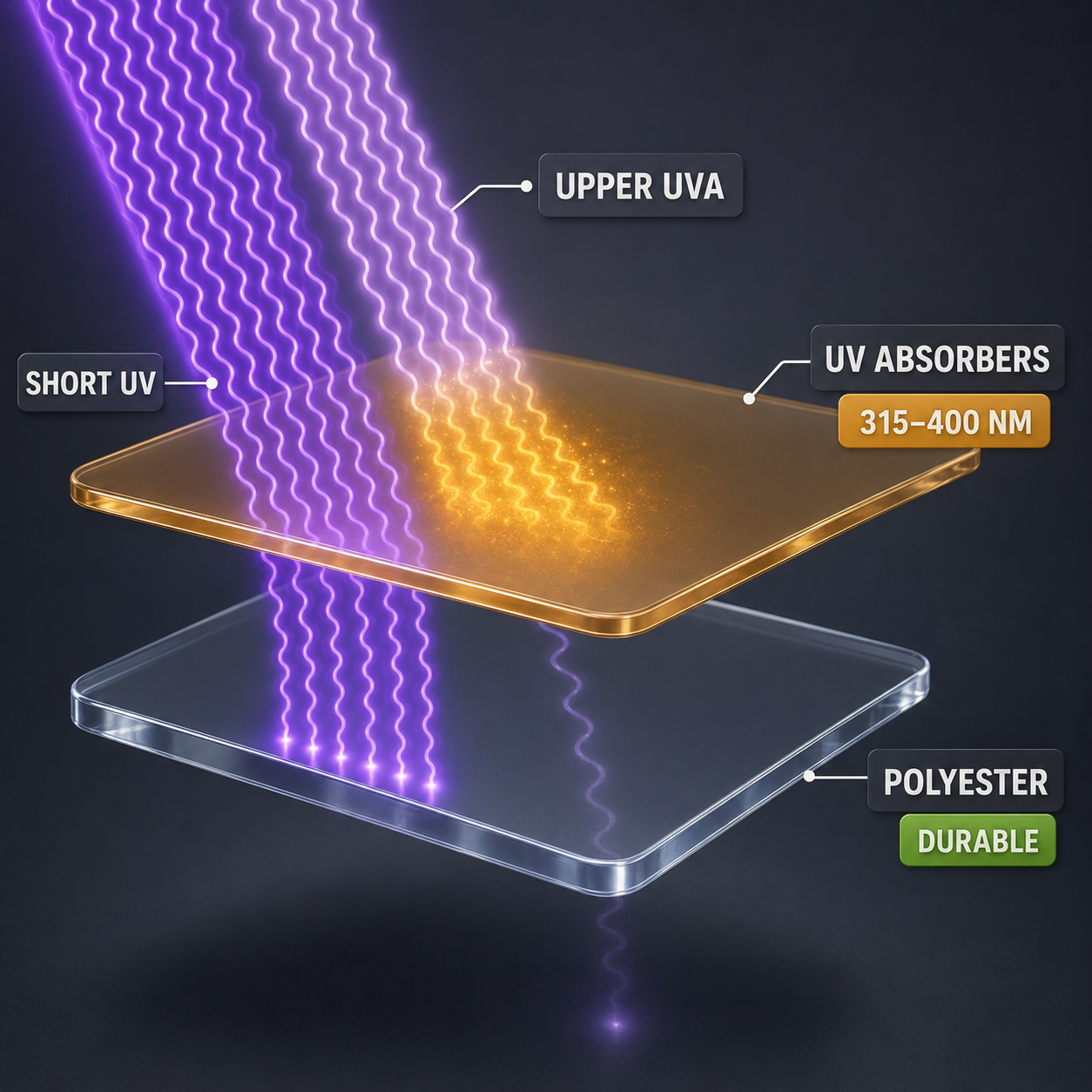
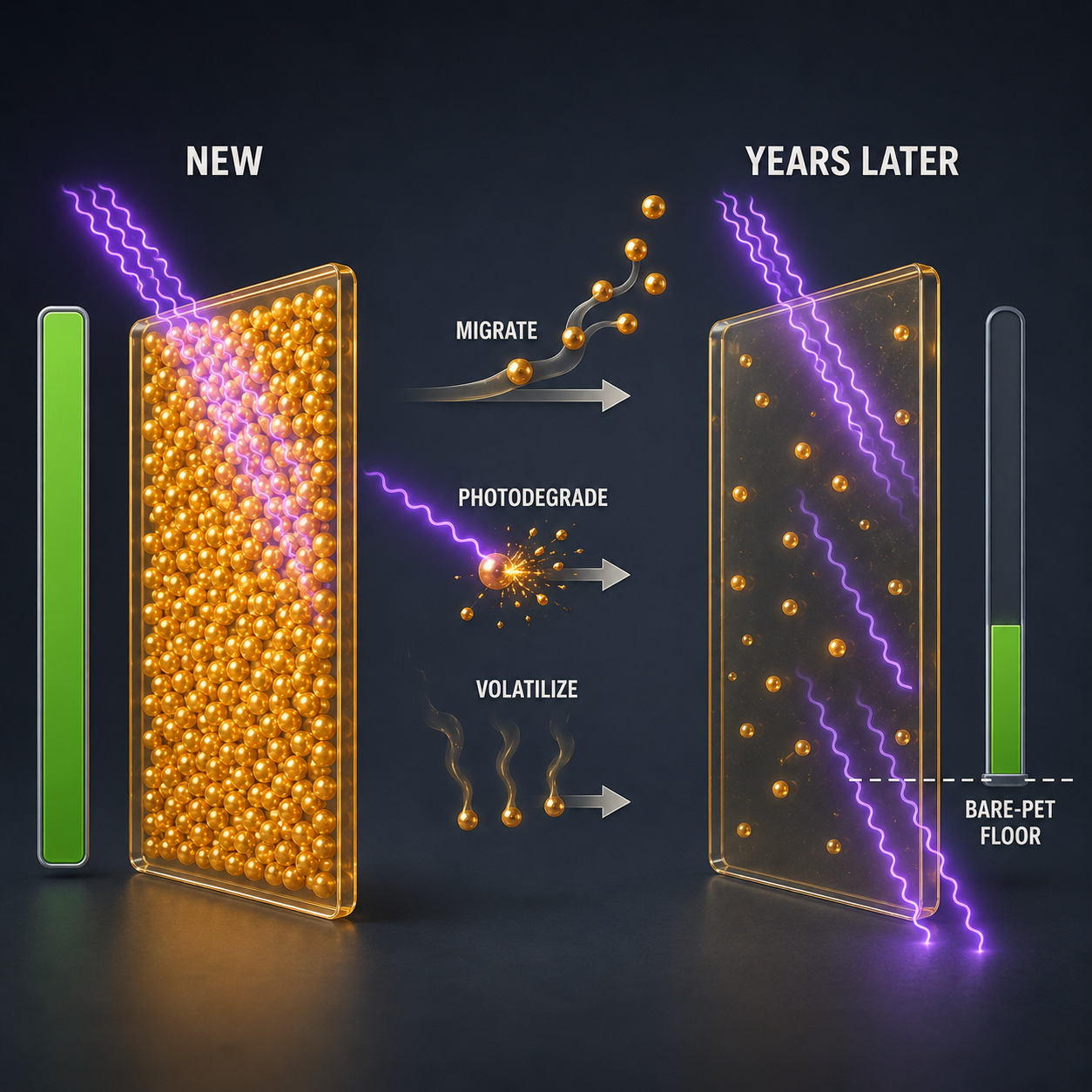
The additive half is the part that can age out — by design. UV absorbers are sacrificial. They work by soaking up UV and dumping the energy as harmless heat, taking the hit so the polymer doesn't. But the molecules can leave three ways: they migrate to the surface and wear away, they photodegrade under the very light they're absorbing, and over years they slowly volatilize out of the film. As the absorber depletes, the rejection curve walks back toward what bare polyester does alone — still strong in UVB, leakier across UVA. This is exactly where cheap film loses ground: less absorber, a less photostable grade of it (older benzotriazole chemistry fades faster than modern triazine), or leaning on a dye to do work the absorber should be doing. The well-built films also pair in hindered-amine stabilizers (HALS), which regenerate instead of getting consumed.
Here's the part most people get backwards: the fading you can see is not the protection you can't. Visible fading is usually the dye breaking down — going purplish, losing clarity. But the UV protection lives in a different layer, the absorber-loaded adhesive plus the PET itself. So the two failure modes run independently. A film can hold its color perfectly while its UVA rejection quietly erodes — or discolor while its UV blocking stays largely intact. The symptom you notice and the function you care about aren't locked together.
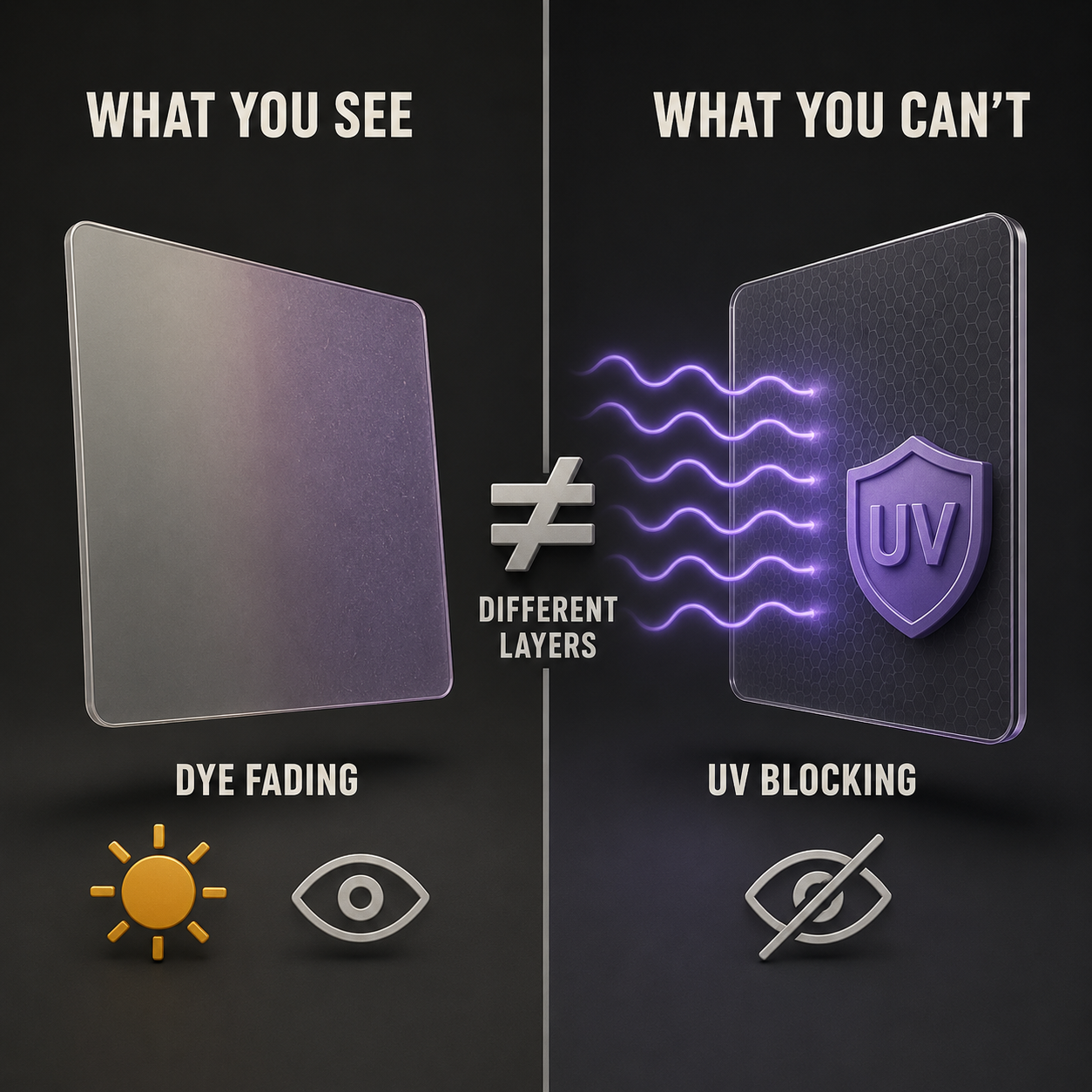
Which leaves one honest takeaway: you cannot eyeball UV protection. A film that still looks great after ten years tells you nothing reliable about whether it's still rejecting 99% of UVA. "It still looks good" is not data. The only way to know what a film is actually doing is to measure it — a UV meter for a rough field check, spectrophotometry for the real curve.
New here? Window Film Facts breaks down the physics of the sun's energy and what window film actually does with it — no hype, just the science. Learn it one chapter a day by email, and if there's something we haven't covered yet, ask us your question.