
Home  /  Posts
heat rejection·June 28, 2026

Heat Rejection: The Most Misunderstood Number in Window Film

Window film doesn't reject heat. That sounds wrong coming from an industry that sells "heat-rejecting" film for a living — but it's the single most important thing to understand about how film actually works, and the marketing keeps getting it backwards.

Start with what actually reaches your glass. It isn't heat — it's solar radiation: energy traveling as light across three bands, ultraviolet, visible, and infrared. That energy only becomes heat when a material absorbs it and converts it. So when a spec sheet claims a film "rejects 98% of heat," it's describing the rejection of something that isn't even heat yet at the glass. The verb is wrong before the number ever matters.

When radiation reaches the film, it does one of three things: it passes through, it reflects, or it gets absorbed. Only the reflected portion is truly sent away. The absorbed portion is where the story turns — the film soaks that energy up, heats up itself, and then re-radiates that heat in both directions: some back outside, but some onward into the room. An absorptive "heat-rejecting" film is really a small heat source sitting on your glass, exporting only a fraction of the heat it makes. That is a very different thing from rejection.
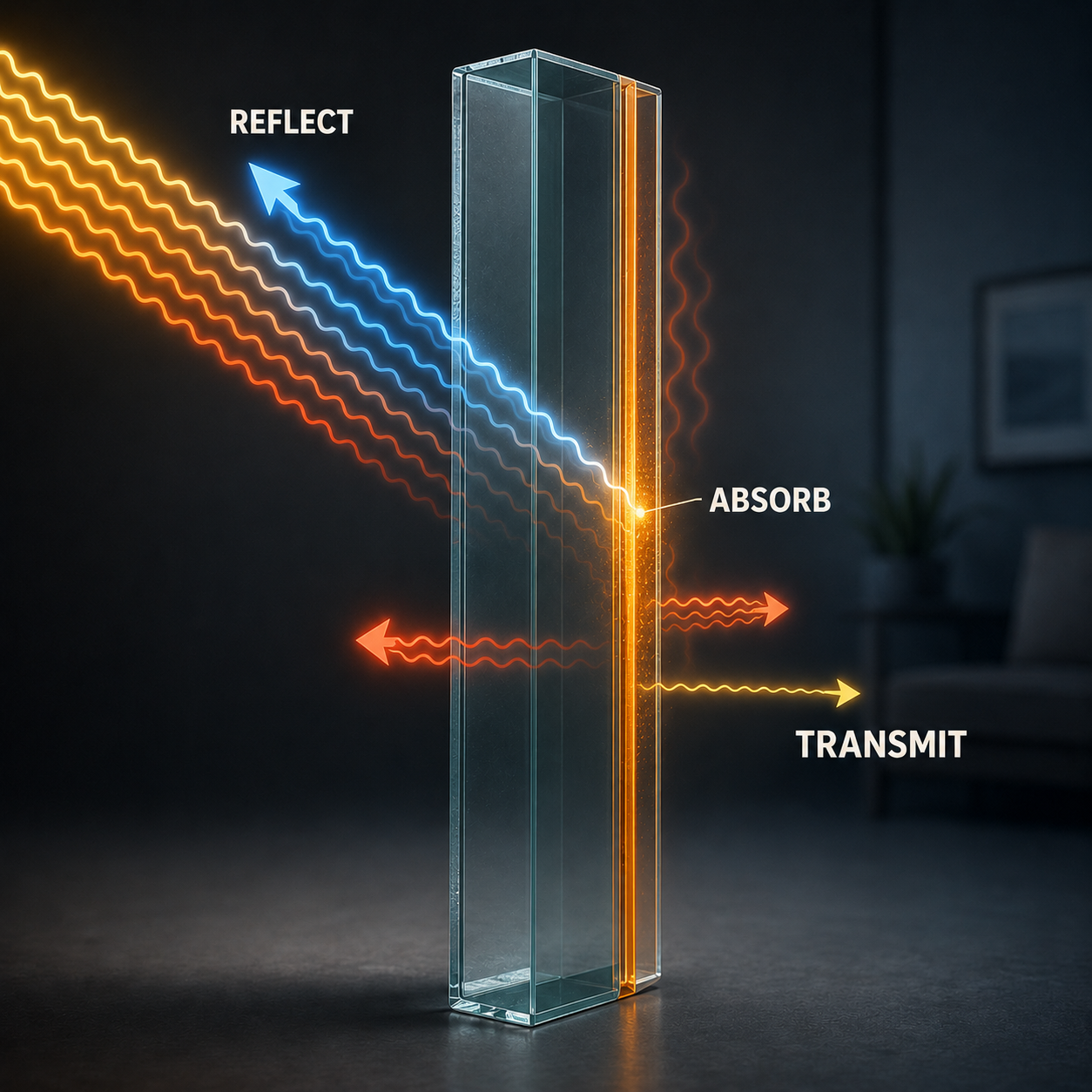
Infographic — Only Reflection Is Rejection: Absorbed energy becomes heat — and part of it flows inward.
Only Reflection Is Rejection Absorbed energy becomes heat — and part of it flows inward.

This is why the spec sheets don't lie but the marketing does. The honest measure is Total Solar Energy Rejected (TSER), and it accounts for the whole picture — what's reflected, what's absorbed, and critically, how much of that absorbed heat flows back inside. A "98%" claim is almost always a single infrared wavelength dressed up as the total, ignoring that near-infrared is only about half of the sun's energy to begin with.
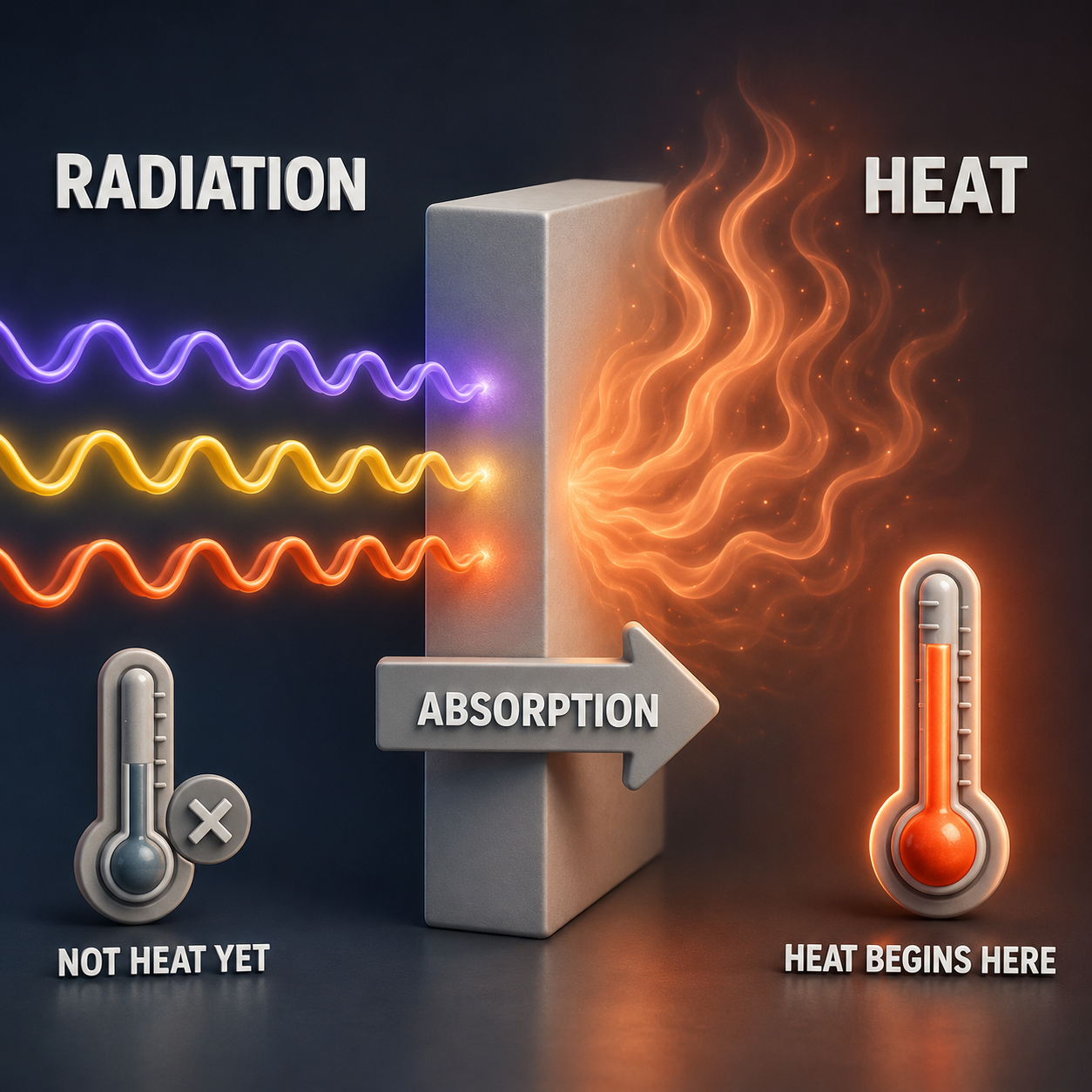
Infographic — What Hits Your Glass Isn't Heat: It's radiation. Heat is what happens when something absorbs it.
What Hits Your Glass Isn't Heat It's radiation. Heat is what happens when something absorbs it.

None of this means film doesn't work. Good film does real, valuable work managing solar gain — it just doesn't do it by magically grabbing heat and throwing it back. So the next time you hear "98% heat rejection," ask the only questions that matter: rejected how, and measured across what? We'll all sell better when we stop pretending the verb is something it isn't.
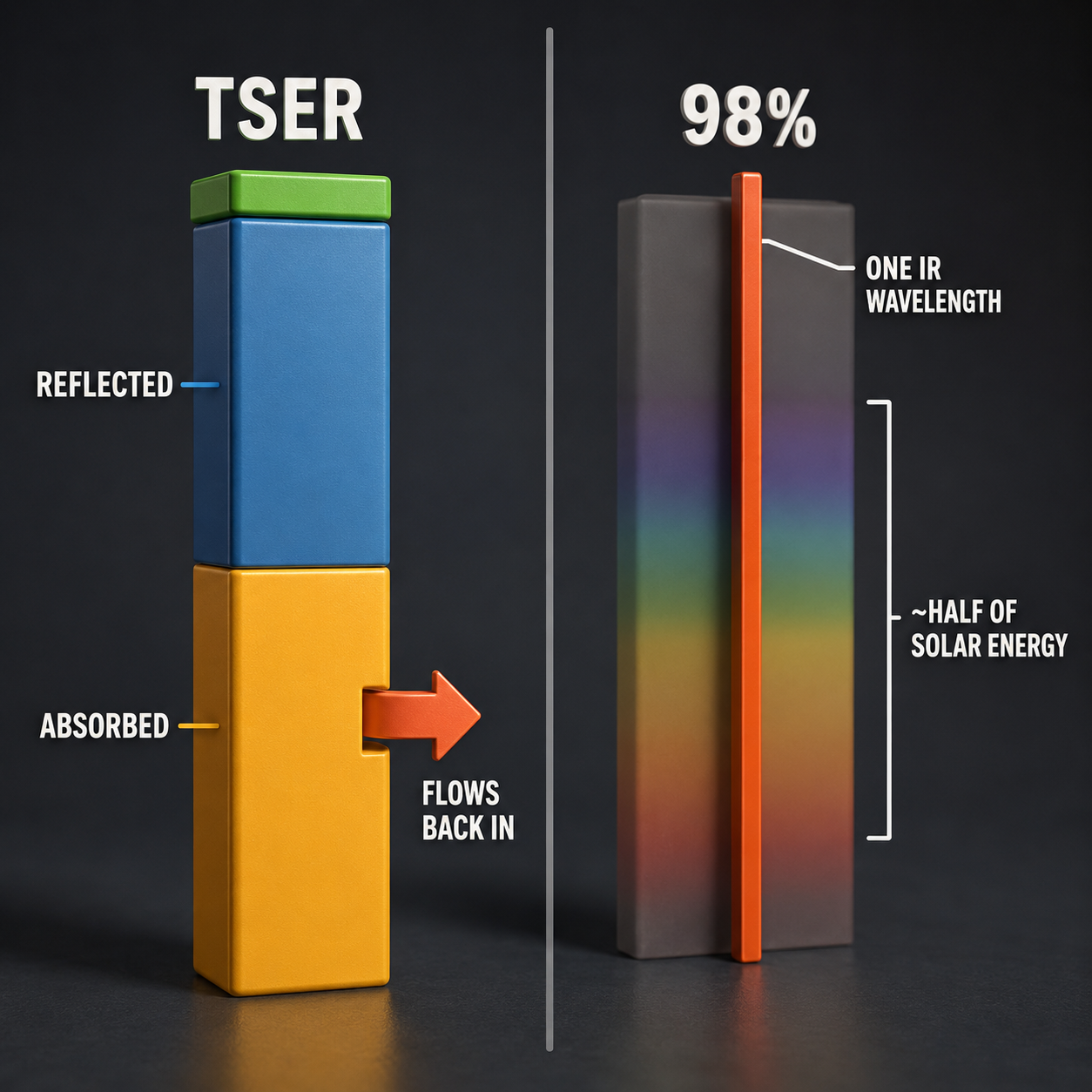
Infographic — Ask: Rejected How, Across What?: TSER counts everything. '98%' usually counts one wavelength.
Ask: Rejected How, Across What? TSER counts everything. '98%' usually counts one wavelength.

New here? Window Film Facts breaks down the physics of the sun's energy and what window film actually does with it — no hype, just the science. Learn it one chapter a day by email, and if there's something we haven't covered yet, ask us your question.

Sources & further reading

Every claim above is checked against independent, citable sources — chemistry and optics references, patents, standards bodies, and peer-reviewed work — kept here so you can verify it yourself.

Checked against primary, non-commercial references — a standards body, NASA, a national-lab-backed consumer guide, and the U.S. DOE. None of them sell window film.

  • Ground-level sunlight is standardized as ASTM G173 — the reference spectrum spanning ultraviolet, visible, and infrared that all comparable performance numbers are computed against; integrating it puts near-infrared at roughly half of total solar energy — ASTM International, G173-03: Standard Tables for Reference Solar Spectral Irradiances: https://www.astm.org/g0173-03r20.html
  • Solar radiation travels as light and only becomes heat when a material absorbs it — absorption is the conversion step — NASA Science, Infrared Waves (the electromagnetic spectrum series): https://science.nasa.gov/ems/07_infraredwaves/
  • What solar radiation does at a window is accounted as reflected, absorbed, or transmitted, and the honest whole-window number (SHGC, TSER's mirror image) explicitly counts the absorbed share that is "subsequently released as heat" to the inside — Efficient Windows Collaborative (NFRC consumer guide), Window Ratings: https://efficientwindows.org/window-ratings/
  • SHGC is "the fraction of solar radiation admitted through a window — either transmitted directly and/or absorbed, and subsequently released as heat inside a home" — U.S. DOE Energy Saver, Energy Performance Ratings for Windows, Doors, and Skylights (archived): https://web.archive.org/web/20260101014014/https://www.energy.gov/energysaver/energy-performance-ratings-windows-doors-and-skylights