
What Your Car Glass Actually Does About UV — And Whether It Wears Out
Let's talk about UV and automotive glass, because this is one of the few places where the factory glass genuinely does a good job — and where a lot of "your fading UV protection needs help!" marketing doesn't match the physics. The honest story is more interesting than the sales pitch, and it starts with a split most people never make.
Your windshield and your side windows are not the same technology. The windshield is laminated glass — two thin panes bonded around a plastic interlayer, almost always PVB (polyvinyl butyral). That interlayer is where the UV blocking lives: manufacturers dissolve UV-absorber molecules into the PVB — benzotriazole types like the Tinuvin family, or benzophenone types — and those absorbers soak up UV-A before it reaches the cabin. It's an absorption story, not a reflection story. The energy gets caught by the interlayer, not bounced away. Your side and rear windows are usually tempered glass instead — a single heat-strengthened pane, no interlayer. Whatever UV they block comes from the glass body itself plus whatever tint or additive the maker chose to include. No dedicated interlayer means no dedicated UV-absorbing layer, and that one structural difference is exactly why the numbers below split the way they do.
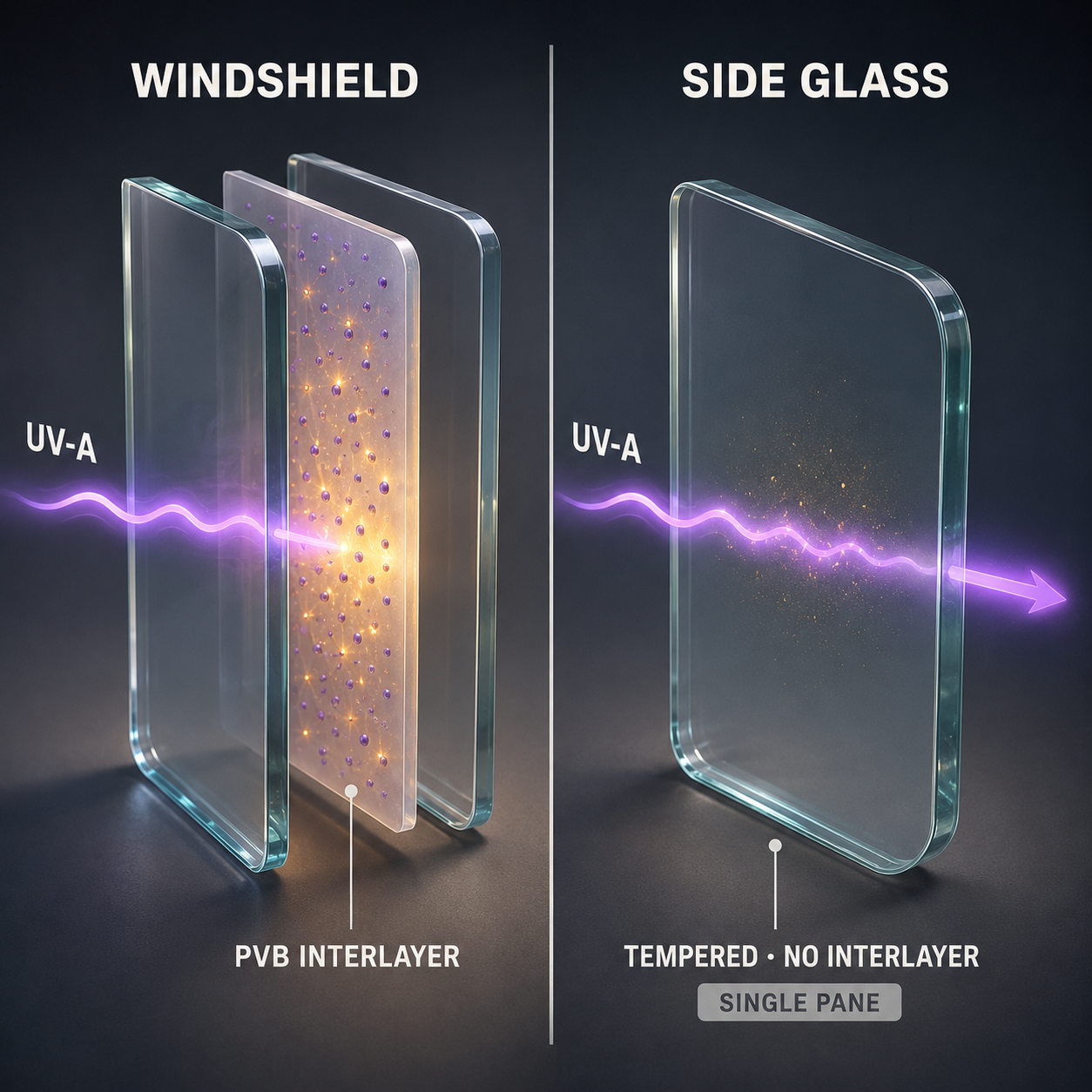
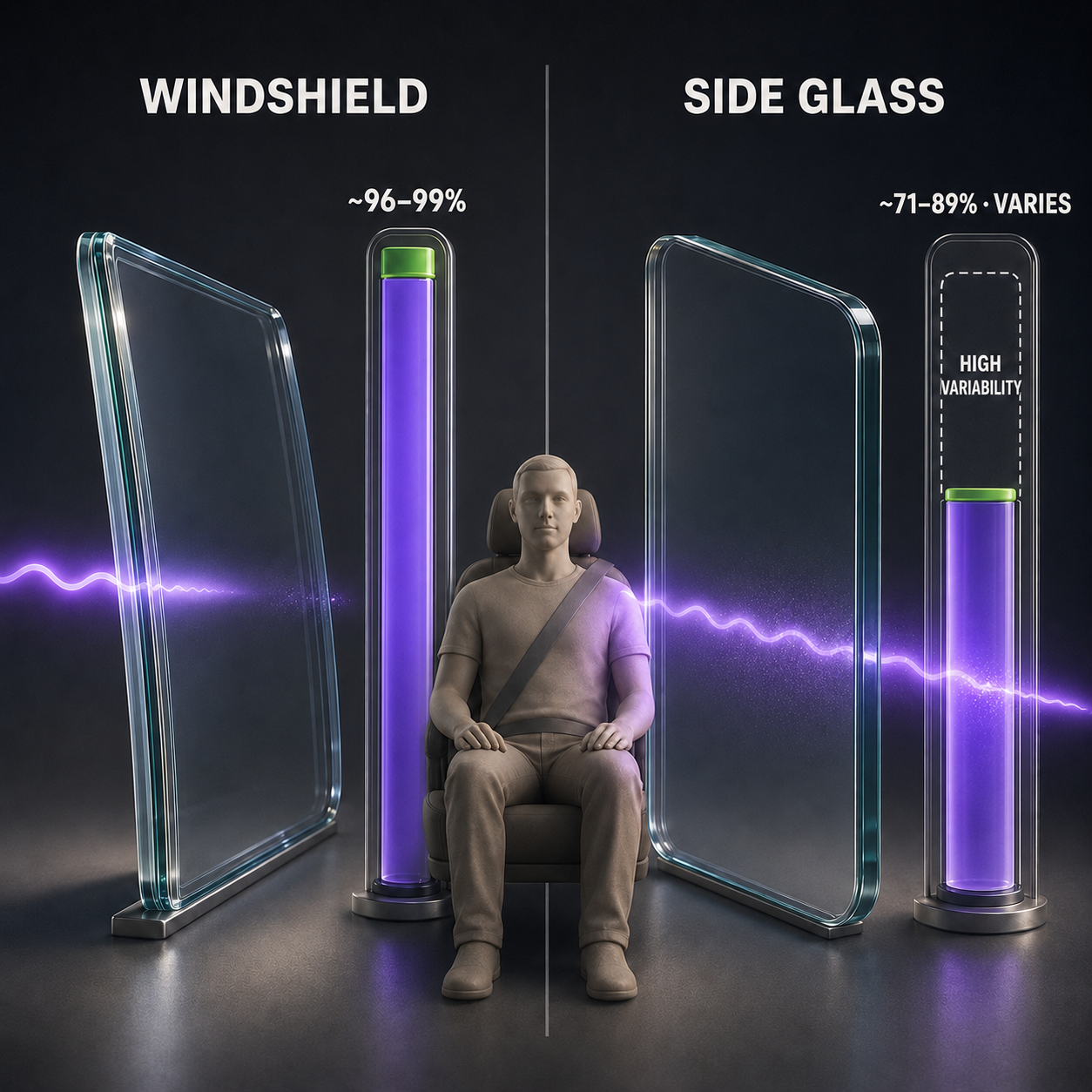
So how much do they actually block — measured, not off a spec sheet? Glass in general is excellent at stopping UV-B, the shorter sunburn wavelength; automotive glass blocks essentially ~100% of it everywhere. That part is basically solved. The gap shows up in UV-A — the longer, deeper wavelength tied to photoaging and melanoma risk. A 2016 study in JAMA Ophthalmology measured 29 cars from 15 makers: windshields blocked 96% of UV-A on average, while side windows averaged just 71% — with a huge spread, from 44% to 96%. A 2025 study in Archives of Dermatological Research re-measured 34 newer vehicles and found windshields up to 99.25% average, side windows improved to 88.78%. Better, but still the weak, wildly variable link car to car. This is the accepted reason drivers in left-hand-drive countries tend to accumulate more sun damage on the left side of the face and the left arm — the side glass just isn't holding the line.
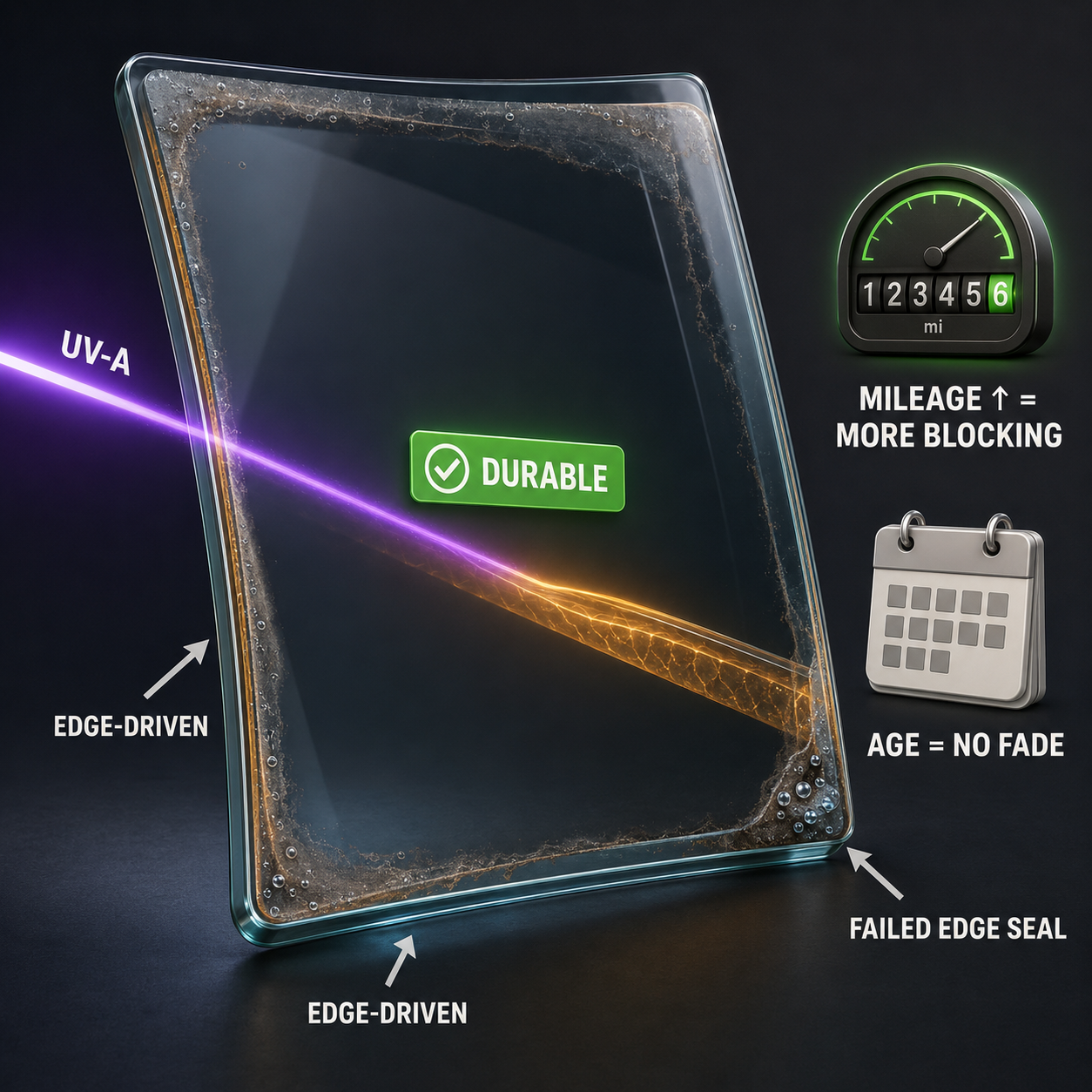
Now the question almost nobody sources honestly: does the UV rejection wear out over time? Short version — the factory UV protection in a laminated windshield is remarkably durable, and the real-world data does not show it fading with age. Two things point the same way. First, in that 2025 study, when they looked at what correlated with UV-A blocking, it was mileage — not year of manufacture — that tracked with higher attenuation. Older, higher-use cars didn't show degraded protection; if UV blocking meaningfully wore off with sun exposure, you'd expect the opposite. Second, the materials science backs it up: the UV absorbers used in PVB are chosen specifically for photostability. In accelerated weathering, properly stabilized PVB holds its color and adhesion — color shift under ΔE ~3 after 2000 hours of QUV-A exposure. The absorbers are doing their whole job, which is getting hit by UV and not breaking down.
Where laminated glass does age, it's usually not "the UV blocking faded across the pane." It's edge-driven: moisture creeping in at a failed edge seal, causing haze, bubbling, or delamination, and over long timescales a slow migration of absorber out through open edges. Those are edge and adhesion problems, not a uniform loss of UV rejection in the middle of your windshield. So the takeaway is a clean one to hand a customer honestly: the windshield is excellent and durable and doesn't need "restoring." The side and rear glass — tempered, no interlayer, weakest and most variable — is the real gap, and it's there from day one, not something that aged out. That's exactly where added UV-absorbing film has a legitimate, measurable job to do. Sell the real problem, not an imaginary one.
New here? Window Film Facts breaks down the physics of the sun's energy and what window film actually does with it — no hype, just the science. Learn it one chapter a day by email, and if there's something we haven't covered yet, ask us your question.