
Hot Take: Your Sunroof Didn't Shatter Because of the Tint. Not By Itself, Anyway.
Every so often a sunroof lets go with film on it, and the film gets blamed on the spot. Sometimes that blame is partly earned. More often it's a scapegoat standing in for a piece of glass that was already living on the edge — literally. Let's do this one honestly, because the real story is more useful than either "tint cracks sunroofs" or "tint is totally fine, relax."
The heating theory: right direction, wrong failure mode
The common intuition goes: an absorptive (ceramic) film makes the glass run hotter, the glass gets a little bigger, and that pressure cracks it. The first half is correct. Absorptive film converts solar energy into heat right at the glass surface, and yes, the glass runs warmer than it would bare.
But glass doesn't fail from getting uniformly bigger. Glass is enormously strong in compression — squeeze it and it shrugs. What breaks glass is tension, and tension shows up when one part of the pane is hot and another part is cool at the same time.
Picture the sunroof: the open center bakes in the sun while the perimeter sits tucked under the roof trim, shaded and in contact with cooler metal. The hot center wants to expand. The cool edge won't let it. So the center effectively stretches the edge, and the edge goes into tension. Now here's the kicker: the edge is also where all the manufacturing flaws live — cutting chips, grinding damage, handling nicks. Tension plus a flaw is how a crack starts. That's why thermal fractures almost always originate at the edge and run inward at a right angle before branching.
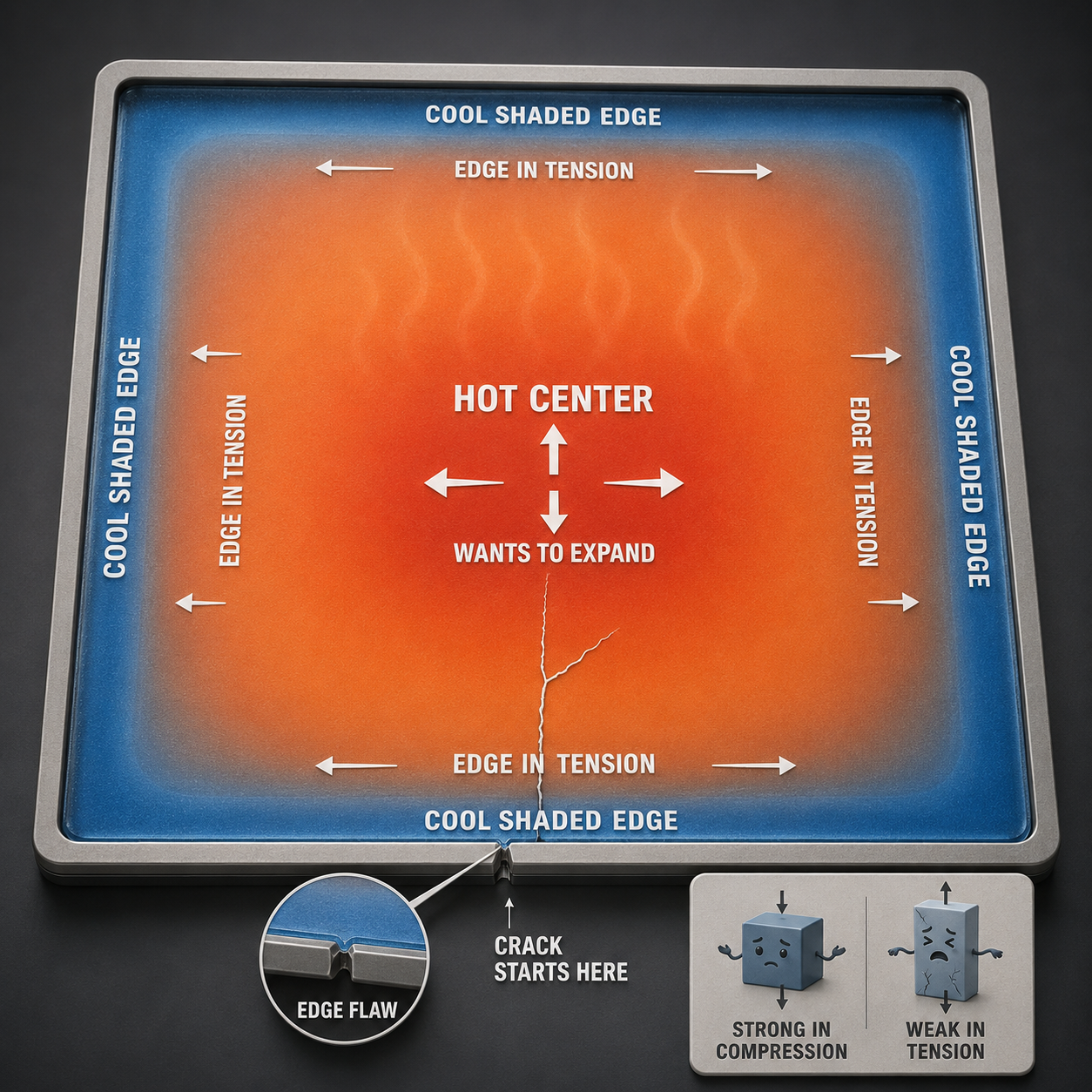
So the instinct to point at the edge was correct. The correction is just this: it's not the glass pressing out on its frame, it's the cooler edge being pulled into tension by the hotter middle. Uneven heat, not bigness.
Why tempered glass changes the whole conversation
Here's the part that gets left out of the scary version. Most sunroofs are tempered glass, and tempered glass is monstrously good at resisting thermal stress. Annealed glass fails at a surface-to-edge temperature difference of only about 30–40°C; tempered glass tolerates something on the order of 200°C or more — far beyond anything a film adds. Independent glass-engineering guidance is blunt about it: applied film is essentially not a thermal-fracture risk on tempered glass, and only a real concern on ordinary annealed glass, which sunroofs are not.
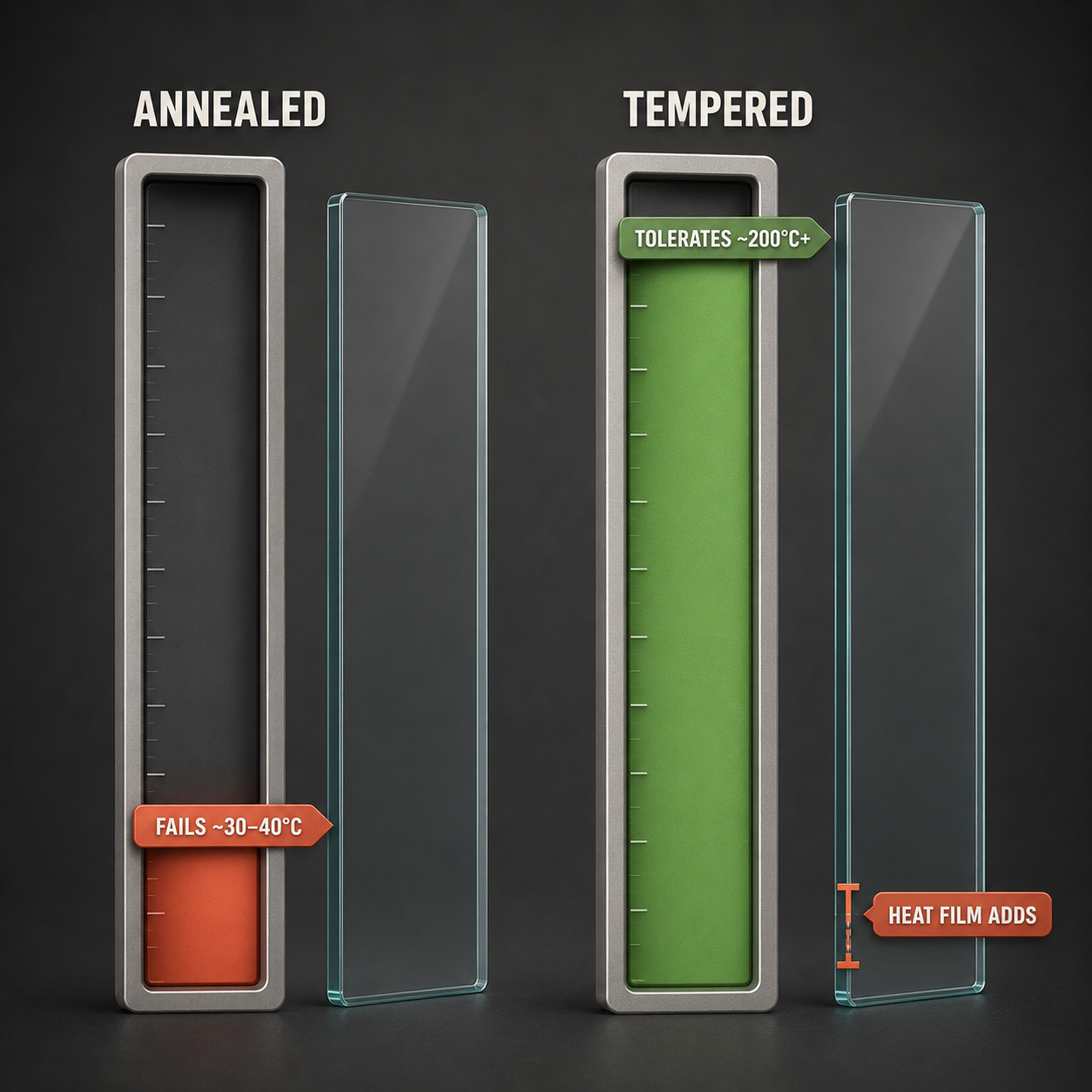
That reframes the film. On a sound tempered sunroof, the heat a film adds is real but usually nowhere near enough to break the glass on its own. Which lines up exactly with what people in the field actually see: film goes on thousands of sunroofs and they're fine, and once in a while one lets go. That's not what a primary cause looks like. That's what a contributing load on an already-compromised panel looks like.
What's actually breaking sunroofs (with or without film)
Tempered sunroofs shatter spontaneously often enough that federal regulators spent years on it. NHTSA's Office of Defects Investigation logged more than 4,000 spontaneous-fracture complaints across many brands, and its Engineering Analysis (EA14-002) pulled failure data from 13 automakers — yet it closed in 2021 without pinning down a single defect mechanism, finding no clear trend by region, season, production date, or vehicle age. The recurring suspects in that record and in the glass-engineering literature:
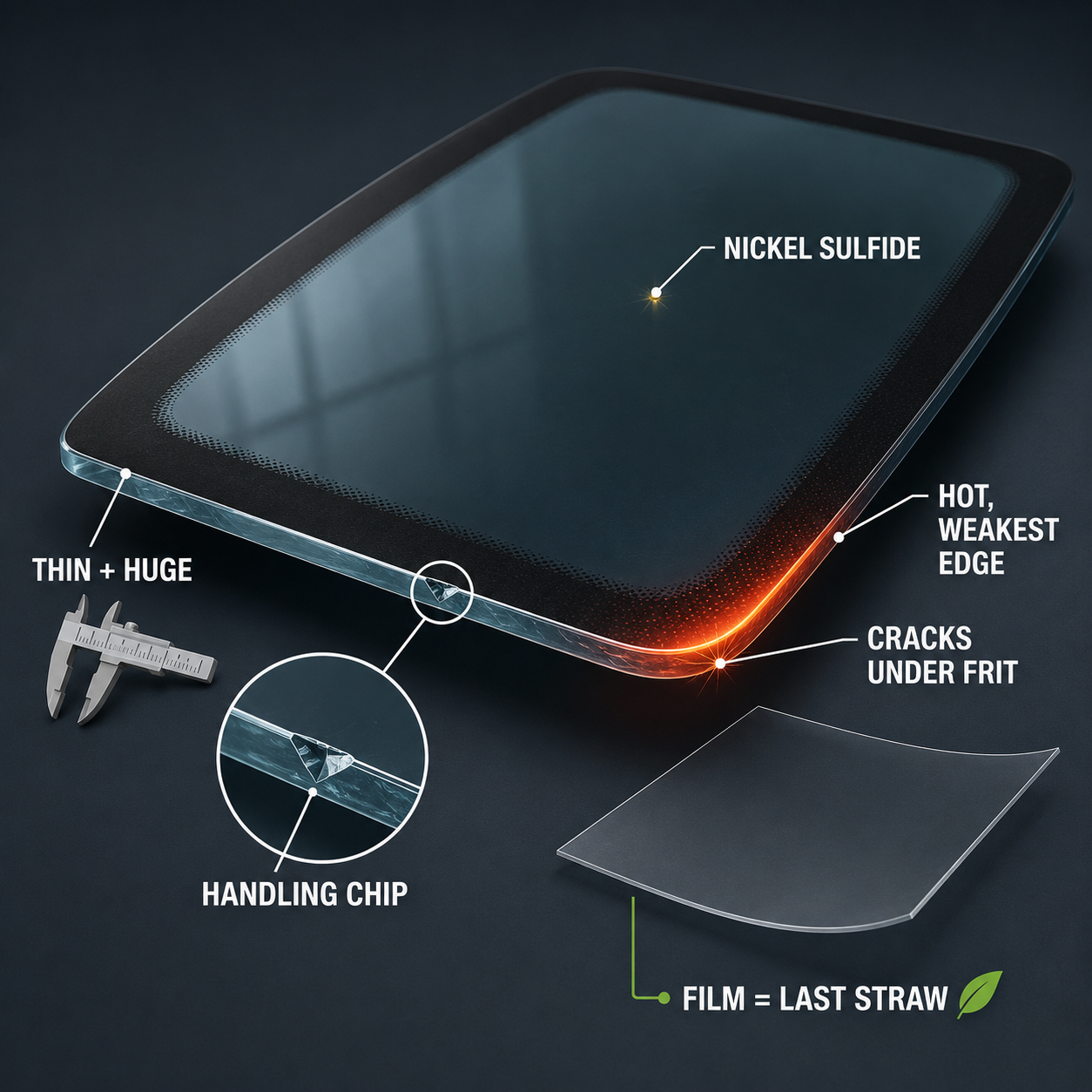
- Thin, huge panoramic lites. Roofs got bigger for the panoramic look while glass got thinner for weight and fuel economy — often around half a centimeter. Bigger, thinner glass has a smaller margin for error.
- The black frit border. That painted ceramic band around the edge isn't just decoration; it hides adhesive and blocks UV. It also absorbs sun and runs hot right at the edge. And — separately, this part is peer-reviewed — the frit itself weakens the glass surface: full-coverage ceramic enamel has been measured cutting the load resistance of tempered glass by roughly half, with fractures originating under the frit. So the sunroof's most stressed zone is also its structurally weakest zone, before any film shows up.
- Edge chips from handling and install. A tiny bevel chip is a stress concentrator. On tempered glass, that can mean a full shatter later, seemingly out of nowhere.
- Nickel sulfide inclusions. Microscopic contaminants trapped during manufacturing slowly change phase and expand over months or years. If one sits in the glass's tension core, it can detonate a tempered pane with zero external trigger — the classic "no one touched it" shatter. Note the honest caveat glass engineers add: an inclusion is one possible cause, but edge and surface damage is the more common explanation.
Read that list again and notice how little of it is about tint. A film can be the last straw on a panel already loaded by three of these. It is rarely the straw and the camel both.
Tempered vs. laminated: know what's over your head
Two constructions show up in sunroofs:
- Tempered (the majority): heat-treated for strength, but when it fails it fails all at once into a cabin full of little cubes. This is why spontaneous sunroof failures are so dramatic.
- Laminated: two thin glass plies bonded to a plastic interlayer. It can still crack, but it tends to spider-web and hold together rather than rain down. Tesla, Volvo, and Ferrari laminate all their panoramic roofs; Honda, Subaru, and Jaguar Land Rover use it on select models; Ford and Nissan have said they use laminated glass in some vehicles without specifying which.
You can usually tell which you have off the etched stamp in a corner of the glass — the construction is typically spelled right out, "Tempered" or "Laminated," alongside a DOT number and an AS code. (Heads up on a common myth: those AS1/AS2/AS3 codes describe the glazing's position and light transmission, not whether it's tempered or laminated — so read the actual word, not the number.) Worth knowing before you make decisions about film, because the thermal-tolerance picture and the failure behavior are different for each.
Ceramic vs. reflective on factory-tinted glass — the real trade-off
This is where the good questions come in, and where the easy answers fall apart.
The reasoning behind reaching for reflective instead of ceramic is thermally sound: for thermal stress, the film property that matters is total solar absorptance. Reflective films bounce more energy and absorb less, so they dump less heat into the glass. Lower absorptance is genuinely the safer direction. Ceramic films, for all their optical niceness, work substantially by absorbing — which is the exact property you'd want to minimize on a heat-stress question.
But factory privacy glass complicates it in a way that trips people up. Tinted glass is itself absorptive — dyed glass already soaks up a big share of the sun, already runs hot, and already carries its own thermal-stress tendency. So:
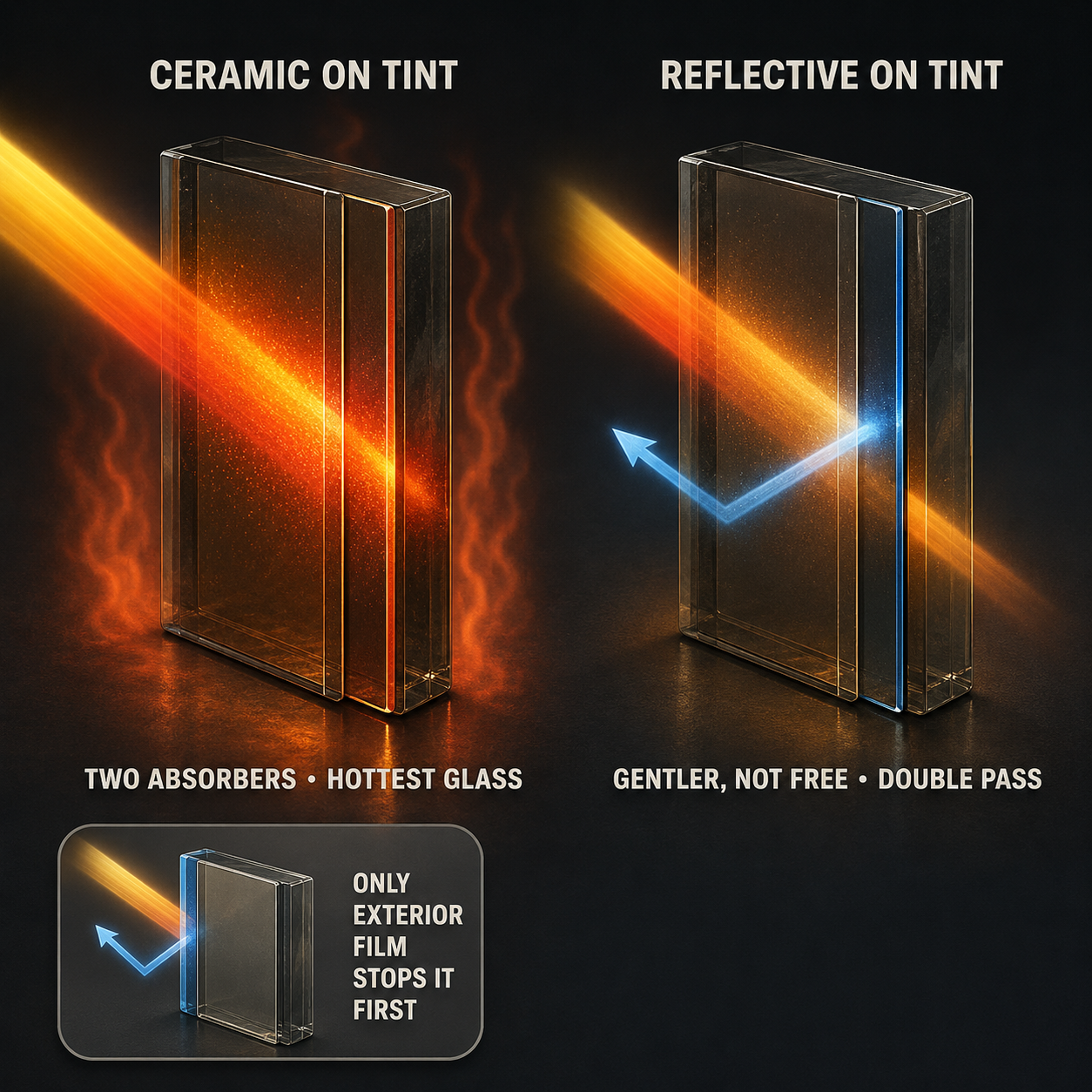
- Stacking an absorptive ceramic film on already-absorptive tinted glass is the hottest-glass combination you can build. Two absorbers in series.
- A reflective film applied to the interior can't stop the tinted glass from absorbing on the way in — the light hits the glass first. And the energy it does reflect has to exit back out through that same dyed glass, which absorbs a second helping on the way through. That double pass means an interior reflective film doesn't cleanly "cool the glass" the way it would on clear glass. (The version that truly removes the mechanism is exterior film, which intercepts the energy before it ever enters the glass — rarely practical on a car.)
And the other half of the concern — "how much heat am I even rejecting through already-tinted glass?" — is fair too. The factory glass already did some of the rejecting, so the marginal comfort gain from adding film is smaller than the brochure numbers (measured on clear glass) suggest, and part of what an absorptive film "rejects" comes right back inward as re-radiated heat off the now-hotter glass. That's the TSER/SHGC accounting we keep coming back to: absorbed energy isn't gone, it's re-emitted, and honest heat numbers count it.
Net: on factory-tinted glass there's no free lunch. Lower-absorptance (more reflective) film is the gentler choice on the glass, but neither interior option magically keeps a dyed pane cool, because the pane is doing much of the absorbing itself.
The honest bottom line
Blaming the film outright overstates it. Giving the film a total pass understates it. The accurate version:
- Film adds heat load; on tempered glass that load alone is almost never enough to break sound glass.
- Sunroofs that shatter are usually already marginal — thin, huge, frit-weakened at the edge, chipped in handling, or carrying an inclusion. Film can be the final contribution to a panel that was going to be a problem.
- For thermal risk, absorptance is the number that matters, not the marketing category. Lower is safer.
- Factory-tinted glass is its own absorber — plan around the glass, not just the film.
Practical takeaways: check the etching to learn your glass type; respect that black frit border as the hottest, weakest zone; favor lower-absorptance film if you film a roof at all; and get a real film-to-glass compatibility read rather than trusting a single "heat rejection" figure.
New here? Window Film Facts breaks down the physics of the sun's energy and what window film actually does with it — no hype, just the science. Learn it one chapter a day by email, and if there's something we haven't covered yet, ask us your question.