
Ammonia and Window Film: A Real Rule, Stretched Too Far
"Don't clean your tint with ammonia" is one of the oldest rules in the trade. It gets repeated everywhere, usually with no explanation attached — which is exactly the kind of rule worth checking. So is it real chemistry, or a myth that just got passed down? The honest answer is both. The mechanism behind the rule is genuinely real. The blanket version of it — never, on any film, ever — is stretched well past what the chemistry actually supports.
Start with what's in the bottle, because it's less than most people think. Modern "ammonia" glass cleaner barely contains any. Windex was a 5% ammonia solution back in 1989; today's formula lists ammonium hydroxide at under 1% — the rest is mostly water, a little solvent, and detergent. And two things decide whether any chemical does damage: how concentrated it is, and how long it sits. A quick wipe of a sub-1% solution that dries in seconds is a completely different event from a metal part soaking in strong ammonia. Hold onto that distinction — it's where most of the argument lives.
Ammonia does have one very specific talent. It chemically grabs certain metals — copper and silver especially — and dissolves them, turning solid metal into ions that rinse away. Chemists call it "ammine complexing"; you can think of it as a key cut for exactly one lock. It does almost nothing to the plastic and glass around it, but where it meets bare copper or silver, it goes to work. In lab tests, copper exposed to ammonia can dissolve at roughly 8 to 30 nanometers per minute — and even ammonia vapor alone, no liquid touching the surface, has been shown to dull and discolor copper foil within an hour.
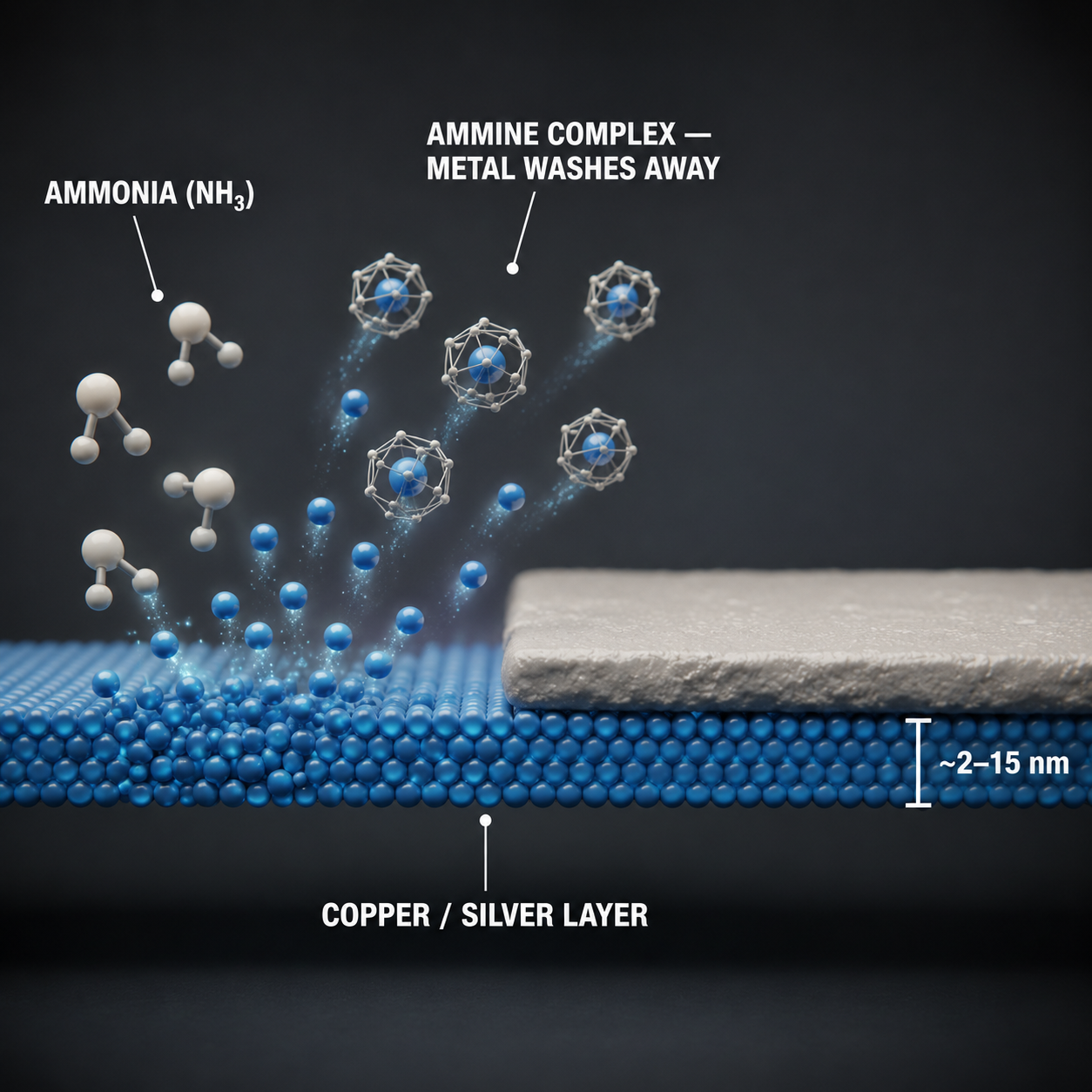
Here's why that number matters for tint. Some films — the metallized, reflective, and low-emissivity kinds — get their performance from a real metal layer built inside them. That layer is astonishingly thin: somewhere around 2 to 15 nanometers, which is only a few hundred atoms stacked up. Put ammonia's dissolving rate next to a layer that thin and the math is unforgiving — if ammonia ever reaches an exposed copper or silver layer, it can eat through it fast. For those films, the caution is completely legitimate.
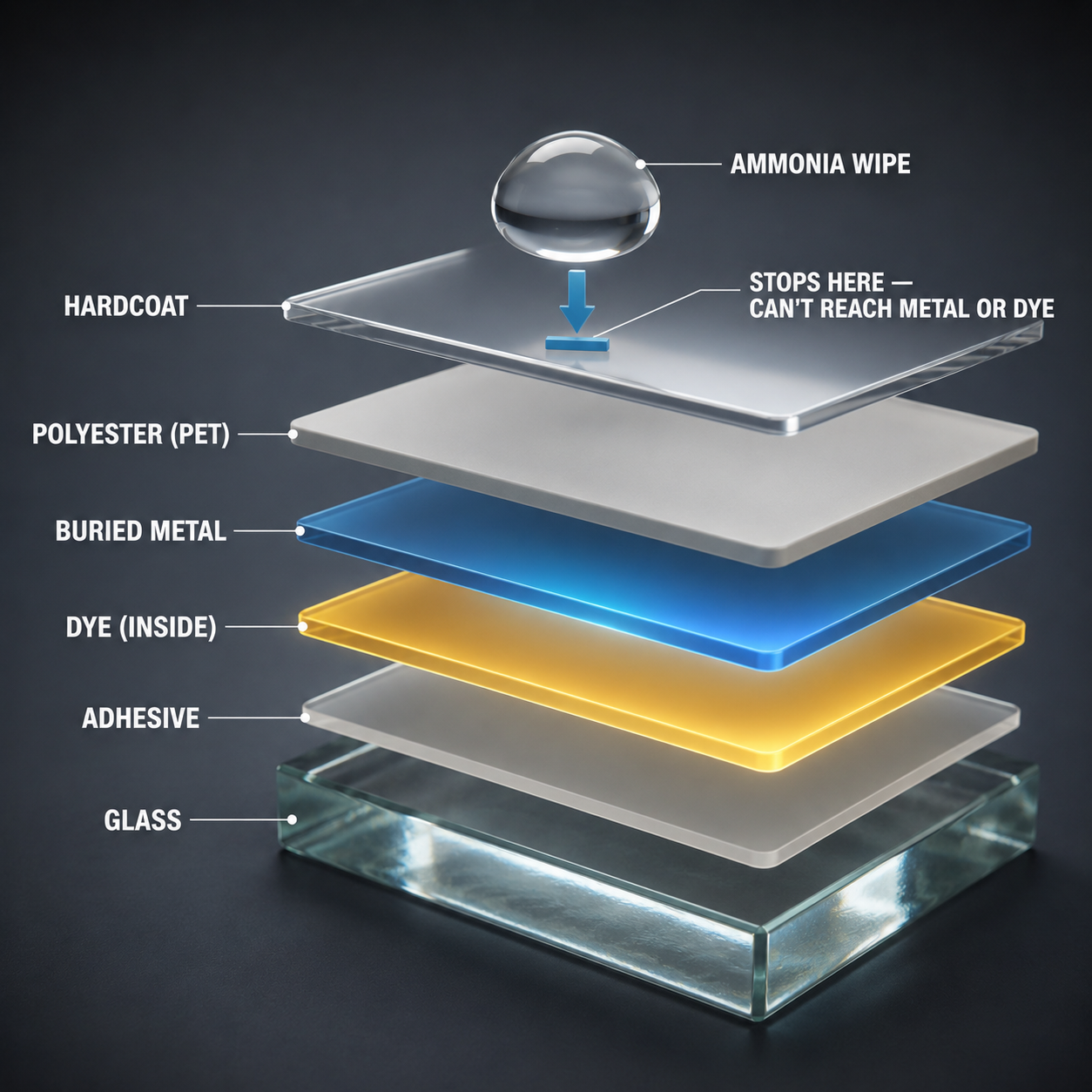
But on a healthy modern film, ammonia can't get there. A film isn't a slab of metal — it's a layered stack, like a sandwich. The metal (when there is any) sits buried in the middle, laminated between sheets of polyester and often given its own protective coating, and the whole thing is capped with a hard, chemical-resistant top coat. The color works the same way: dye lives inside the stack, not on the surface you wipe. So when your cloth touches the film, it's touching that tough outer coating over polyester — not the metal, and not the dye. And that outer polyester shrugs off dilute ammonia; it doesn't begin to give until concentrations far higher than anything in a spray bottle.
A lot of the damage blamed on ammonia was never chemical to begin with. Scratches and hazing usually come from paper towels or grit dragged across the surface — mechanical wear that happens regardless of what's in the bottle. Liquid pooling at a cut edge can wick in and cause problems over time, but that's true of any liquid, water included, not ammonia specifically. Bubbling and peeling are age, heat, and adhesive stories. Three of the classic "ammonia ruined my tint" complaints would have happened with plain water.
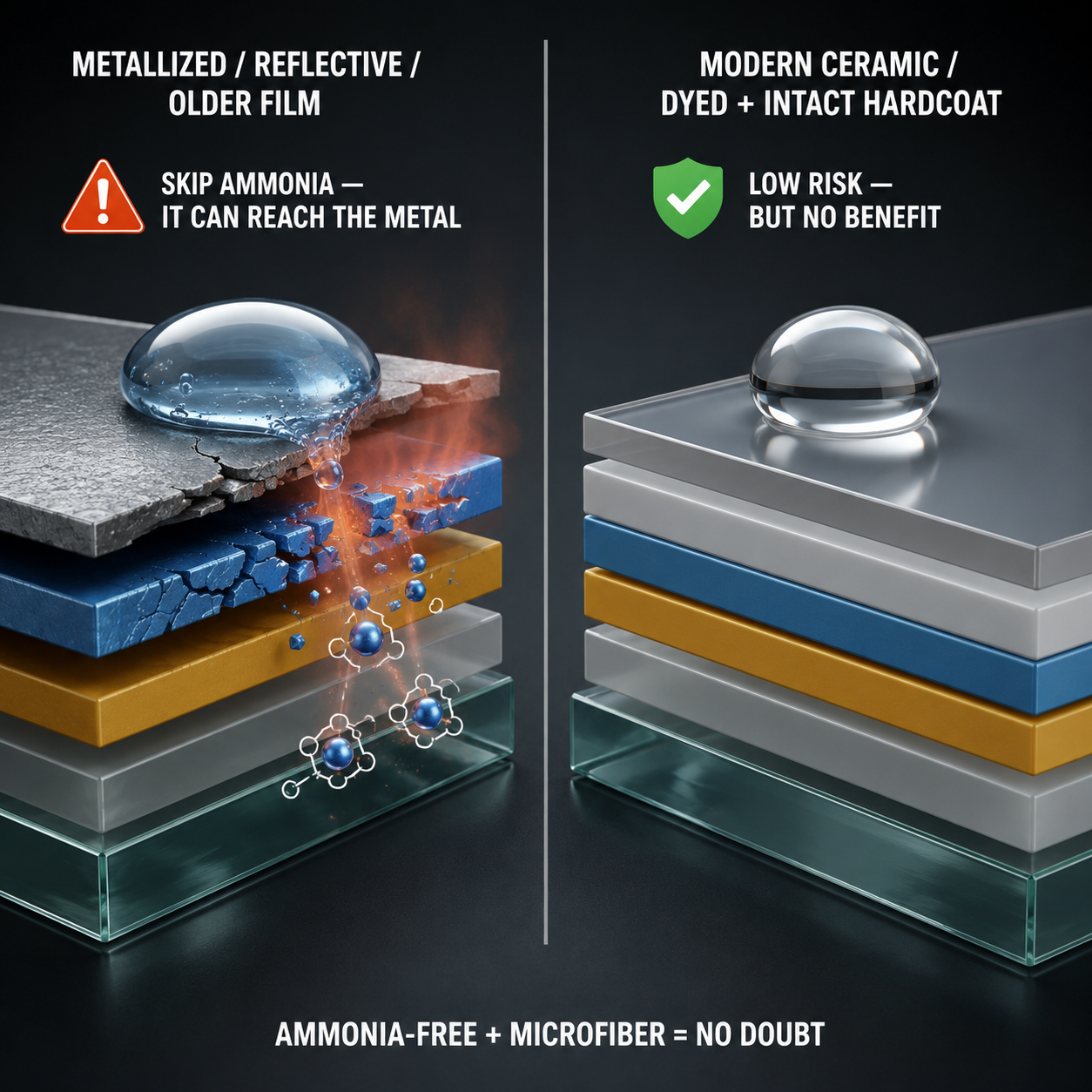
So where does that leave the rule? Not in the myth pile — but not as an absolute law either. Skip ammonia on metallized, reflective, low-e, and older or worn film, where it can reach a layer it genuinely destroys. On a modern ceramic or dyed film with an intact top coat, a quick wipe of today's weak ammonia cleaner, dried right away, isn't likely to do real harm — but it also buys you nothing. And that last part is the quiet reason the blanket rule survives: it's correct for the worst-case films, the person doing the cleaning usually can't tell which film they've got, and switching to an ammonia-free cleaner with a soft microfiber removes all doubt at zero cost. A good rule of thumb doesn't have to be true in every single case to be worth following.
One caveat worth stating plainly: no one has published a controlled study of ammonia glass cleaner on actual window film. Everything above is established chemistry — how ammonia behaves, how film is built, and what's really in the bottle — reasoned together, not a lab test on tinted glass. The mechanism is solid. How much any specific film is at risk depends on how it's made, how old it is, and how it's cleaned.
New here? Window Film Facts breaks down the physics of the sun's energy and what window film actually does with it — no hype, just the science. Learn it one chapter a day by email, and if there's something we haven't covered yet, ask us your question.