
The Frit Edge: Why That Dotted Black Border Goes Whitish During a Tint
Look at the edge of almost any car window and you'll find it: a solid black border that breaks into a field of tiny black dots before fading to clear glass. It has a name — the frit, or obscuration band — and if you've ever watched a window get tinted, you may have seen something odd happen along it. As the film goes on, that dotted edge can turn faintly whitish or silvered, like a haze has crept in under the film. Then, a day or two later, it clears on its own. The explanation you'll hear most often is that "the frit absorbs moisture." It's a tidy story. It's also, as far as the actual materials science goes, backwards.
Start with what the frit really is, because "black paint around the glass" isn't it. The frit is fired ceramic enamel — finely ground glass mixed with a black pigment and a carrier that lets it be printed on. When the glass goes through the tempering oven, the carrier burns off and the ground glass melts and fuses directly into the glass surface. What's left isn't a coating sitting on top of the glass; it's a glassy layer that has become part of the glass, which is why it never peels, fades, or wipes off. It's the same basic idea as the porcelain enamel baked onto a stove or a sink.
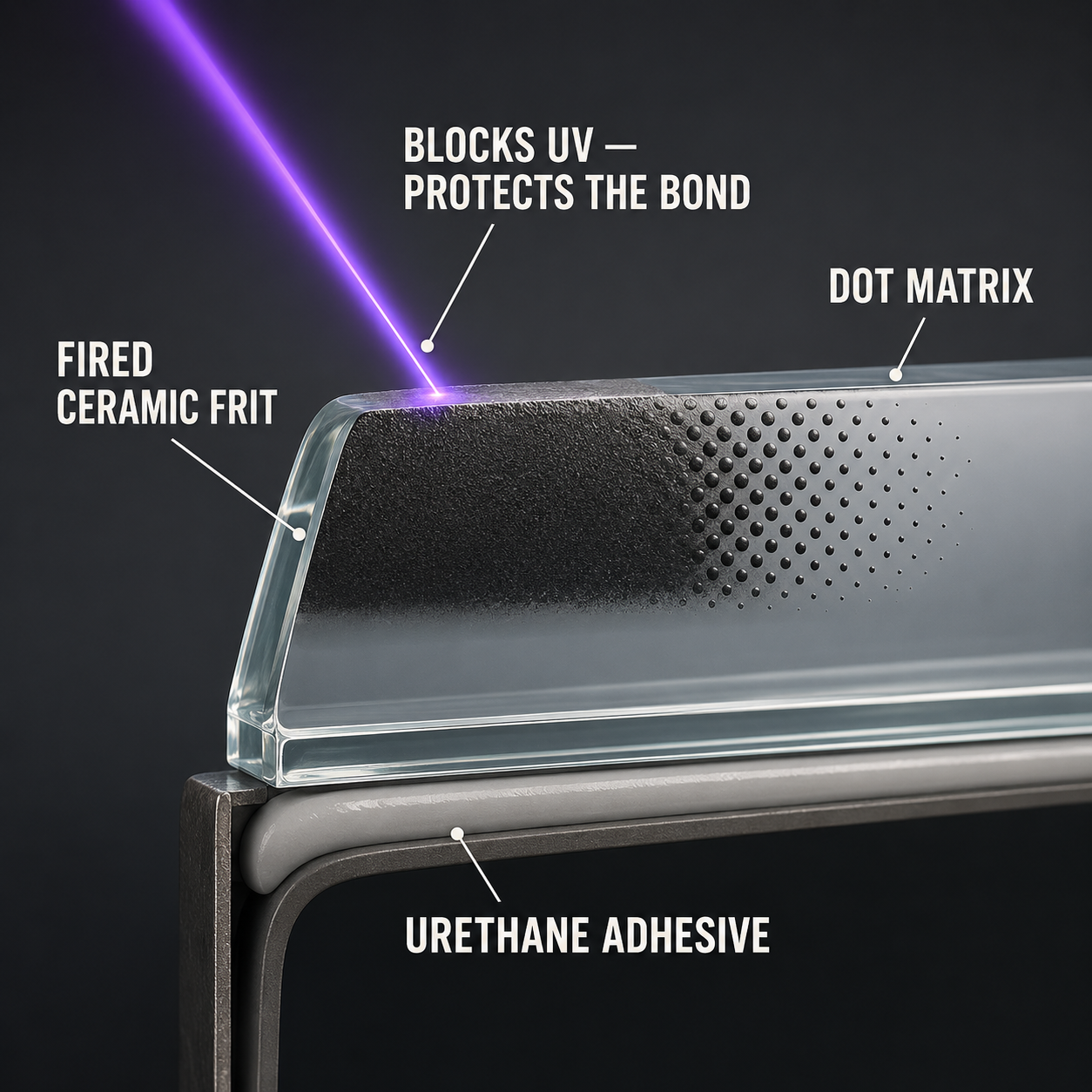
It's there to do a real job. On a car, the black band hides the strip of polyurethane adhesive that glues the glass into the body, and — more importantly — it shields that adhesive from ultraviolet light, which would slowly cook the bond loose if the sun could reach it. The band also conceals the wiring, antenna traces, and defroster connections around the edge. The dot matrix — that gradient of shrinking dots — is mostly cosmetic: it softens the hard visual step between solid black and clear glass so your eye glides across it instead of hitting a line.
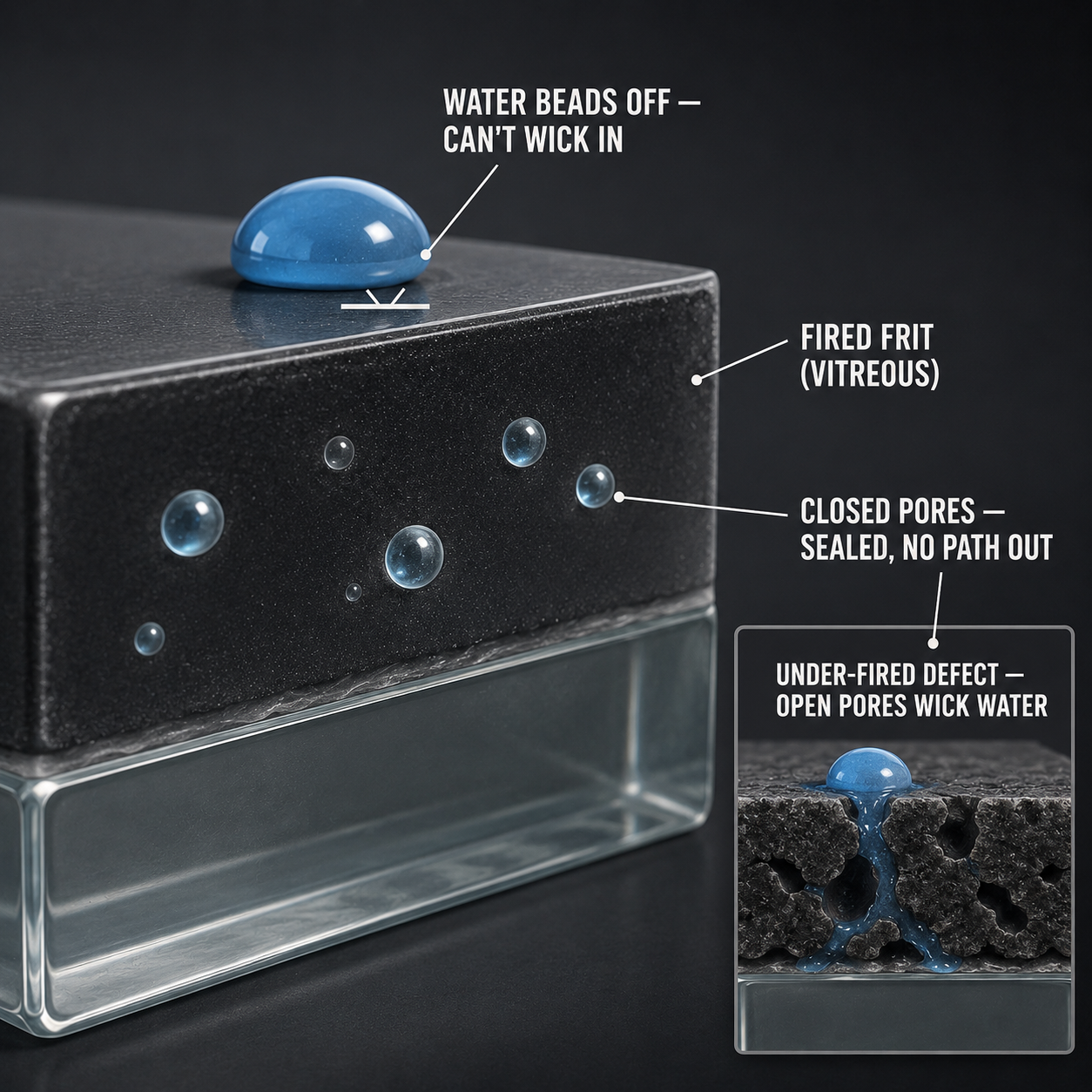
Now the moisture question. The word that settles it is vitreous, which just means "glass-like." A vitreous material, by definition, absorbs almost no water — under half a percent by weight is the usual bar. Fired frit is vitreous. Peer-reviewed reviews of enamel coatings describe them as a strong barrier against liquids soaking in, not a sponge. So the premise that fired frit "soaks up" water the way a paper towel does runs against what the material actually is.
"But doesn't it have pores?" Some — and here's the important part — the pores in a properly fired enamel are closed. They're tiny sealed bubbles, formed when gases escape during firing, locked inside the glassy layer with no path to the surface. A closed pore can't take on water any more than a sealed air bubble in an ice cube can. (Those same trapped bubbles are actually a strength concern, not an absorption one — but that's a different story.) There's one real exception: if a frit is under-fired or over-fired, it can end up with open, connected porosity that genuinely does wick water. That's a manufacturing defect, though — not a normal property of good frit, and nothing a tint installer does could cause it.
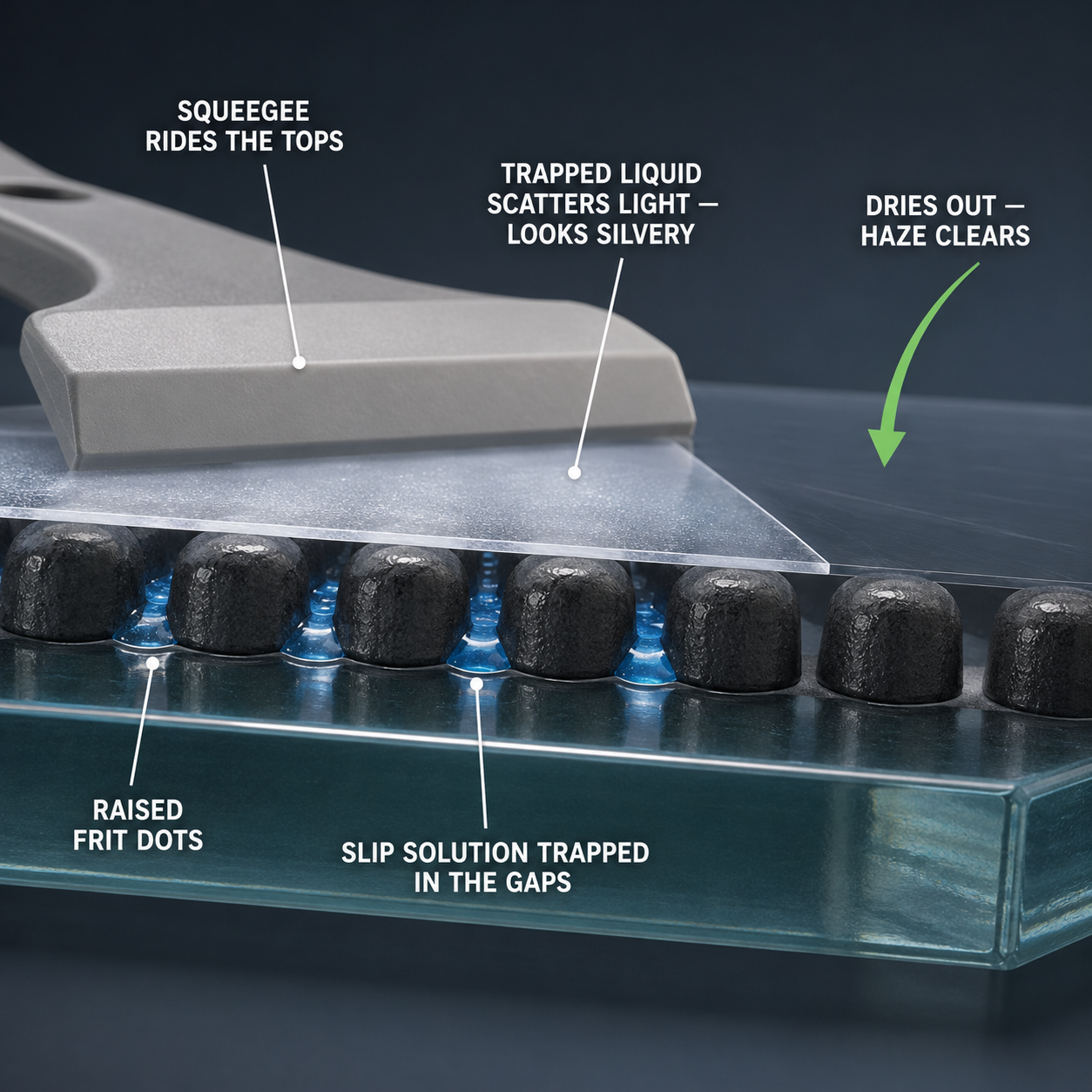
So if the frit isn't drinking the water, why does the edge go whitish? The most physically sensible explanation has nothing to do with absorption and everything to do with shape. The dot matrix is raised — each dot is a little bump of fused enamel standing above the glass. When an installer floods the glass with slip solution and squeegees the film down, the squeegee blade rides across the tops of those bumps and can't reach into the tiny valleys between them. A thin film of solution stays trapped down in that texture, where it evaporates slowly, and trapped liquid in a rough surface scatters light — which reads to your eye as a light, silvery haze. As the last of it finally dries out from between the dots, the haze clears. It's the same reason a textured surface looks different wet than dry.
Two honest caveats, because this is the part the tidy version skips. First: that geometry explanation is reasonable and it fits the physics, but it comes from installer and shop experience, not from a controlled study — no peer-reviewed source has tested exactly what happens at a dot-matrix edge during a tint. We're presenting the most defensible mechanism, not a proven one. Second, and more firmly: the "porous frit absorbs moisture" version isn't just unproven, it points the wrong way — fired vitreous enamel is one of the least absorptive surfaces on the whole window. The observation is real. The usual explanation for it inverts the science.
New here? Window Film Facts breaks down the physics of the sun's energy and what window film actually does with it — no hype, just the science. Learn it one chapter a day by email, and if there's something we haven't covered yet, ask us your question.