"Nano-Ceramic" Film: A Real Term That Gets Used Loosely
"Nano-ceramic" is on the window-sticker of just about every premium film sold today. It sounds like a spec, and buyers treat it like one. But the honest picture is more interesting: the term is built from two words that each have a real, checkable meaning — and it's also a label anyone is free to print, with no one checking whether it's earned. Both of those are true at once, and knowing where the line falls is what tells you when "ceramic" is telling you something and when it's just a word on a box.
Start by taking the term apart. Ceramic, in materials science, means an inorganic, non-metallic solid — the same broad family as pottery glaze, spark-plug insulators, and body armor. Nano is a size, not a material: it means the particles are down at the nanometer scale, so small that thousands would fit across the width of a hair. Put together, "nano-ceramic" describes a film that gets its heat control from ceramic particles ground down to the nanometer scale and scattered through one of its layers. As a plain description of what a film is built from, that's a legitimate thing to say.
And the particles are real. The workhorses inside these films are materials like indium tin oxide, antimony tin oxide, cesium tungsten oxide, lanthanum hexaboride, and titanium nitride — a mouthful, but every one is a genuine ceramic by the textbook definition. What they share is a specific talent: they soak up near-infrared, the invisible part of sunlight you feel as heat, while letting visible light pass through. That's the whole point of a good tint — block the heat, keep the view.
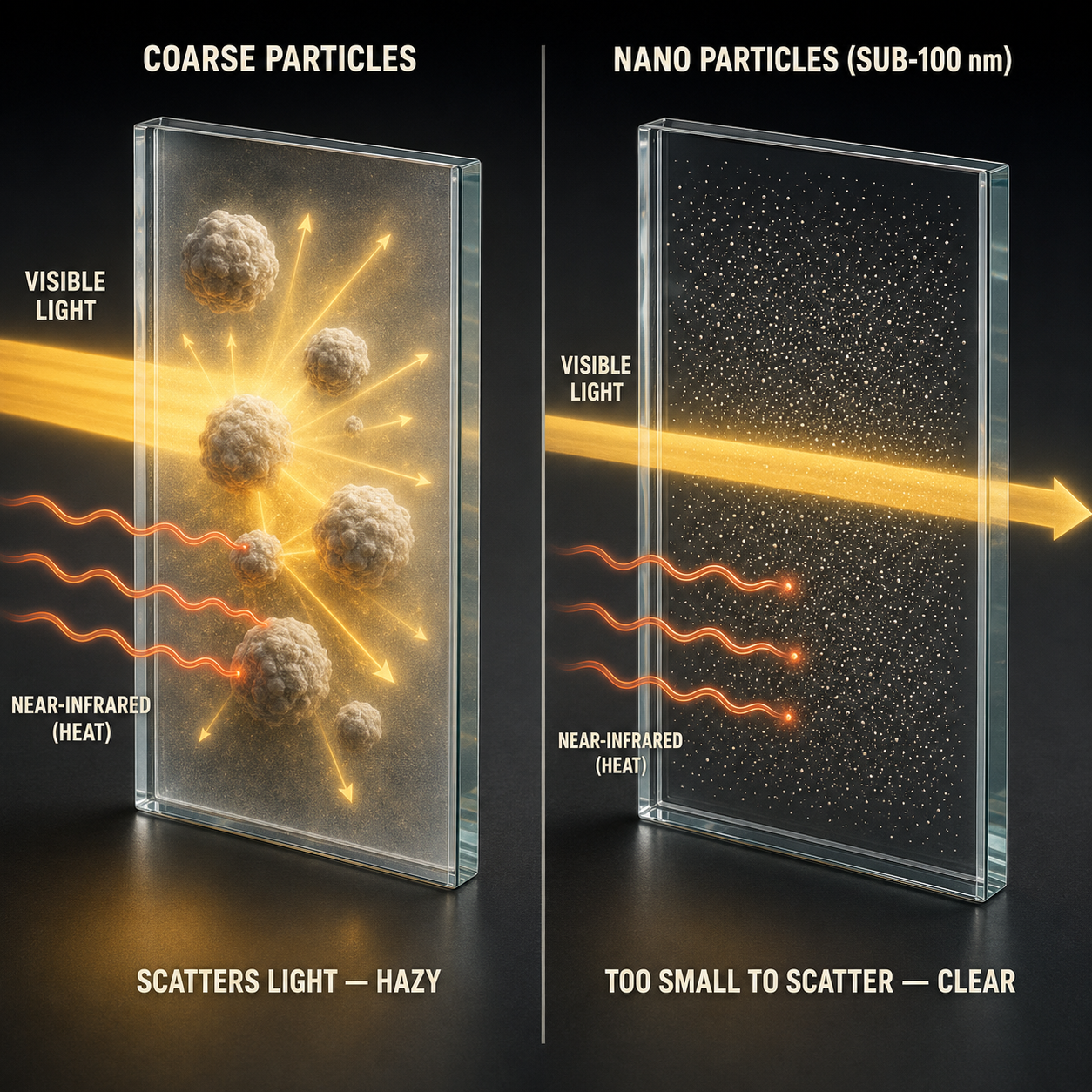
Here's where "nano" stops being marketing and becomes physics. Particle size decides how much of the visible light the particles scatter. Grind ceramic too coarse and the particles are about the size of a light wave, so they bounce visible light in every direction and the film looks frosted and hazy — useless for a window. Shrink them below roughly 100 nanometers and that scattering falls off a cliff (it drops with the sixth power of particle size), so the particles become effectively invisible while still catching heat. That's the entire engineering reason to go nano: it's the only way to pack in enough heat-blocking material without turning the glass milky. So when the particles genuinely are that small, "nano" isn't a flourish — it's the thing making the film both clear and effective.
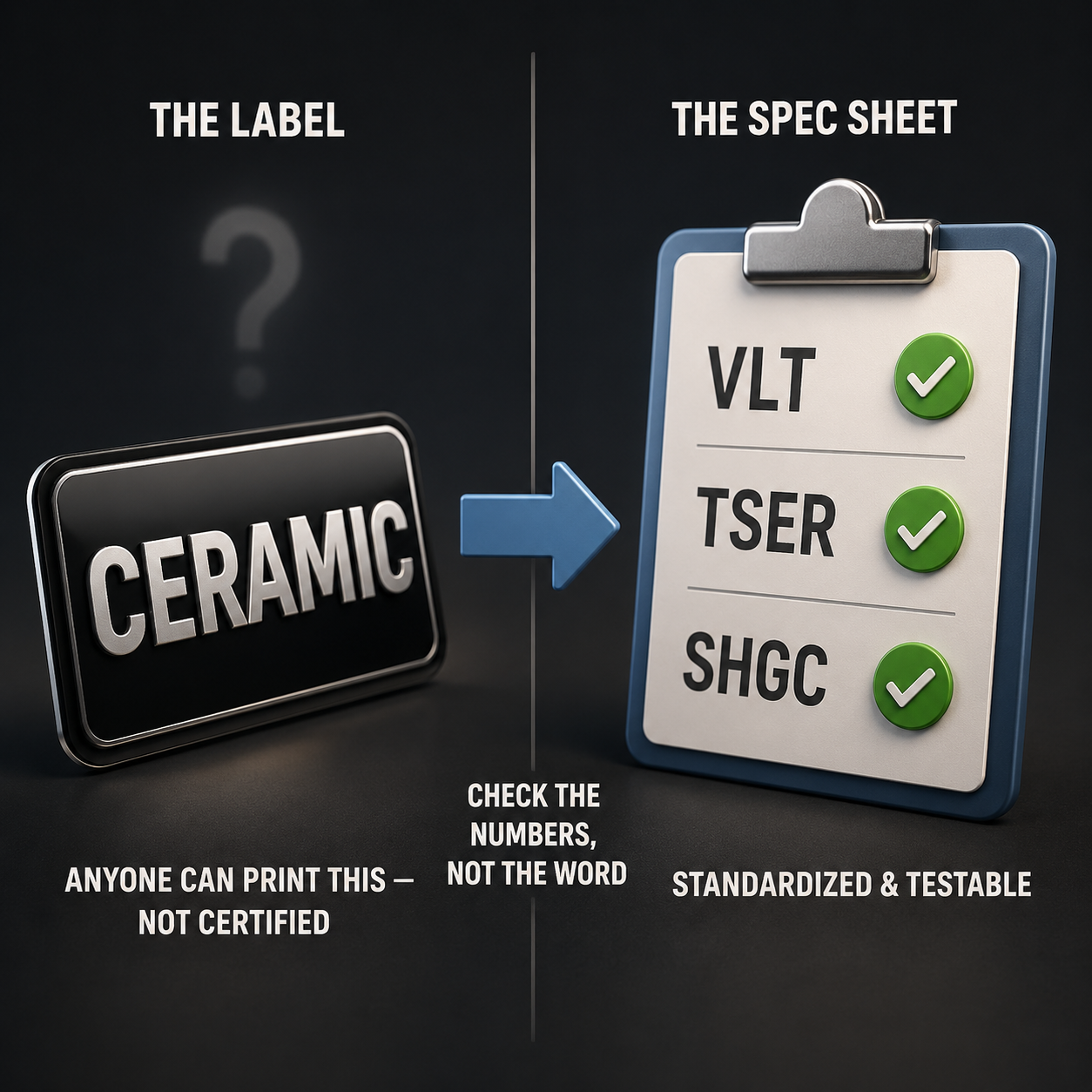
Now the catch, and it's a big one. No standards body — not NFRC, ASTM, ISO, or the film industry's own IWFA — defines or certifies "ceramic" as a category. What they do standardize are the measured numbers: how much visible light gets through (VLT), how much total solar heat is rejected (TSER), and the heat-gain rating (SHGC). Those are testable and comparable. The word "ceramic" is not. It's a description a manufacturer applies to its own product, and nothing stops anyone from printing it. Which means the label, by itself, tells you how a film is supposedly built — not how well it performs.
That gap is where the loose usage lives. A few patterns worth knowing: some films that are actually metallized get a thin ceramic coating added and are then sold as "ceramic," even though the metal layer is still doing most of the work — a common tell is that they interfere with your phone or GPS signal, which true dispersed ceramic particles don't do. "Metal-free" and "non-conductive" get stretched too, since several of these ceramics are technically metal compounds and do conduct electricity at the particle level (what's fair to say is there's no continuous metal layer). And the headline "IR rejection" number is a favorite — a film can quote a sky-high figure by cherry-picking the one narrow slice of the spectrum where its material peaks, which is not the same as the honest, whole-spectrum TSER.
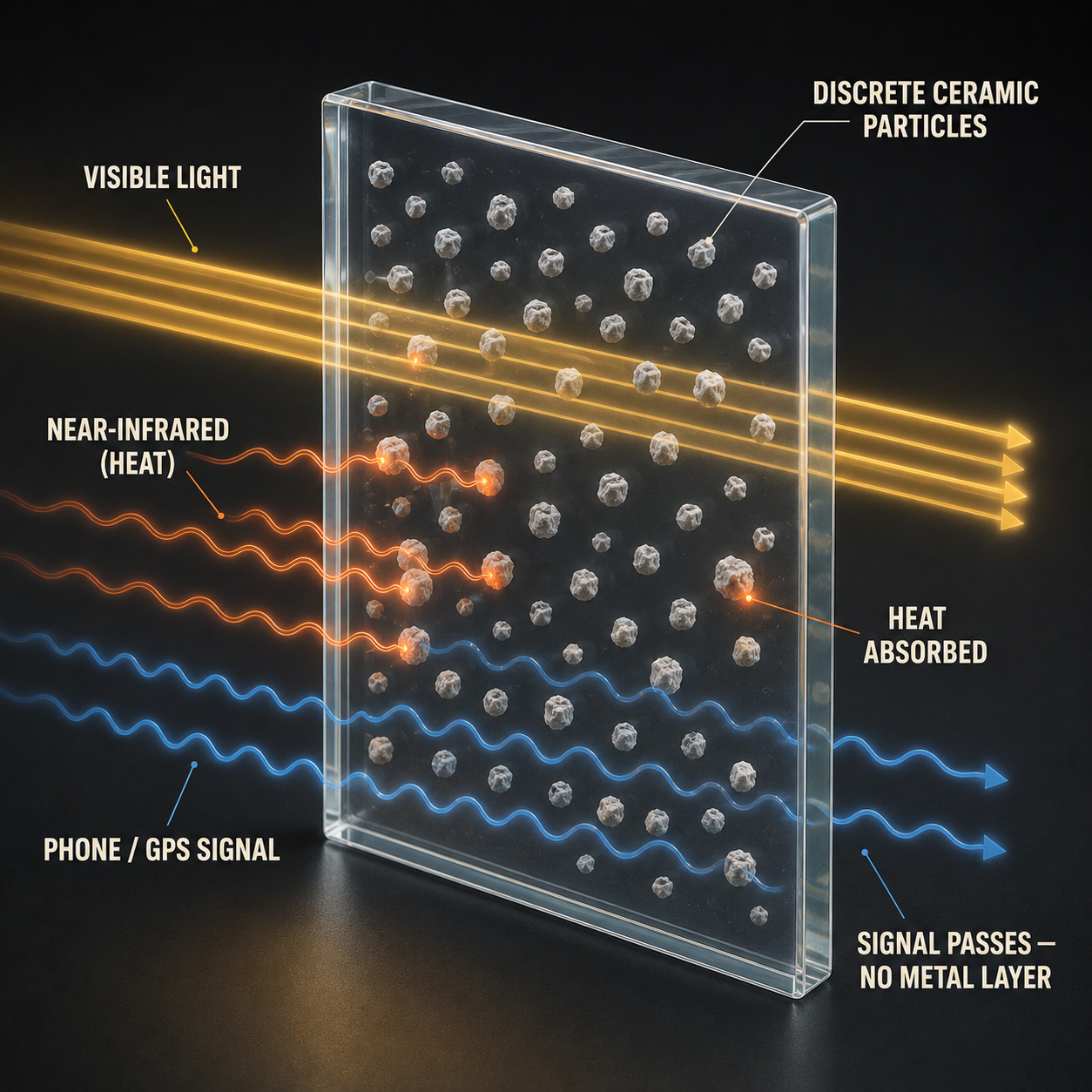
None of this makes "nano-ceramic" a scam. When a film really is built from nanometer-scale ceramic particles, the term is accurate and it signals something useful: no dye that fades, no continuous metal to interfere with signal, heat control by selective absorption. The takeaway is just this — read "ceramic" as a claim about construction, then check it against the actual numbers on the spec sheet. Two films can both honestly say "ceramic" and perform completely differently. The word tells you the recipe; only VLT, TSER, and SHGC tell you the result.
New here? Window Film Facts breaks down the physics of the sun's energy and what window film actually does with it — no hype, just the science. Learn it one chapter a day by email, and if there's something we haven't covered yet, ask us your question.