
Dark From the Outside, Clear From the Inside: Why Tint Looks One-Way (It Isn't)
You've seen the clip. Someone films a tinted window from the street and it looks nearly black — a solid dark panel you can't see a thing through. Then they walk inside, point the camera back at the same glass, and suddenly it's clear: they can see the whole street. The obvious conclusion is that the film is one-way — that it blocks the view coming in while letting you see out. It's a great demo. It's also not what's happening.
The effect is completely real and you can reproduce it any sunny afternoon. But it isn't a property of the film. Nothing about that tint is "directional." What you're watching is two ordinary things stacked on top of each other: how a camera (or your eye) sets its brightness, and which side of the glass happens to be brighter. Pull those two apart and the mystery disappears.
Start with the one fact that settles the whole thing: a window film passes the same amount of light in both directions. If a film lets 20% of visible light through from outside, it lets exactly 20% through from inside, too. This isn't a manufacturing goal or a lucky coincidence — it's a law of optics called reciprocity. For any passive surface with no power source, light takes the same fraction along a path as it does along the reverse of that path. There's no "20% looking in but 5% looking out." A film that genuinely transmitted more one way than the other would be a perpetual-motion machine for light; it would break the second law of thermodynamics. So whatever's producing that dark-outside look, it is not the film letting less light in than out. That number is symmetric, full stop.
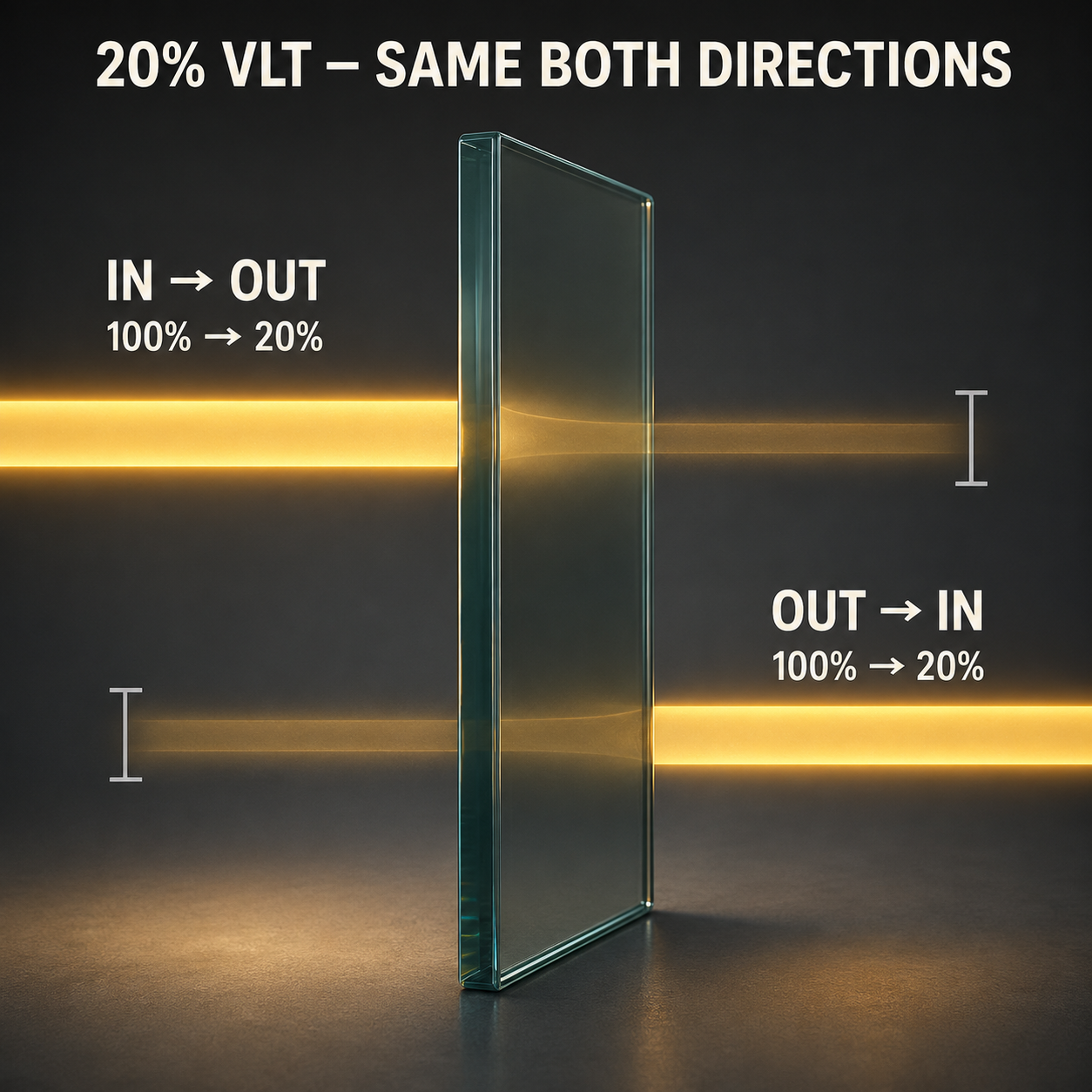
So where does the asymmetry come from? Mechanism one is the camera. Every camera — and this is the important part, your eye too — sets its brightness for whatever fills most of the frame. Point a phone at a sunlit street and it meters for all that brightness and turns the exposure down. Everything dimmer than the street then falls off toward black — including the shaded interior sitting behind the tint. Turn around and film the bright outdoors from inside, and the camera exposes for that same bright scene, so it comes through fine. The window never changed. The camera just re-metered for a different reference each time. On top of that, in daylight the glass surface throws back a veil of reflected glare that sits in front of the already-dim interior image, burying it further — that part's pure optics and it fools your eye as much as the lens.
There's a clean way to prove it's the metering and not the film. Most cameras let you lock the exposure. Lock it for the bright exterior and the interior stays black no matter how long you look; lock it for the dim interior and the outdoors blows out to solid white. A single fixed exposure can never show "dark one way, clear the other" at the same time. The everyday demo only works because the camera is quietly re-exposing between the two shots.
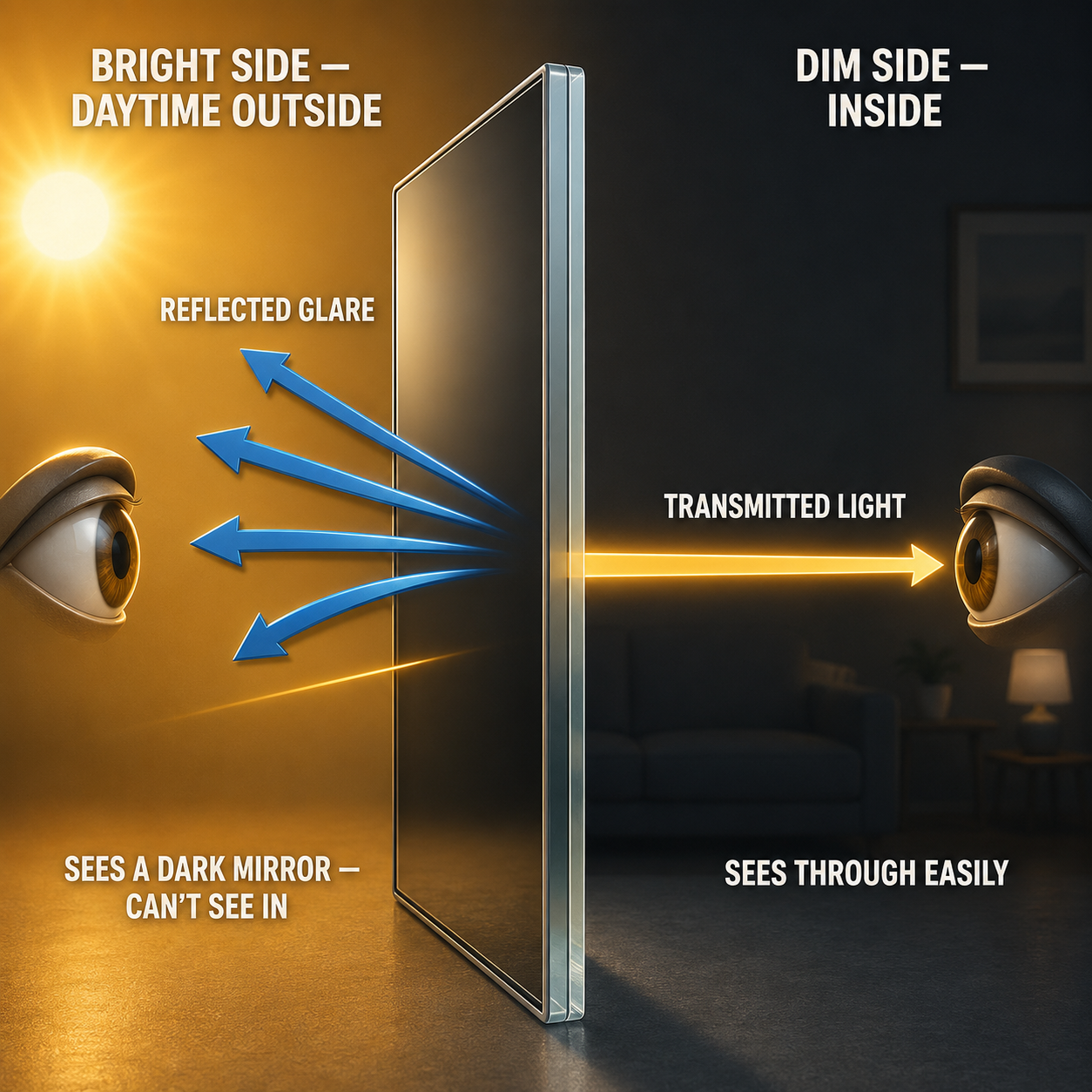
Mechanism two works even with no camera at all, which is why the effect is convincing in person. At any partly-see-through, partly-reflective surface, what reaches your eyes is a tug-of-war between two things: the light coming through from the far side, and the light bouncing back off your own side. Whichever wins decides whether you see through or see a mirror. Stand on the bright side and there's a flood of light on your side to reflect as glare, while only a trickle of the dim far side makes it through — so glare wins and the glass looks like a dark mirror. Stand on the dark side and there's almost nothing on your side to reflect, while the bright far side pours through even after the tint dims it — so the view wins and you see out easily. It's the same physics as a two-way mirror in an interrogation room, and it needs the same thing to work: one side has to be a lot brighter than the other. No light difference, no effect.
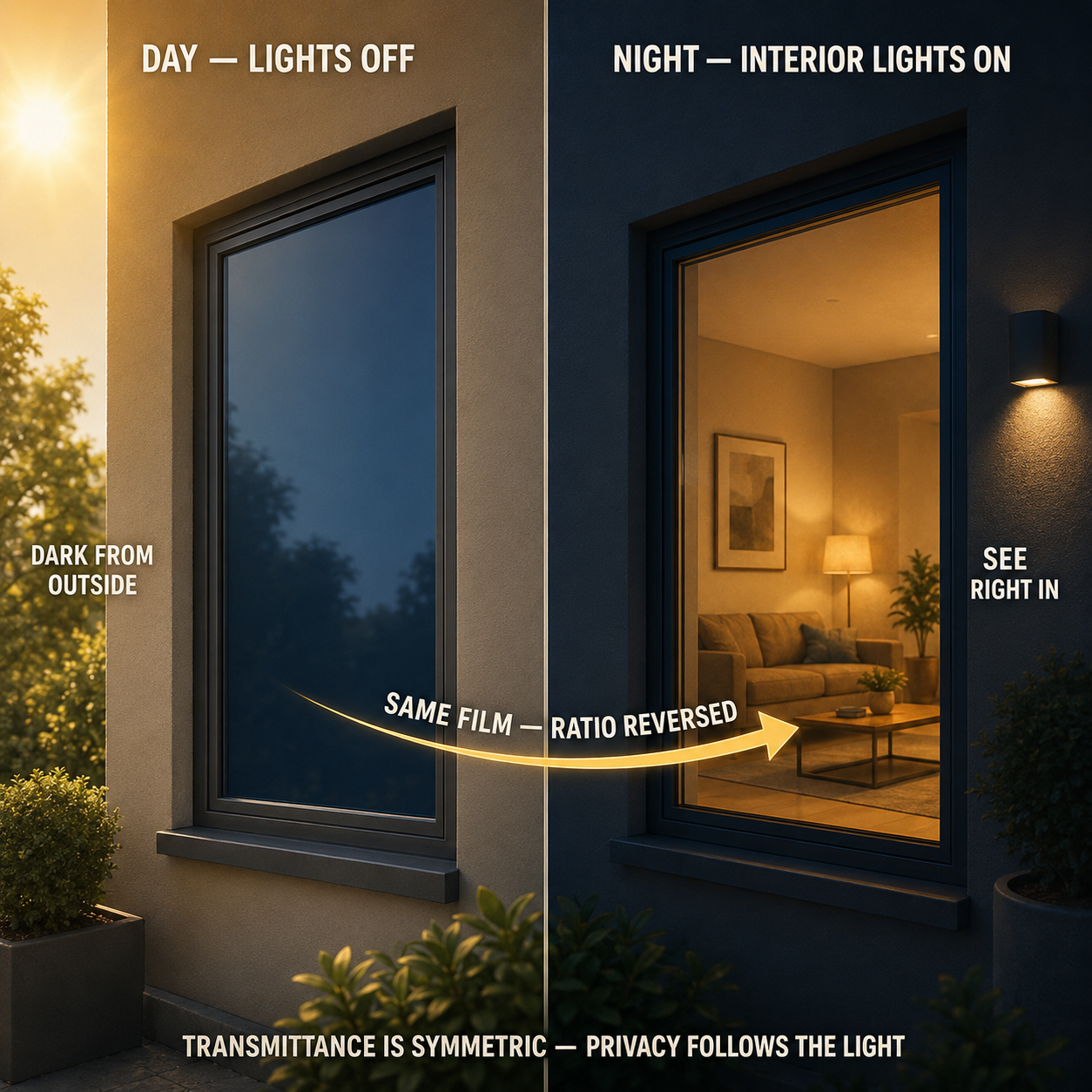
And that's the tell. Because the whole thing runs on the light difference, it flips the moment the lighting flips. In daytime the outside is the bright side, so outsiders get the mirror and occupants see out — the state every one of those clips is filmed in. But at night, turn the interior lights on and now the inside is the bright side. Because transmittance is symmetric, anyone outside can now see straight into the lit room. The privacy didn't "fail" — it did exactly what the physics says it must. Same film, reversed light ratio, opposite result.
This is also where a specific piece of marketing gets misread. "Dual-reflective" films are built to reflect more on the outside face and less on the inside face, and that's a genuine, real feature — it means at night you see less of your own reflection and keep a cleaner view out. But notice what it changes: reflection, not transmission. It does nothing to stop an outsider seeing into your lit room after dark, because that's governed by transmittance, and transmittance is symmetric. When a product promises "clear views day and night," it's talking about your view looking out — not privacy from the street looking in. Those are two different things, and this is the exact spot where the sales copy and the physics get tangled together.
So, the honest summary. A 20% film passes 20% of the light both ways, always. In daylight it looks dark from outside because your camera and your eye are set for the bright exterior and surface glare is piling on top — both drowning the faint interior image. It looks clear from inside because you're looking from a dim space toward a bright one, and even a slice of a very bright scene is plenty to see by. It is not a one-way film. It's a daytime lighting condition wearing a very convincing costume — and at night, with the lights on, it takes the costume off.
New here? Window Film Facts breaks down the physics of the sun's energy and what window film actually does with it — no hype, just the science. Learn it one chapter a day by email, and if there's something we haven't covered yet, ask us your question.