
Metalized Window Film: The Heat Rejection and the Signal Problem Are the Same Thing
Metalized window film has a reputation with two halves. The good half: serious heat rejection at a friendly price. The bad half: it can weaken your phone signal, confuse your GPS, and make your key fob act up. Those usually get told as a feature and a separate flaw — as if the manufacturer just forgot to fix the signal part. Here's the fact worth knowing: they aren't two things. The heat rejection and the signal interference are the same physical property, doing two jobs at once. You cannot have one without at least some of the other.
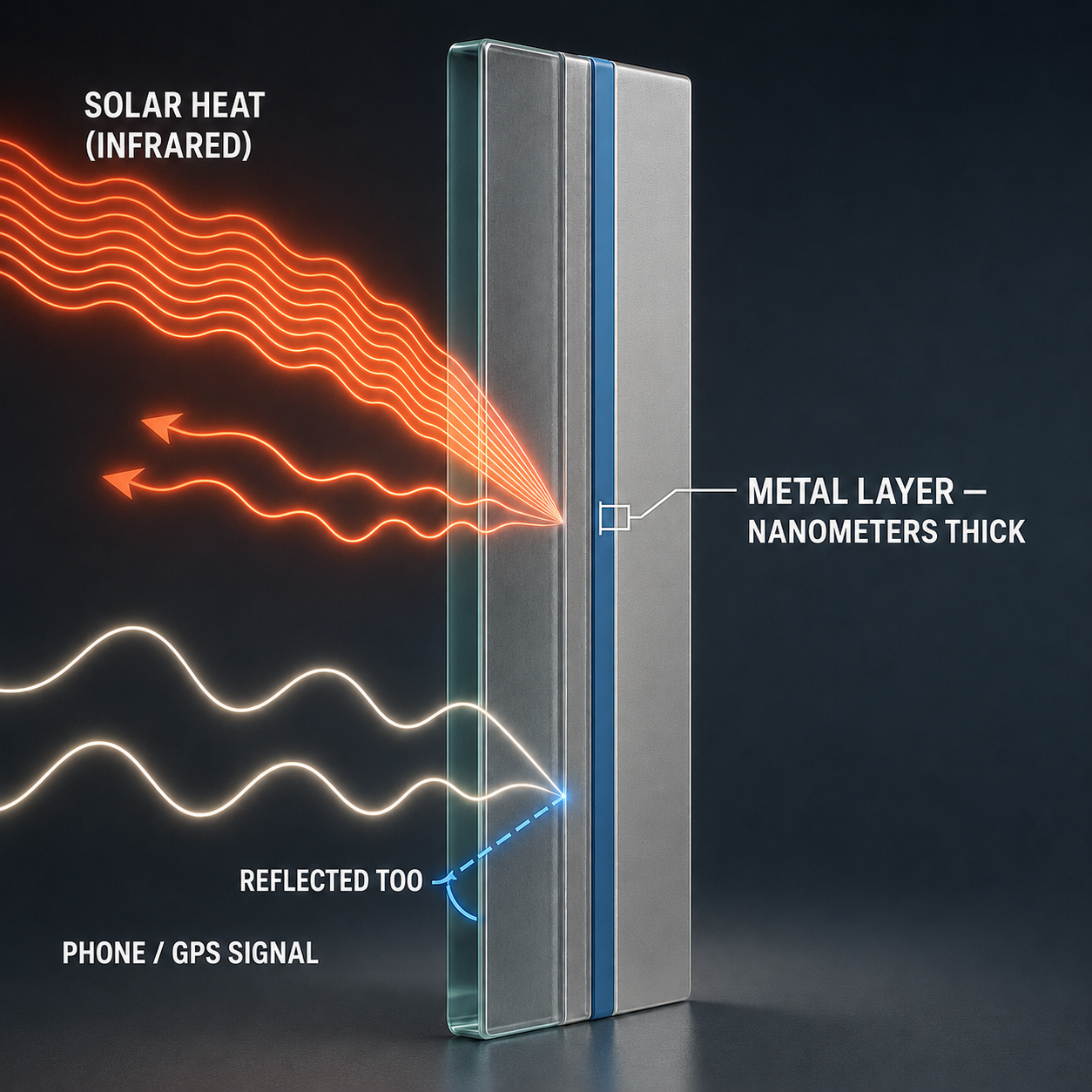
Start with what the film actually is. A metalized film is a sheet of polyester carrying a real metal layer — aluminum, silver, nickel, and similar metals — that is astonishingly thin: nanometers, a few hundred atoms stacked up. It gets there one of two ways. In vacuum metallizing, the metal is vaporized in a chamber and condenses onto the film like fog on a cold window. In sputtering, atoms are knocked off a metal target one blast at a time and land in an extremely even, controlled coat. Sputtering costs more and allows finer control, but either way the result is the same in the way that matters here: a continuous, electrically conductive metal layer riding on the glass.
Why does a metal layer reject heat so well? Metals are full of free electrons — electrons that aren't tied to any one atom and can slosh around like water in a pan. When a wave of light or heat radiation arrives, those electrons slosh in response and push back, canceling the wave before it can get inside. The wave has nowhere to go but back out: reflection. That's why metals are shiny. And it matters for heat because roughly half of the sun's energy reaching the ground arrives as near-infrared — invisible heat radiation. A metal layer is a mirror to that entire band, so it bounces a large share of the sun's heat away before the glass ever absorbs it. There's even a tidy rule in the physics (the Hagen–Rubens relation): the better a metal conducts electricity, the better it reflects infrared. Conductivity is the heat rejection.
Now the other job. Your phone signal, Wi-Fi, GPS, and the chirp from your key fob are also electromagnetic waves — the same phenomenon as infrared, just stretched to far longer wavelengths. The free electrons in that metal layer don't check what kind of wave is arriving. They slosh, they cancel, they reflect — sun or cell tower, same response. Engineering studies on metal-coated glazing measure the effect at around 30 decibels for cellular frequencies, and decibels are a logarithmic scale: 30 dB is roughly a thousand-fold cut in signal power. Cover most of a car's glass with a conductive film and the cabin starts to behave like a partial Faraday cage — the same principle as the metal box that shields sensitive electronics. That's why the complaint list is what it is: weaker bars, GPS drift, keyless entry that only works up close, tire-pressure sensors and toll tags acting flaky.
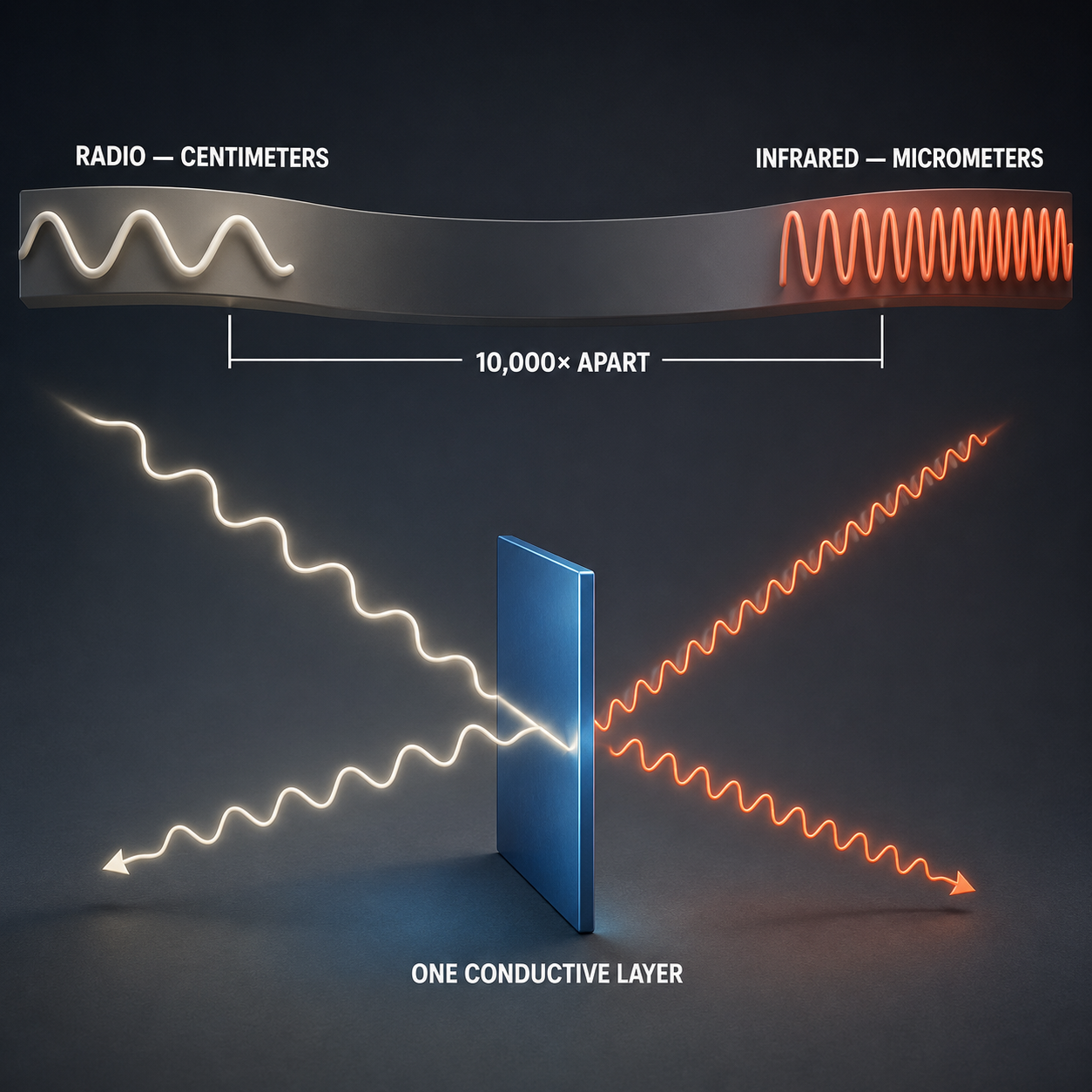
One popular explanation deserves a correction, because it circulates widely in the trade: "metalized film blocks cell signal because radio frequencies fall on the infrared spectrum." That's not how the spectrum works. Radio waves are centimeters long; infrared waves are micrometers — about ten thousand times shorter. They are nowhere near each other. What they share is not a band but a cause: one conductive layer reflects both. Same mirror, very different waves.
This is also why metalized film earns its keep on price. Reflection is the most efficient way to reject heat — a reflected wave leaves entirely, while a film that absorbs heat (the dyed and, partly, ceramic approach) warms up and re-releases a portion of that heat inward. And the machines that deposit metal onto film have been running at industrial scale for decades, so the film is cheap to make. High rejection, low cost — that's the honest case for it, especially in hot climates. One caveat when you compare numbers: the only fair yardsticks are the standardized whole-spectrum ones, TSER (total solar energy rejected) or SHGC. A "98% IR rejection" claim measured at a single convenient wavelength is a marketing number, not a comparison.
The trade-off does come in degrees. Interference scales with how conductive and continuous the metal layer is — a heavy mirror-finish aluminum layer blocks the most; thinner, more resistive, or patterned layers block less. Modern spectrally selective films use ultra-thin sputtered metal stacks that pass visible light and skip the mirror look, but they're still conductive, so some effect remains. The only films with no interference by this mechanism are the non-conductive ones: ceramic, carbon, and dyed. That's the cleanest dividing line in the whole category — not brand, not price, but conductive versus not. (You'll also hear that metalized film "only lasts a few years" before it corrodes. The underlying chemistry is real — exposed thin metals can oxidize, usually starting at cut edges — but the specific lifespan numbers floating around come from sales material, not studies, so treat them as unverified.)
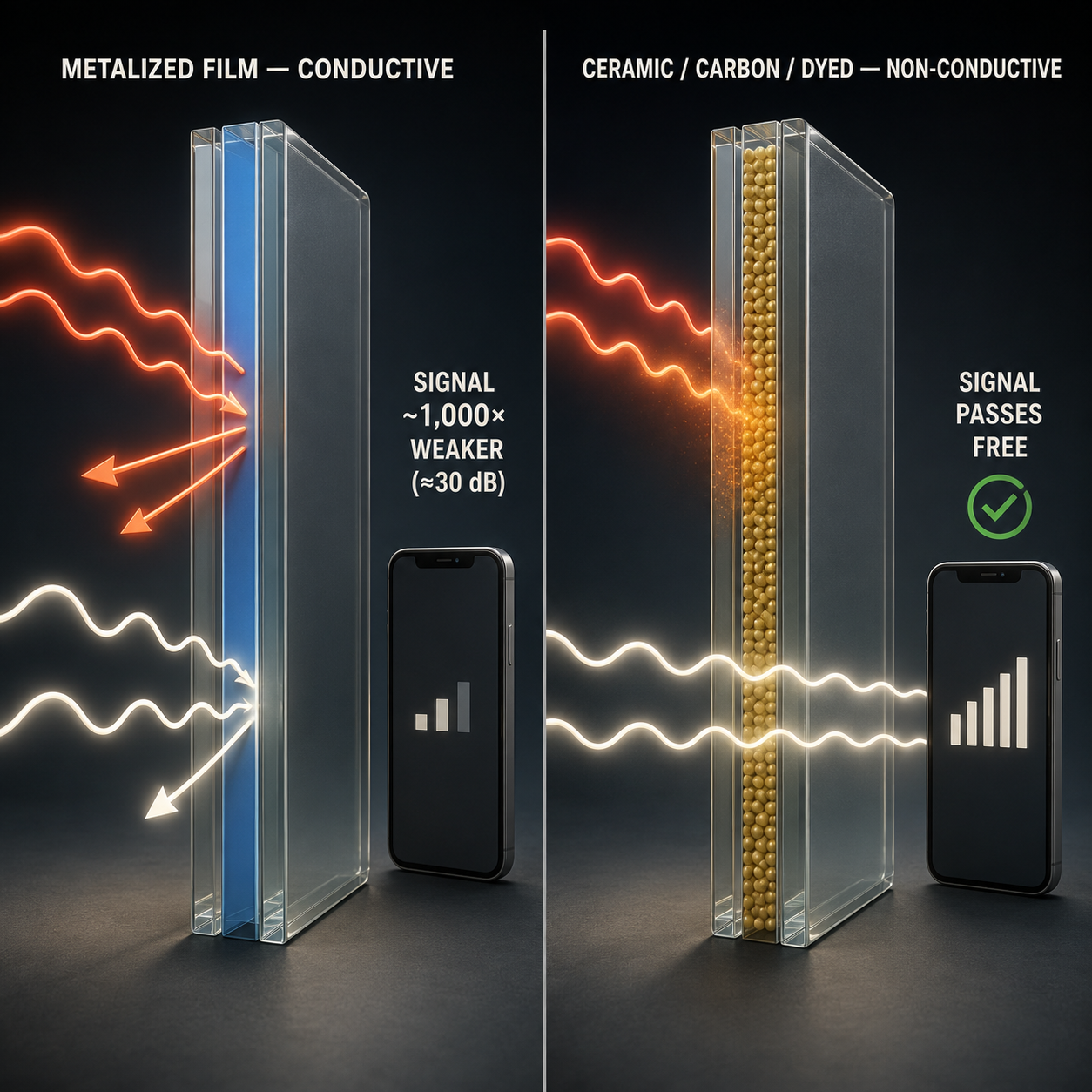
So the reputation is accurate — it's just usually told wrong. Metalized film isn't a good film with a defect. It's one piece of physics with two faces: the free electrons that mirror away the sun's heat mirror away your phone signal with exactly the same enthusiasm. If maximum heat rejection per dollar is the goal and the signal loss doesn't bother you, it remains a rational choice. If your key fob, GPS, or phone matters, the physics has already made the decision: you want a non-conductive film. The mirror can't tell the difference between the sun and the cell tower — and no one can build one that does.
New here? Window Film Facts breaks down the physics of the sun's energy and what window film actually does with it — no hype, just the science. Learn it one chapter a day by email, and if there's something we haven't covered yet, ask us your question.