
Window Film Adhesive: Half of What Gets Blamed on the Glue Isn't the Glue
The adhesive is the most blamed and least understood layer in a window film. Bubbling, peeling, that purple cast an old film takes on, the milky haze that creeps in over years — all of it tends to get pinned on "bad glue." Some of it genuinely is. A lot of it isn't. And the useful part is that a failing film usually tells you which, right there on the glass, if you know what you're reading. It helps to start by retiring the phrase "glue on the back," because the adhesive isn't just what holds the film up — it's a working layer of the film, and it's often where the film's UV absorbers actually live.
Start with a fact that quietly resolves half the confusion: a film isn't one sheet with glue behind it, and it doesn't have one adhesive. It's a laminated stack, and there are two different adhesives doing two different jobs. The mounting adhesive bonds the whole film to the glass. A separate laminating adhesive bonds the film's own inner layers to each other. When someone says "the adhesive failed," they almost never say which one — and the two fail in completely different places. Mounting-adhesive trouble shows up at the glass: edges lifting, bubbles, a panel letting go. Laminating-adhesive trouble shows up inside the film: a milky haze, cloudiness, layers separating from one another. Same word, two culprits, two locations.
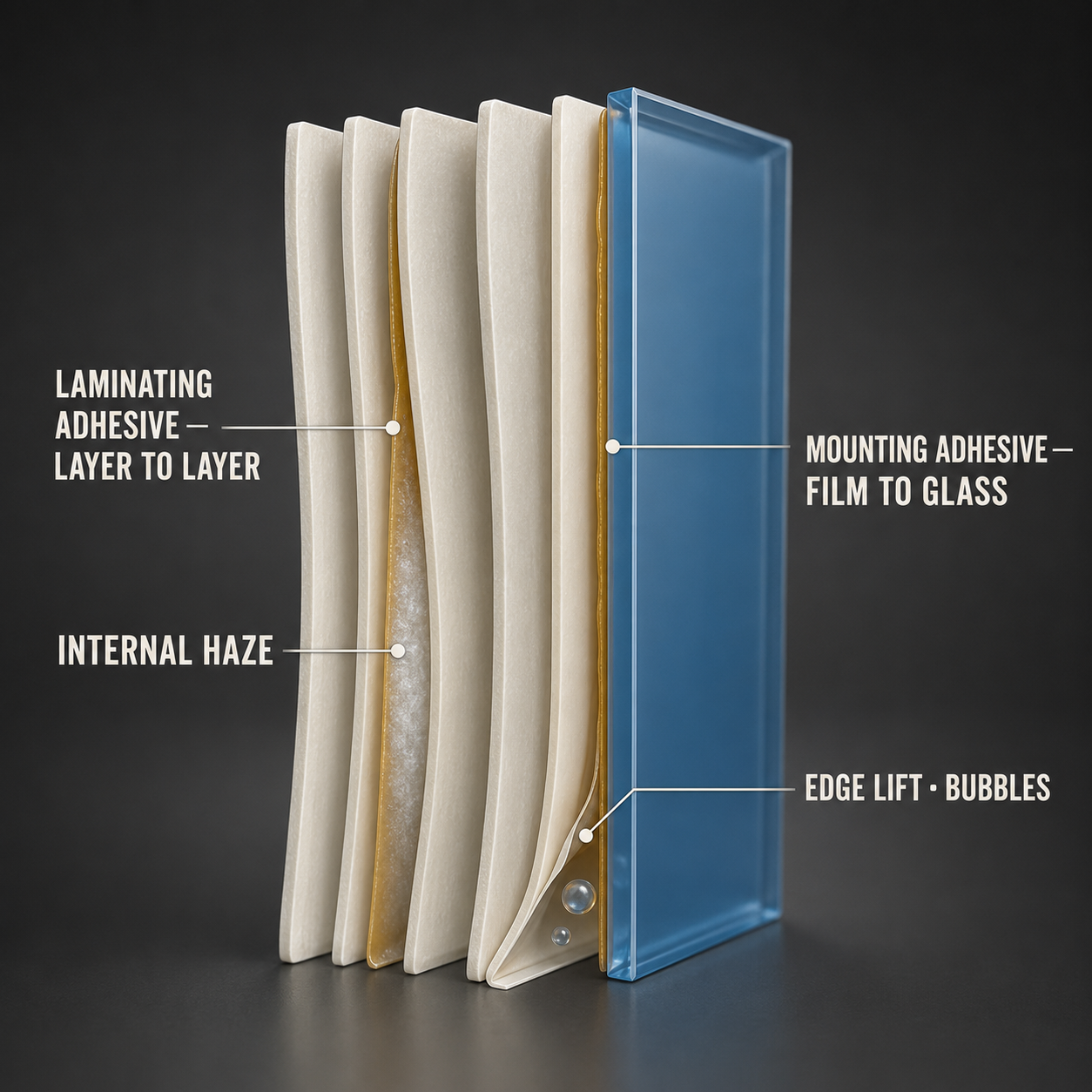
A quick tour of what the adhesive actually is. The permanent films you'd have installed use one of two systems. Pressure-sensitive adhesive is tacky the instant the liner peels off and grabs fast — good for the curves and defroster lines of auto glass. Dry adhesive is dried at the factory so it isn't tacky to the touch; the mounting solution wakes it up and it builds its bond over a cure period, which makes it forgiving on big flat panels you need to slide into place. (Static-cling films are a third thing entirely — they aren't glued at all, just held by surface contact, and are meant to come off.) That soap-and-water spray the installer uses isn't for cleaning, by the way: it briefly defeats the bond so the film can be floated into position and squeegeed, after which the fluid is worked out and the bond sets. Most of these adhesives are acrylics, and the thing that really decides how long one lasts is crosslinking — how tightly the acrylic is chemically knitted together. It's invisible on the shelf and never printed on a label, but a well-crosslinked adhesive resists yellowing and aging that a poorly crosslinked one doesn't.
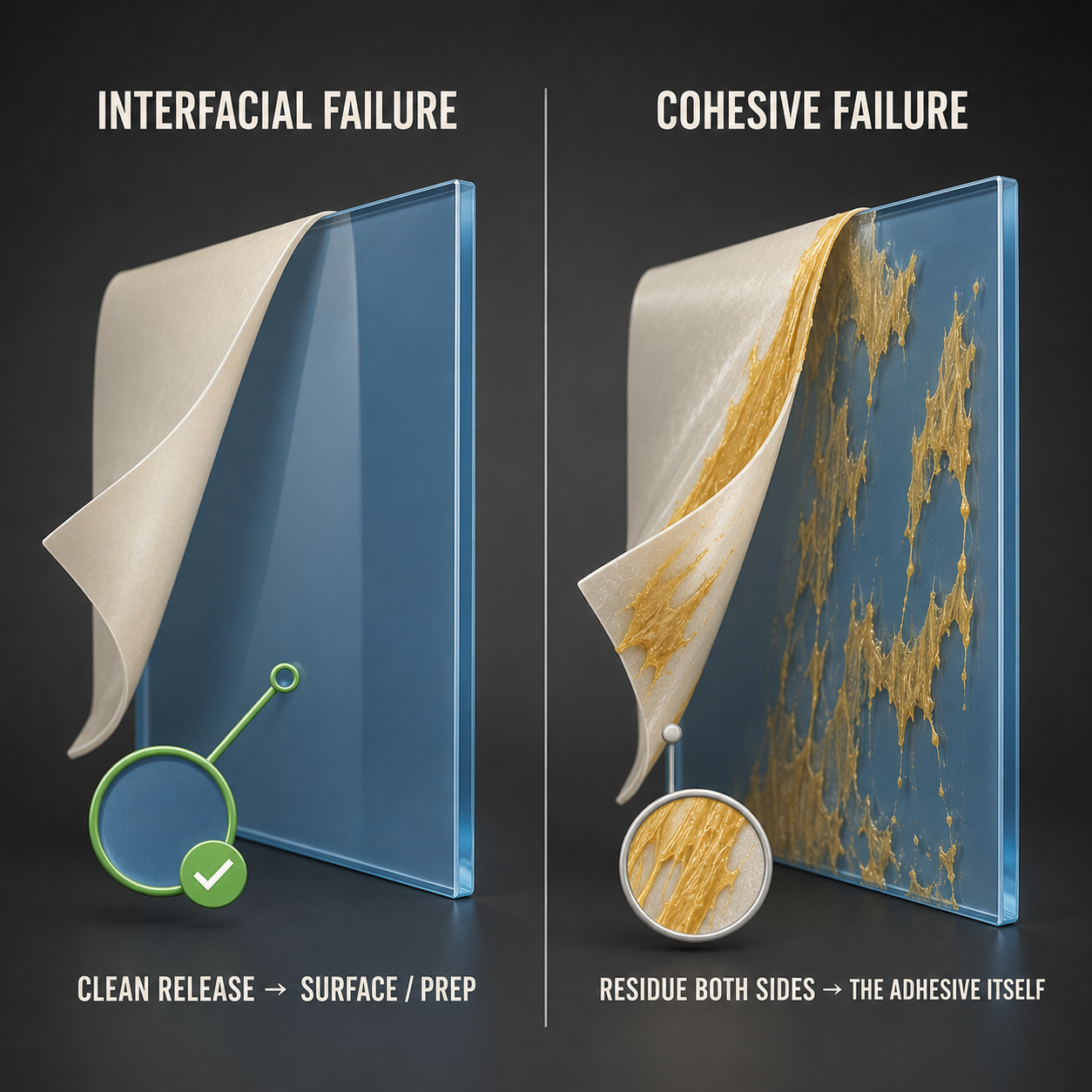
Now the part worth memorizing, because it's how the pros actually diagnose a failure. When any glued joint gives out, it does so in one of a couple of tell-tale ways, and adhesion scientists read them like a fingerprint. Peel a failed film off and look at the glass. Clean release, almost no residue means the bond let go at the interface — this is called adhesive failure, and it points to the surface, not the glue: contamination, poor prep, a panel that never fully bonded to begin with. Adhesive gunk left on both the glass and the film means the adhesive layer tore down its own middle — cohesive failure — and that points to the material itself: under-cured, spread too thick, or simply aged out. One says the interface was wrong. The other says the glue reached its limit. Same film on the floor, two different stories.
There's also a reason failure almost always starts at the edges, and it's pure physics. Adhesives are enormously strong when you try to shear them sideways or pull them straight off, and weak when you peel them — think how hard it is to pull a sticker straight up off a table versus lifting one corner and rolling it back. The edge of a film is the one spot where the bond is loaded in peel, so it's always the first place to give. That's why the usual triggers are edge events: a car wash catching a lip, a harsh cleaner or fuel wicking under the perimeter, or just years of heat cycling fatiguing the outer inch.
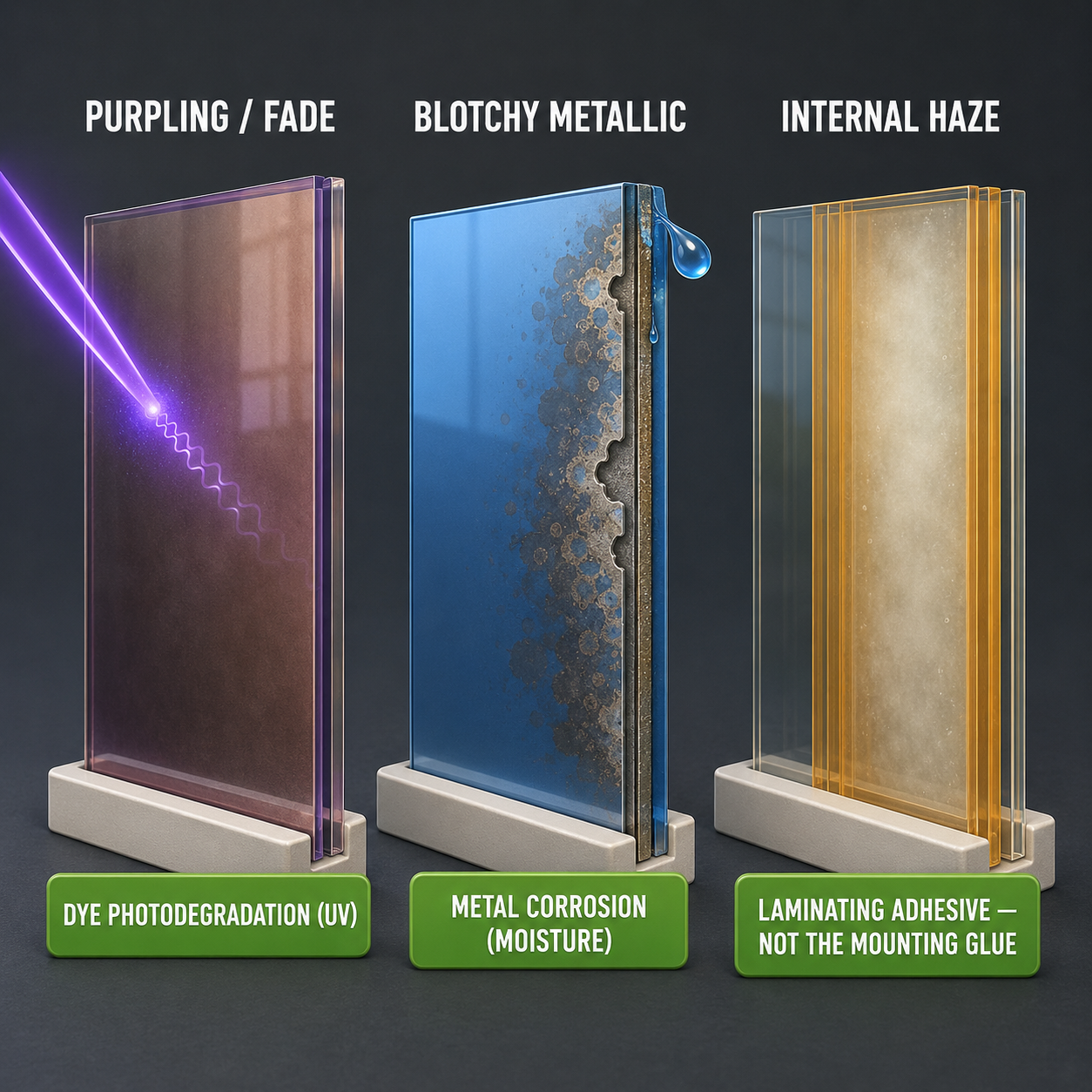
Then come the misattributions — the failures that get blamed on glue but come from other layers entirely. The film that turned purple or brown? That's the dye photodegrading under UV, a failure of the color layer, and it has nothing to do with the bond. A metallic film that developed clear or coffee-stain blotches? That's the wafer-thin metal layer corroding where moisture reached it; the adhesive's job there was to seal the moisture out, but what you're seeing is corrosion, not glue. Milky cloudiness inside a film is usually the laminating adhesive between plies, not the mounting adhesive on the glass. Even bubbling splits in two: tiny bubbles in the first days are just trapped mounting solution working its way out as the adhesive cures, and they typically clear on their own; bubbles that show up months later and keep spreading are the real thing — the bond to the glass actually breaking down. Different bubble, different cause, different fix.
This is also where the marketing gets slippery, so it's worth a plain word. Adhesive gets sold under names — "CDF," "AB," "detackified," "premium bond" — that sound like standardized categories but aren't; no standards body defines them and they drift from shop to shop. The honest way to compare two adhesives is the same boring way a lab does it: standardized peel strength (ASTM D3330), shear or holding power (ASTM D3654), tack, and accelerated aging that bakes a bond at heat and humidity to see whether it still holds. A "strongest adhesive" claim with no number behind it is language, not a measurement. And one last honest caveat: a film looking fine tells you almost nothing about the glue underneath — the mounting adhesive can be quietly aging while the surface still looks perfect, and a film can look great while its UV blocking is long gone.
So the next time a film bubbles, hazes, purples, or lifts, the useful question isn't "is the adhesive bad." It's which layer actually failed — because the film leaves the answer on the glass. The glue does fail, at the edges, driven by heat and moisture and time. But at least half of what gets pinned on it was never the glue at all.
New here? Window Film Facts breaks down the physics of the sun's energy and what window film actually does with it — no hype, just the science. Learn it one chapter a day by email, and if there's something we haven't covered yet, ask us your question.