
Home  /  Posts
installation·August 14, 2026

Why Window Film Goes on the Inside of the Glass

Almost every window film you'll ever have installed goes on the inside of the glass, and to a lot of people that feels backwards. The sun is outside. The heat is outside. If you're trying to stop something, wouldn't you stop it at the outside surface, before it ever gets in? It's a fair question, and installers rarely answer it well because to them it isn't a question at all. The real answer is worth hearing, because it isn't a shortcut or an installation convenience. It's a deliberate division of labor between two materials, and it goes like this: glass is the tougher of the two, and the side of the glass that faces the world is a genuinely hostile place. Put the film behind the glass and each material gets to do the job it's actually good at.

Start with what the two things are, physically, because the mismatch is bigger than people picture. Window film is polyester — PET — usually a few thousandths of an inch thick, laminated in layers, with a scratch-resistant hard coat on the face you can touch. That hard coat is real engineering, but it's typically only about 6 to 8 microns thick: roughly a tenth of a human hair. Glass, meanwhile, is a few millimeters of soda-lime silicate that sits around 5.5 to 6 on the Mohs hardness scale, and it was designed from the start to be the surface that faces weather. Bare polyester isn't remotely in the same class — in lab testing, uncoated PET film registers a pencil hardness of 9B or softer, which is about as soft as that scale goes. Coatings close some of that gap. They don't close all of it. If one of these two materials has to be the armor, there's no argument about which one it is.
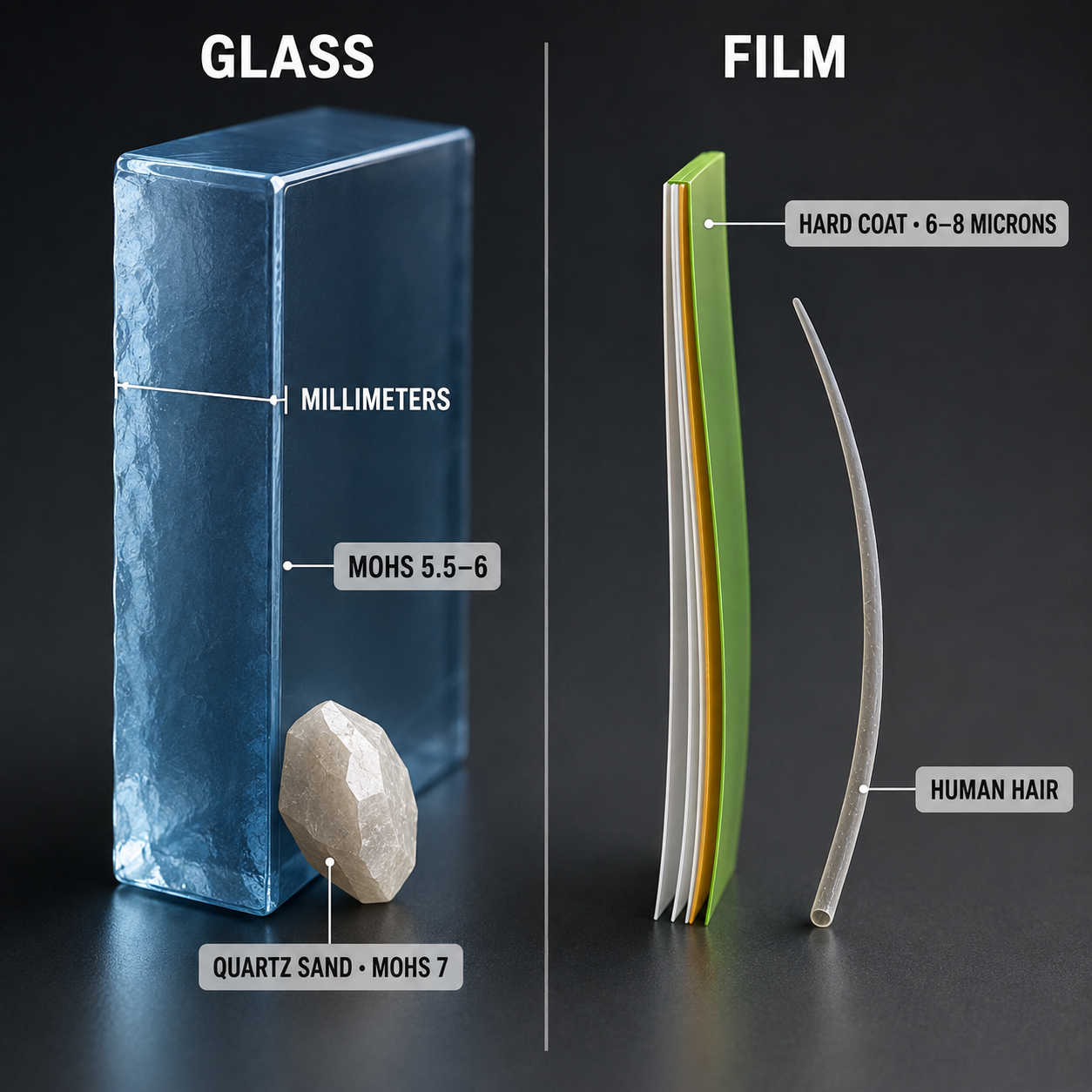
Cross-section comparison: a thick glass pane with its hardness called out, beside a paper-thin film stack whose hard coat is only microns thick.
The Glass Is the Armor Glass is millimeters of hard mineral. The film's toughest layer is microns of polymer — about a tenth of a human hair.

Now look at what the armor is actually up against, because "outside" is a much rougher environment than it sounds. Ordinary windblown quartz sand sits at about a 7 on the Mohs scale — harder than the glass itself, which is exactly why grit scratches windows and windows don't scratch grit. Researchers have measured what that does over time: in a 2021 study in Materials, float glass panels were sandblasted at realistic wind-driven velocities, and their visible light transmittance fell steadily from a starting 92.34%, with roughly a 2.1% drop in light transmission for every 1% of surface area damaged. That's sand slowly frosting glass. A polymer surface in the same position doesn't do better; it does worse, and it does it faster.

Then there's the part unique to cars: wipers. A wiper is the one device we deliberately drag back and forth across the outer glass, thousands upon thousands of times, and it doesn't sweep grit away so much as it carries grit with it. That's why abrasion testing for automotive glazing literally loads a wiper blade against a sample with standardized test grit and counts cycles. Washer fluid isn't just for visibility — it floats the particles so the blade can carry them off instead of grinding them in. Put a soft polymer where the glass is and you've put it directly under that squeegee.

The chemistry outside is just as relentless. Iron fallout — the fine metallic dust that makes a car's paint feel gritty — is dominated by brake wear, which peer-reviewed work identifies as one of the largest non-exhaust traffic sources, contributing somewhere between 16% and 55% of non-exhaust traffic PM10, with iron oxides as the major component of the debris. Those particles land hot, sit, and oxidize in place. On glass, that's a solvable problem: you dissolve them with an iron remover or shear them off with a clay bar, and the glass shrugs. On a film surface, that same aggressive chemical-and-mechanical decontamination is precisely what you're told never to do.
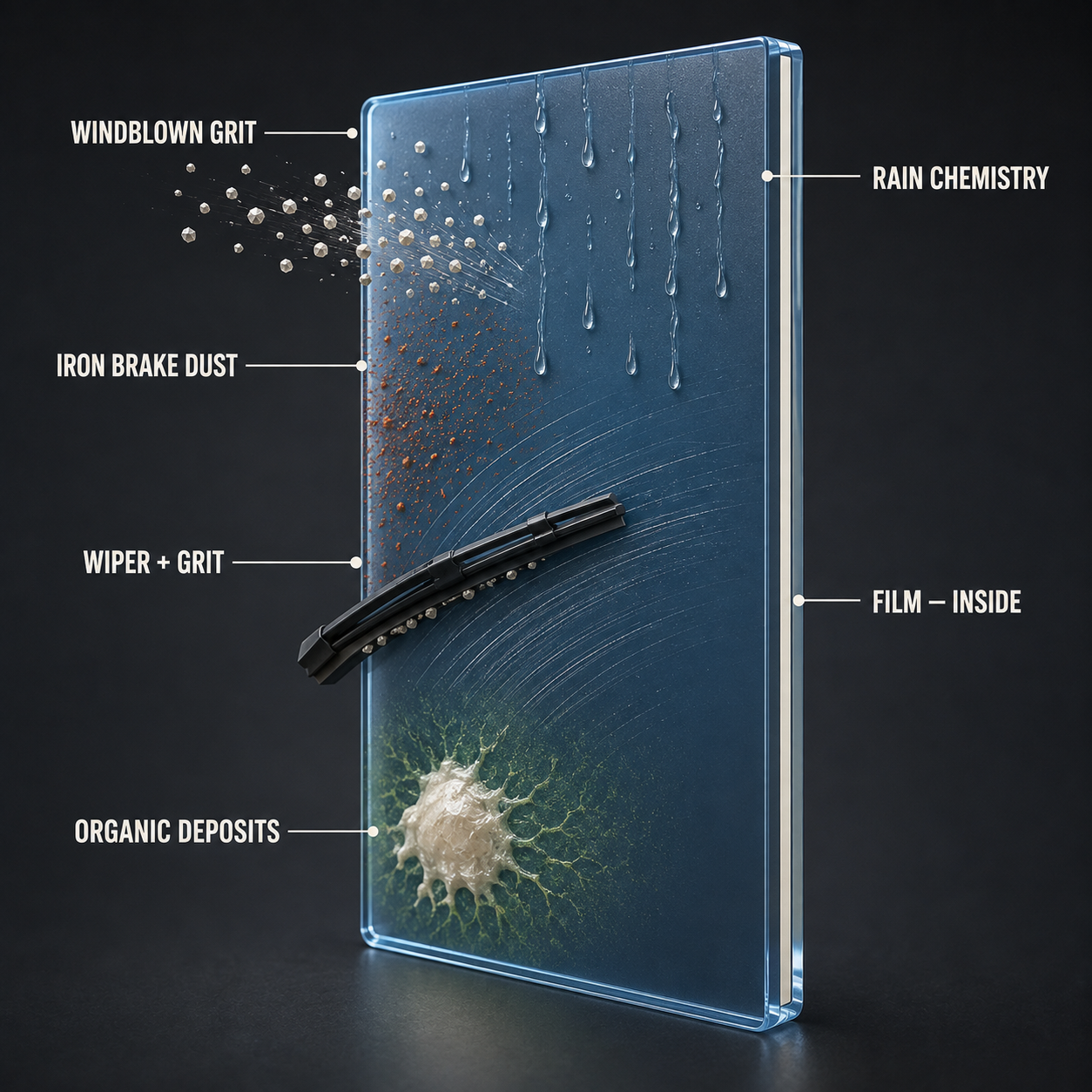
The outer surface of a glass pane facing a converging barrage of sand grains, iron particles, a wiper blade, rain droplets, and an organic splash.
What the Outside Actually Throws At It Quartz grit, iron brake dust, wiper-dragged sand, rain chemistry, and enzyme-loaded organic deposits — all of it lands on the outer face.

Organic deposits — what birds leave behind, tree sap, insect residue — deserve their own note, because the mechanism isn't what most people assume. It's tempting to say "it's acidic," but a Journal of Coatings Technology and Research study that actually measured it found the pH of real droppings sitting around 6.25, close to neutral, and traced the damage instead to enzymes driving hydrolytic degradation — chemistry that etched the automotive clearcoat it landed on. That's worth flagging honestly: that study tested a car's clearcoat, not window film, so treat it as a well-founded analogy rather than a measurement on film. But it's a pointed analogy, because polyester is an ester polymer, and hydrolysis is the exact reaction that unzips it. And in case you think glass gets off free: it doesn't. Conservation-science studies of weathered glass find rainwater slowly leaching sodium and calcium out of the surface, leaving alkali-depleted layers tens of nanometers deep. The hardest material in the whole assembly is itself being quietly etched by rain. That's the neighborhood we're deciding whether to put a polymer in.

Here's the part that surprises people most, though: even the sunlight argues for the inside. You'd think a film wants to meet the sun first. It doesn't. PET's absorption of UV starts below about 360 nm, climbs sharply below 320 nm, and peaks hard between 280 and 300 nm — meaning the short-wavelength UV is what really tears polyester apart. And clear soda-lime glass transmits essentially nothing below about 315 nm; it stops UVB cold, passing along mostly the gentler UV-A. So mounting film behind glass means the wavelengths that damage the film most never reach the film at all. The glass is acting as a UV pre-filter for the very material it's protecting. A large accelerated-weathering study of PET film published in PLOS One found that photodose was the primary degradation stressor, with moisture amplifying the effect — and putting film on the interior removes a big share of the first and nearly all of the second, since the inside face of a window doesn't get rained on.
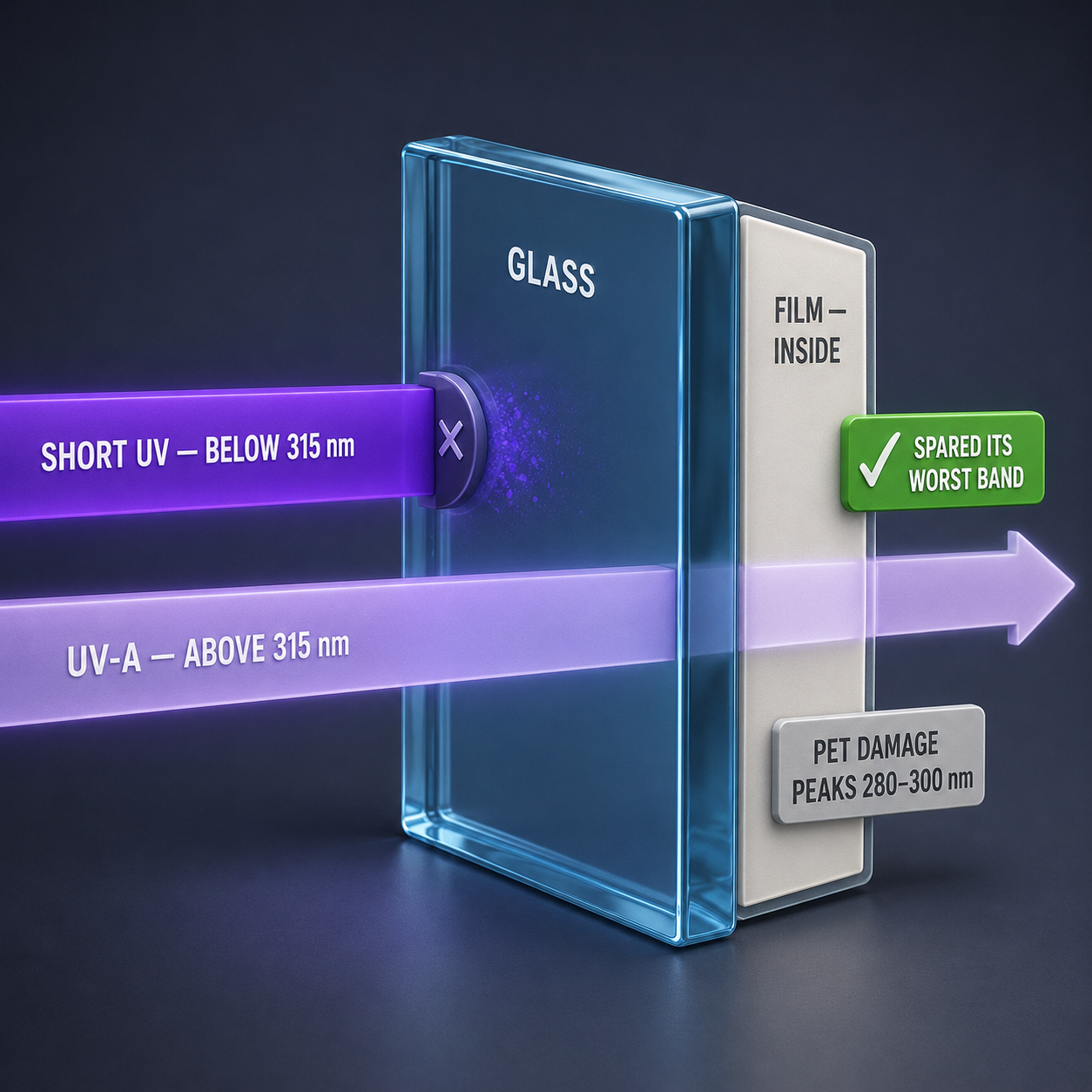
A UV beam meeting a glass pane: the short-wavelength portion stops at the glass, longer UV-A continues to the film mounted behind it.
The Glass Filters the Film's Worst Enemy Polyester degrades hardest under the short UV below 315 nm — exactly the band ordinary glass has already stopped.

All of that theory has a number attached, and it's a blunt one. Window film patents — from Eastman Performance Films, formerly CPFilms, so this is the industry describing its own materials in a legal document rather than an ad — state plainly that exterior window film has historically had a service life on the order of about 24 months, and that a typical film in accelerated weathering fails at 600 to 900 hours from loss of adhesion between the hard coat and the base film, at which point the coating cracks and flakes off. The improved constructions those patents claim push things to 3,000-plus hours, or roughly 5 to 7 years — and they get there by adding an adhesion-promoting undercoat, UV absorbers loaded into the substrate, and a UV-cured urethane-acrylate hard coat. Compare that to interior film, which manufacturers routinely warrant for 10 to 15 years in commercial glazing and often for the life of the vehicle in automotive. Same technology, same companies, same sunlight. The variable is which side of the glass it's on.
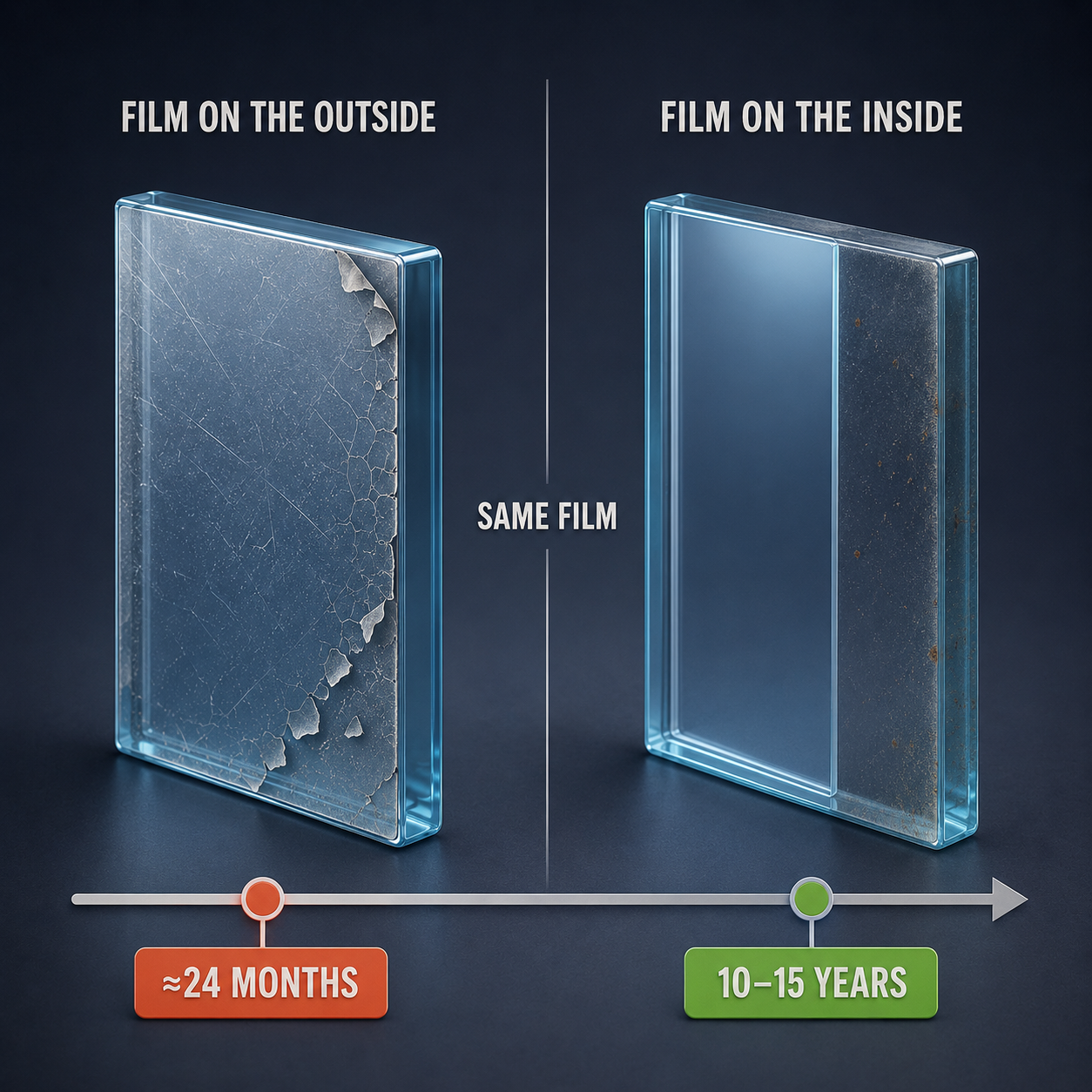
Two identical film-on-glass panels on a timeline: the outside-mounted one cracking and flaking early, the inside-mounted one still clear years later.
Same Film, Two Lifespans Exterior-mounted film has historically served about 24 months. Interior film is routinely warranted 10–15 years.

So does exterior film exist? Absolutely, and for good reasons — it just isn't the default, and it isn't interior film flipped around. It's used where there's no interior access to the glass at all, and, importantly, where an interior heat-absorbing film would be risky: on some insulated or laminated units, a film that absorbs energy on the inboard pane can drive that pane's temperature and thermal stress up, raising the risk of glass fracture or seal failure, so the film is moved outside to reject the energy before the assembly ever absorbs it. That's a real engineering trade — you accept a shorter service life to solve a bigger problem. And there's one more category where inside isn't even optional: safety and security film, whose entire job is to hold broken glass together toward the occupied side, has to be on the occupied side to do it.

Which brings it back to the simple version, the one that's worth handing a customer. Glass is hard, weatherproof, chemically stable, replaceable, and already built to stand in the weather — so let it take the sand, the brake dust, the wipers, the rain, and the bird strike. Film is a precision optical material whose job is managing energy, not surviving a sandstorm — so put it behind the armor where it can do that job for a decade or more. Inside isn't a compromise. It's the assignment.

New here? Window Film Facts breaks down the physics of the sun's energy and what window film actually does with it — no hype, just the science. Learn it one chapter a day by email, and if there's something we haven't covered yet, ask us your question.

Sources & further reading

Every claim above is checked against independent, citable sources — chemistry and optics references, patents, standards bodies, and peer-reviewed work — kept here so you can verify it yourself.

Peer-reviewed literature — abrasion & erosion of glass

  • Zhao, Y., Liu, R., Yan, F., Zhang, D. & Liu, J. "Windblown Sand-Induced Degradation of Glass Panels in Curtain Walls." Materials 14(3):607 (2021). DOI 10.3390/ma14030607. (Sandblasting of 6 mm float glass at 17.4–35.3 m/s; cutting / smashing / plastic-deformation damage modes; visible light transmittance falling from an initial 92.34%; ≈2.1% transmission loss per 1% of damaged area.)
  • "Revealing the surface structural cause of scratch formation on soda-lime-silica glass." PMC8854411. (Scratch-formation mechanism on soda-lime glass surfaces.)
  • "Effect of annealing and chemical strengthening on soda lime glass erosion wear by sand blasting." Journal of the European Ceramic Society (2003), ScienceDirect S0955221902001693. (Sand-blast erosion as the standard method for evaluating erosive resistance of glass.)

Peer-reviewed literature — polymer hardness, photodegradation & hydrolysis

  • "Hardness and Abrasion Resistance Characteristics of Poly(ethylene terephthalate) Films without and with Hard and Adhesive Coatings." Macromolecular Research (2021). DOI 10.1007/s13233-021-9030-7. (Bare PET films show very low hardness and abrasion resistance — pencil hardness ≤9B even at low load; substantially improved by thin UV-curable acrylic hard coatings.)
  • "Predictive models of poly(ethylene-terephthalate) film degradation under multi-factor accelerated weathering exposures." PLOS One (2017). DOI 10.1371/journal.pone.0177614. (PET degrades via photolytic and hydrolytic cleavage of ester bonds — molecular weight loss, discoloration, haze; photodose is the primary degradation stressor and moisture increases the effect.)
  • "Multivariate multiple regression models of poly(ethylene-terephthalate) film degradation under outdoor and multi-stressor accelerated weathering exposures." PMC6301690. (Companion outdoor-exposure modeling of PET film degradation.)
  • Yari, H., Mohseni, M. & Ramezanzadeh, B. "A mechanistic study of degradation of a typical automotive clearcoat caused by bird droppings." Journal of Coatings Technology and Research 8 (2011). DOI 10.1007/s11998-010-9273-2. (Measured pH of natural droppings ≈6.25 and pancreatin ≈6.3 — near neutral; enzymes, not acidity, drive the catalyzed hydrolytic degradation and surface etching of the clearcoat. Tested on automotive clearcoat, not window film — used here as an analogy for hydrolytic attack on ester polymers, and flagged as such in the copy.)
  • "Investigating the degradation resistance of silicone-acrylate containing automotive clearcoats exposed to bird droppings." Progress in Organic Coatings (2012), ScienceDirect S0300944012001105. (Follow-up work on the same degradation mechanism.)

Peer-reviewed literature — glass weathering by rain / atmosphere

  • "Potash-lime-silica glass: protection from weathering." npj Heritage Science (2015). DOI 10.1186/s40494-015-0051-4. (Water is the main environmental factor in glass durability; rain and humidity cycling drive surface attack.)
  • "Degradation of Traditional Silicate Glass and Protective Coatings Under Simulated Unsheltered Conditions." Heritage 9(1):2. DOI 10.3390/heritage9010002. (Leached layers tens of nanometers thick, depleted in sodium and calcium and enriched in silica; unsheltered samples weather more than sheltered ones.)
  • "Glass corrosion mechanisms: A multiscale analysis." Journal of Non-Crystalline Solids / ScienceDirect S0167273808005365. (Ion-exchange leaching of network-modifying alkali ions at low pH.)

Peer-reviewed literature — iron fallout / brake wear particles

  • Grigoratos, T. & Martini, G. "Brake wear particle emissions: a review." Environmental Science and Pollution Research 22 (2015): 2491–2504. DOI 10.1007/s11356-014-3696-8 (also PMC4315878). (Brake wear contributes 16–55% of non-exhaust traffic-related PM10 and 11–21% of total traffic-related PM10; debris is mainly oxidized metals with iron oxides as the major component.)
  • "Iron Oxide and Hydroxide Speciation in Emissions of Brake Wear Particles from Different Friction Materials Using X-ray Absorption Fine Structure." Atmosphere 15(1):49 (2024). DOI 10.3390/atmos15010049. (Iron is the dominant contributor to brake-wear PM10 and PM2.5 for both tested friction material types.)
  • "Brake wear-derived particles: Single-particle mass spectral signatures and real-world emissions." PMC10011745. (Fe, Cu, Ba, Sb as real-world brake-wear tracers.)

UV transmission of glass

  • Almutawa, F. et al. "Current status of photoprotection by window glass, automobile glass, window films, and sunglasses." Photodermatology, Photoimmunology & Photomedicine 29(2) (2013). DOI 10.1111/phpp.12022. (Comparative UV transmission of glass types and films.)
  • "The role of glass as a barrier against the transmission of ultraviolet radiation: an experimental study." Photodermatology, Photoimmunology & Photomedicine (2009), PubMed 19614895. (All tested glasses blocked UVB completely; clear tempered glass transmits only wavelengths longer than ~315 nm while passing roughly 70% of UV-A.)

Patent literature — exterior film construction and service life

  • USPTO 8,999,509 — "Weather resistant exterior film composite," Eastman Performance Films LLC (formerly CPFilms), granted 2015-04-07. (Prior exterior window films fail at 600–900 hours of accelerated weathering from loss of adhesion between the hard coat and the base film, giving ~18–24 months of service before the coating cracks and flakes; failure modes include yellowing, embrittlement, delamination, distortion, fading and loss of solar/optical performance; UV stabilizers required to quench excited states and scavenge photodegradation radicals; improved single-coat construction exceeds 3,000 hours ≈ 5–7 years.)
  • USPTO 9,303,132 — "Exterior window film," Eastman Performance Films LLC (formerly CPFilms), granted 2016-04-05. (Exterior window film "typically has a service life in the order of about 24 months," failing through loss of hard-coat adhesion to the base substrate; construction = UV-absorber-loaded PET substrate + 6–12 µm water-based acrylic-urethane undercoat + 6–8 µm UV-cured urethane-acrylate hard coat, with the undercoat at least as thick as the hard coat.)
  • USPTO 12,534,636 — "Exterior window film." (Later exterior-film construction: transparent substrate, hard coat on the exposed side, pressure-sensitive adhesive on the glass side; rain, wind and temperature change deteriorate the hard coat layer.)
  • USPTO 6,602,447 — "Low-color ultraviolet absorbers for high UV wavelength protection applications." (PET absorption of UV begins below ~360 nm, increases markedly below 320 nm and is very pronounced below 300 nm, with maximum absorption between 280 and 300 nm; UV from 280–400 nm induces yellowing and mechanical property loss in polyesters.)
  • USPTO 12,122,714 — "Glass with unique fracture behavior for vehicle windshield." (Windshield abrasion testing protocol approximating repeated wiper contact: 4"×4" samples, 100 cycles of a wiper blade under a 250 g load with standardized test grit.)

Standards / test-method bodies

  • ASTM D1044 — Standard Test Method for Resistance of Transparent Plastics to Surface Abrasion by the Taber Abraser. (Abrasion quantified as percent increase in haze per Test Method D1003; CS-10F wheels under a 500 g load.)
  • ASTM F735 — Standard Test Method for Abrasion Resistance of Transparent Plastics and Coatings Using the Oscillating Sand Method. (The sand-abrasion method specifically written for clear plastics and coatings used in windows and viewing ports.)
  • ANSI Z97.1 — Safety Glazing Materials Used in Buildings. (Soft-body impact test — 100 lb impactor; Class A 48" drop ≈400 ft-lb, Class B 18" drop ≈150 ft-lb — rating a film's ability to retain glass fragments; cited for why safety/security film is applied to the occupied interior side.)

Manufacturer / trade material — labeled as product claims, not physics authority

  • 3M Safety & Security Window Film technical data sheets and architectural specification section 08 87 16. Manufacturer literature, cited for interior safety film being specified for application to the interior glass surface.
  • Interior vs. exterior film warranty ranges (interior commonly 10–15 years; exterior commonly 5–10 years) are widely stated across manufacturer warranty documents and dealer literature. Treated as commercial warranty terms, not measured performance — the measured service-life figures in this post come from the patent literature above.