What Actually Fades Your Floors and Furniture
Everybody has seen it. You slide the rug over, or lift the lamp that's sat in the same spot for six years, and there it is — a hard-edged rectangle of the original color, surrounded by a floor that's drifted somewhere else entirely. Once you've seen that line, you can't unsee it, and the first question is always the same: what did that? The answer people usually get is "UV," delivered with a lot of confidence and almost no detail. The real answer is more interesting, and in one important respect it's the opposite of what most people are told. The light you can see is doing most of the fading on the things most likely to fade.
Start with what fading actually is, because the word covers several different processes that happen to look alike from across the room. Color exists because certain molecular structures — chromophores — absorb some wavelengths and reflect others. When one of those structures absorbs a photon energetic enough to break or rearrange a bond, the structure changes, and so does the color. That's photodegradation, and it's the mechanism behind a dye going pale. But a floor can also lose its look because the wood itself is breaking down, or because the finish over it is yellowing, or because heat alone has aged the material, or because something in the air reacted with it. Those are different problems wearing the same costume. And one thing is true of all of them: fading is not reversible. The Canadian Conservation Institute puts it plainly — there's no true recovery from faded colors or disintegrated surfaces; restoring that loss means replacing material. Every strategy that follows is about rate, not repair.
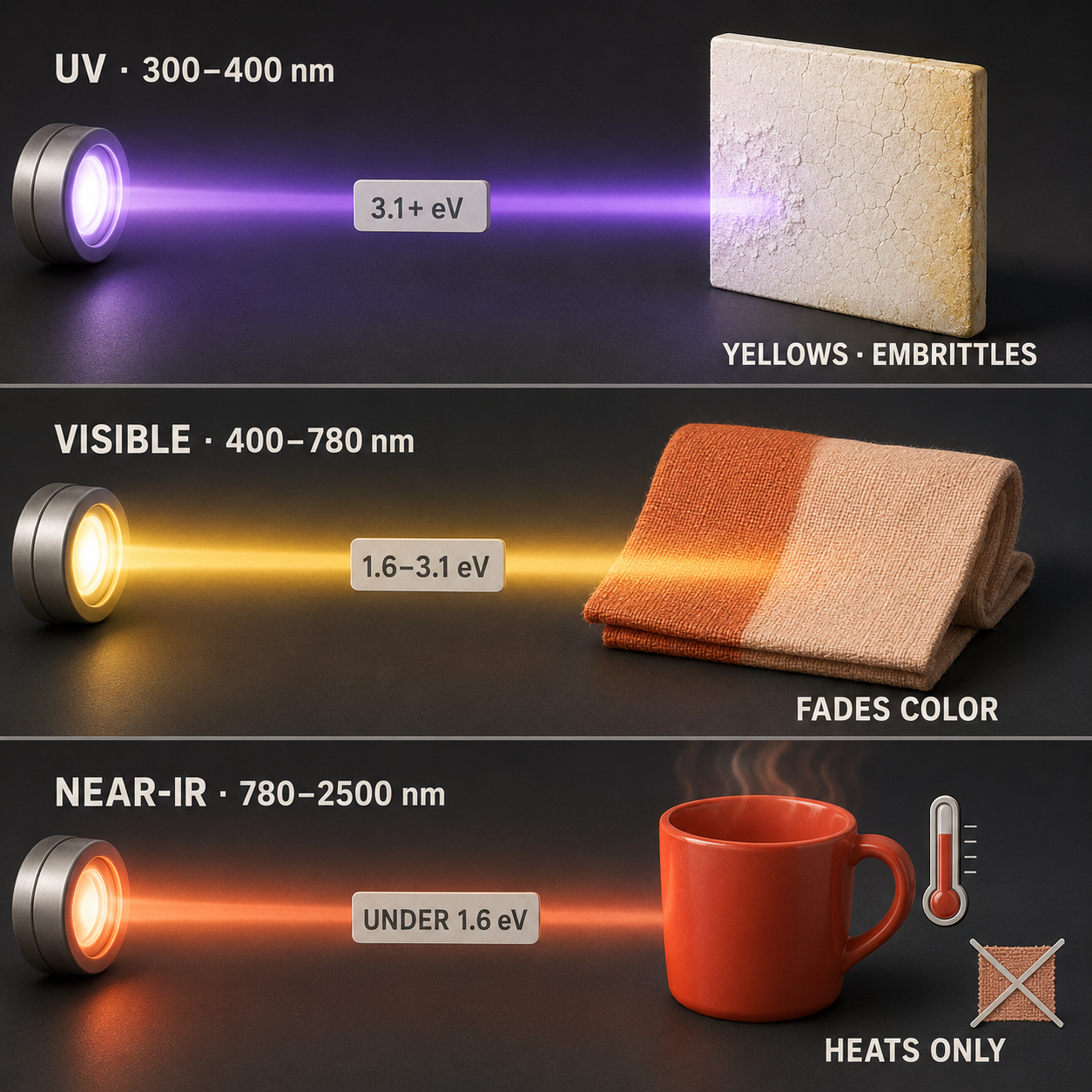
Now the physics, which is refreshingly clean. Only light that gets absorbed can drive a chemical reaction, and the reaction needs a photon carrying enough energy to do the job. That single rule sorts sunlight into three bands with three distinct roles. Ultraviolet (roughly 300–400 nm) carries more than 3.1 electron volts per photon — plenty to attack binders, polymers, and the lignin in wood, producing yellowing, chalking, and embrittlement. Visible light (400–780 nm) carries about 1.6 to 3.1 eV, which is squarely the range that bleaches colorants — the same band your retina uses, which is not a coincidence so much as a cruel symmetry. And near-infrared (780–2500 nm), the band everyone associates with "heat," carries under 1.6 eV. That is not enough to do photochemistry at all. Infrared cannot fade anything. It can only warm a surface, and warming is a separate story we'll get to.
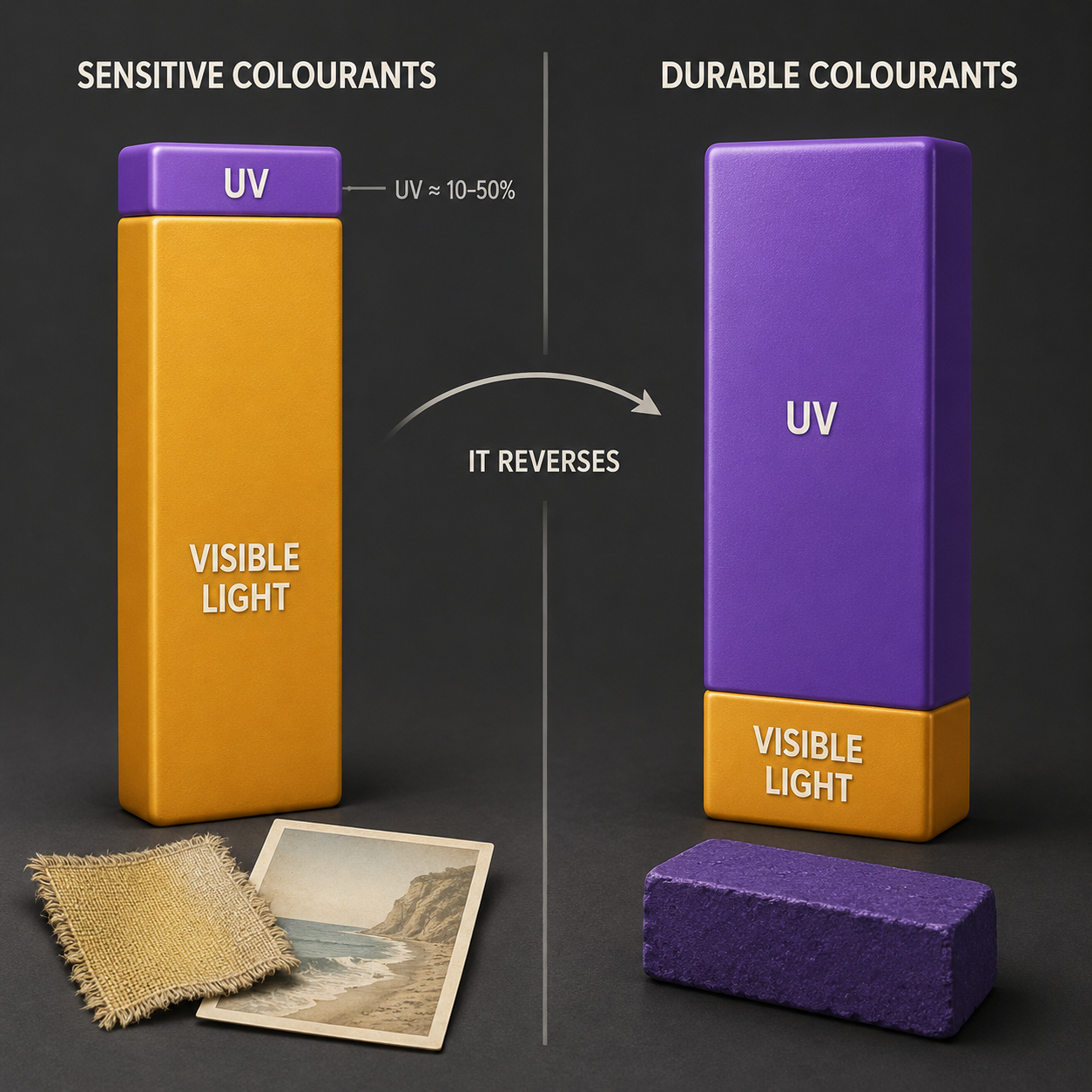
Here's the part that inverts the usual pitch. It is tempting to assume UV is the villain and visible light is a bystander, but CCI states directly that both cause fading and that it is incorrect to think avoiding UV stops it. More specifically: highly light-sensitive colorants are faded mostly by visible light, with only a minor UV contribution — Michalski quantifies it as UV usually contributing less than half, and often about one tenth. For light-durable colorants, the relationship flips and UV genuinely dominates. Read that twice, because of what it implies about your house. The things actually at risk — cheap synthetic dyes, plant-derived dyes, color photographs, marker and ballpoint ink, a lot of ordinary textile dyes — are precisely the materials for which removing UV helps least. The materials UV filtration protects best are the ones that were going to last decades anyway.
Which is a good moment to deal with a graphic you have almost certainly seen: the pie chart claiming UV causes 40% of fading, visible light 25%, heat 25%, and "other factors" 10%. It circulates on hundreds of trade pages, usually attributed to a study nobody links. We went looking for the primary source and could not find one — every instance traced back to another trade page or an unattributed graphic. Worse, the number isn't even well-formed: fading isn't a scalar that sums to 100% across causes. Forty percent of what? Of dose? Of color change? Measured on which material — when material identity is the single biggest variable in the whole problem? And putting heat in the same pie as UV and visible light quietly turns a rate multiplier into a cause, which it isn't. The honest version of that claim does exist: the National Fenestration Rating Council, a standards body, says UV is responsible for about 40–60% of the damage for typical furnishing materials, and lists visible light, artificial light, heat, humidity, fabric age, and dyes as contributors without assigning any of them a percentage. That's the sourced statement. The tidy four-slice pie is not.
So if you can't stop fading, what can you actually do? You can slow it, and there's real math behind that. Damage accumulates with dose — intensity multiplied by time — under what's called the Bunsen–Roscoe reciprocity law, meaning the same total damage results from bright light for a short while or dim light for a long while. This is the entire mathematical basis of "film slows but doesn't stop fading." If a glazing system cuts the damaging light by a factor of three, then the time to reach any given amount of fade is multiplied by roughly three. Not eliminated — deferred. Dose keeps accumulating for as long as light enters the room, so there's no threshold you drop below and become safe. (One honest caveat: microfading studies have found reciprocity holds well for the most stable colorants but deviates for less stable ones, mostly at the high intensities used in accelerated testing. For real daylight through a real window it's a reasonable planning assumption, not an exact law.)
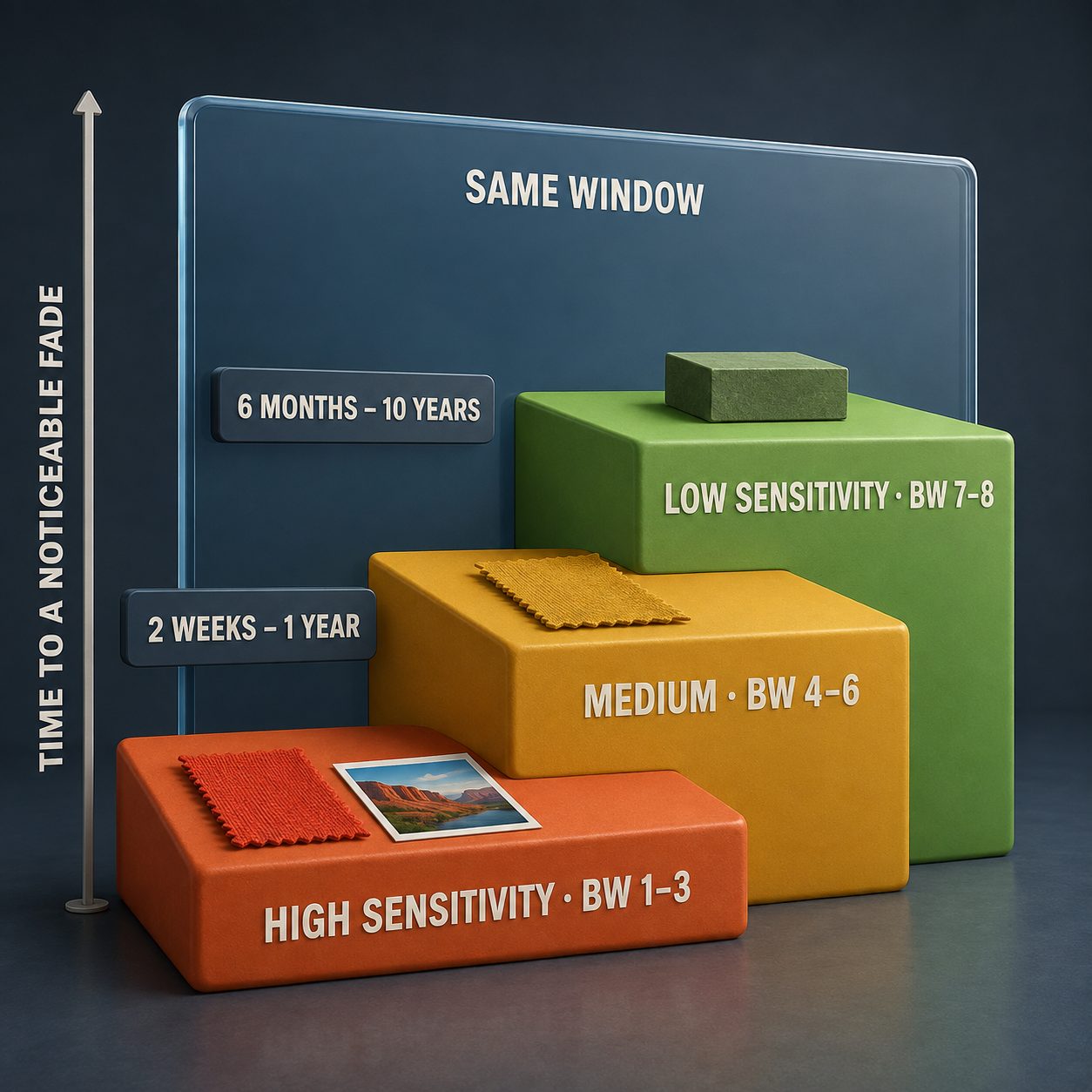
Then there's the variable that dwarfs everything else, and it isn't the window. It's the object. Conservation science rates a colorant's durability against the Blue Wool scale, from BW1 (most fugitive) to BW8 (most stable), where each step is roughly two to three times more durable than the last. At 30,000 lux — average daylight — a high-sensitivity material (BW1–3) reaches a just-noticeable fade in one day to two weeks. A medium one (BW4–6) takes two weeks to a year. A low-sensitivity one (BW7–8) takes six months to ten years. The spread between categories is far larger than the spread within any one of them, which is exactly why two neighbors with the same windows and the same exposure get completely different results. The material sets the order of magnitude. The window adjusts it.
Heat deserves its own paragraph, because the trade gets it wrong in an interesting way. Infrared doesn't fade anything directly — we established that — but it absolutely matters, as a multiplier on every other reaction. Organic materials sitting in sunlight can reach 40 °C, higher if they're dark or behind glass, and per CCI that 20-degree rise over room temperature increases the rate of thermal decay by a factor of at least 20. Sunlight can push surface temperatures 40 °C above ambient or more. On top of that, heat drives its own damage that needs no light at all: yellowing, embrittlement, adhesives and finishes aging in the dark. So heat is not a fourth slice of a pie. It's a dial that turns up whatever else is happening. And this is where solar-control film has a genuine, physically grounded benefit — cutting transmitted solar energy lowers the surface temperature of everything the sun lands on, which turns that dial back down. That's real. It's just not "blocking 25% of fading."
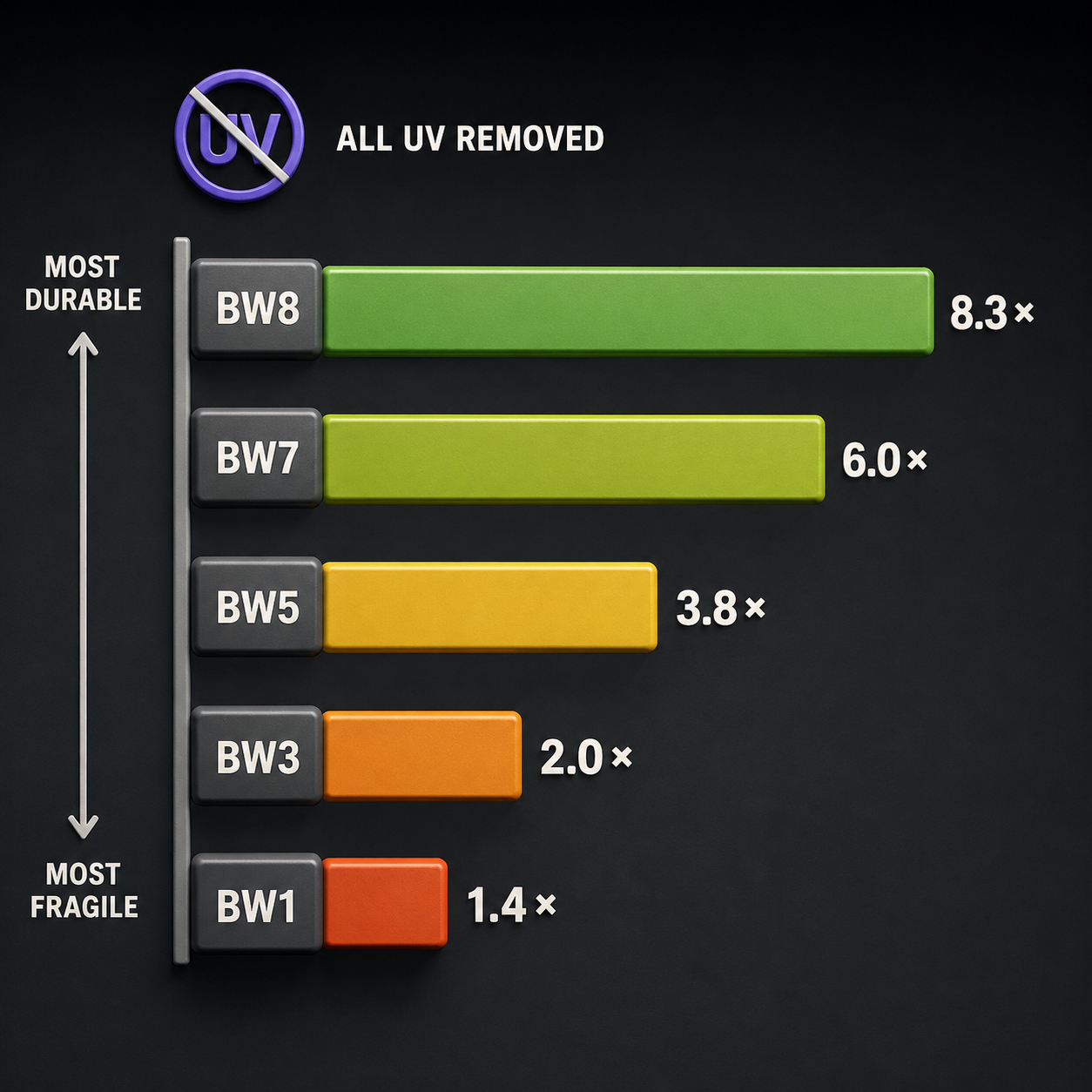
Now the number people actually want: how much does removing UV help? CCI publishes the light dose needed to produce a just-noticeable fade for each Blue Wool standard both with UV present and with UV removed, and dividing one by the other gives you the fade-life multiplier for perfect UV filtration — better than any commercial film achieves. For BW1, the most fugitive materials, it's about 1.4×. BW3 is about 2×. BW5, about 3.8×. BW8, the most durable, about 8.3×. So the range is roughly forty percent more time at one end and eight times more time at the other — and notice the direction: the benefit is largest exactly where the risk is smallest. The commonly repeated trade figure that blocking all UV slows fading "by about a factor of three" sits right in the middle of that range and is broadly consistent with the data for mid-sensitivity materials, though the specific study it's usually attributed to couldn't be traced to a primary source and should be treated as unconfirmed. CCI's own controlled fading experiments make the same point visually: the difference between UV-filtered and unfiltered samples, while sometimes noticeable, was much smaller than the difference between exposure levels. Less light beats filtered light.
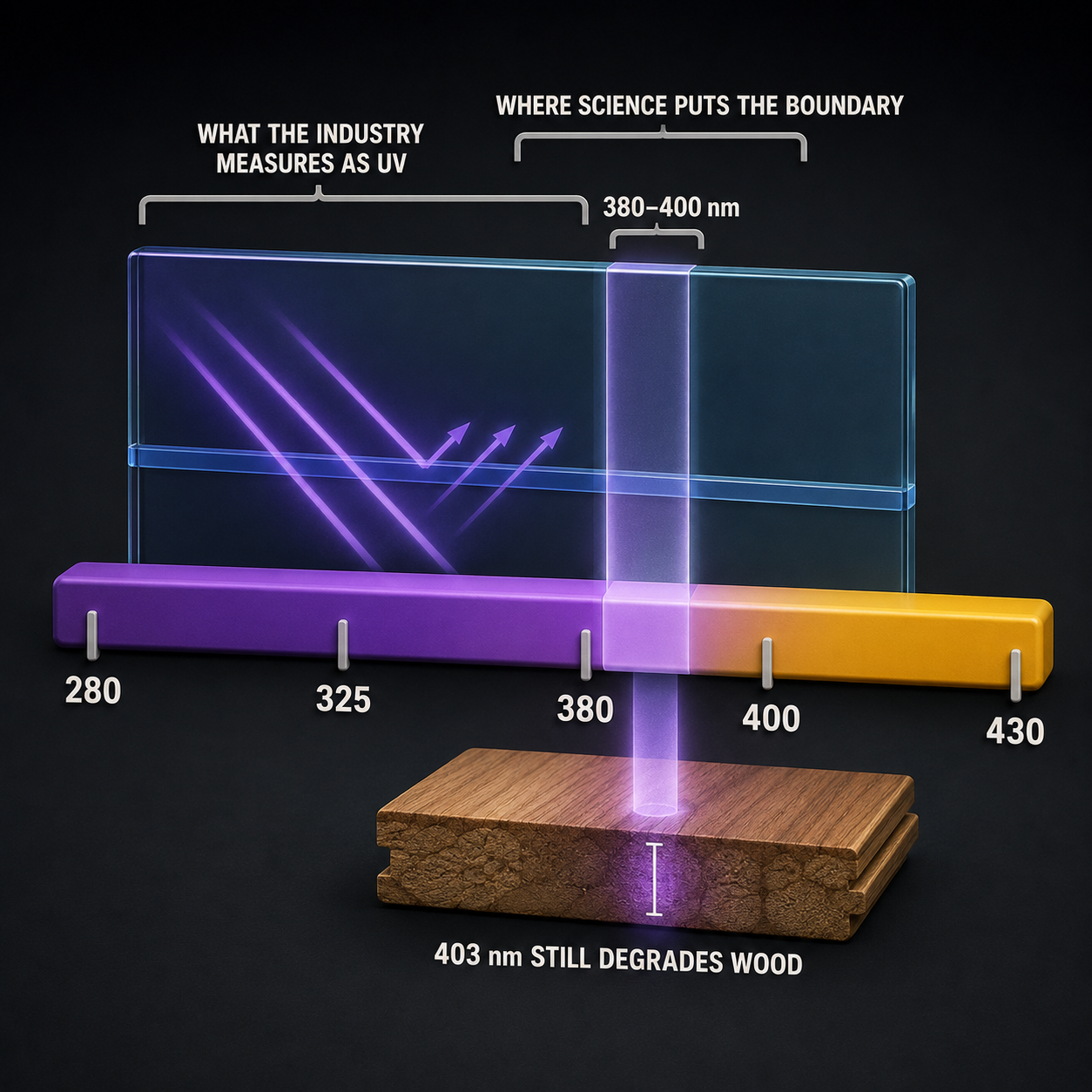
There's one more piece of fine print worth knowing, and it's about what "blocks 99% of UV" is measuring. The CIE and conservation practice put the UV/visible boundary at 400 nm. The window film industry measures UV as 280–380 nm — CCI notes this convention explicitly, and the European chapter of the IWFA defines it that way in its own technical papers. The National Park Service, evaluating UV-filtering films for museum use, was blunt about the consequence: almost any solar film filters to about 380 nm, very few filter the complete UV spectrum, and literature stating "98% of UV filtered" generally means 98% of the 325–380 nm range. Does that missing 380–400 nm slice matter? For wood floors, demonstrably yes: USDA Forest Service research found the depth of photodegradation in wood increases with wavelength up to and including violet at 403 nm — the exact band the measurement convention has reclassified as "visible." Two fair caveats: that NPS evaluation is from 2004 and formulations have improved, with some current products absorbing closer to 400 nm. But the measurement convention is still current, so a 99% figure quoted against a 280–380 nm band tells you nothing about 380–400 nm, and the datasheet won't let you tell the difference. NPS also found measured residual UV across films ranging from 0 to 400 µW/lm against an unfiltered window's 2,000 — an enormous spread among products all marketed the same way.
Since floors are what most people are actually asking about, they're worth a moment on their own, because wood doesn't fade the way a fabric fades. It's not primarily a dye problem — it's lignin photodegradation. Lignin, the natural polymer that stiffens wood, absorbs strongly across roughly 295–400 nm; when it breaks down it first yellows, then goes gray and silvery as surface lignin is lost and bare cellulose is exposed. That reaction is essentially a surface event — UV penetrates only about 75 micrometers into wood — but longer wavelengths reach deeper, and blue light (434–496 nm) goes deeper still and bleaches wood without significantly touching the lignin. Earlywood degrades faster than dense latewood, which is why the grain contrast shifts, not just the overall tone. And a floor is a stack: stain, wood, and clear finish each degrade on their own schedule, so an apparently "faded" floor may really be a spent polyurethane sitting over perfectly intact stain, or the reverse.
So where does that leave window film? Honestly, in a better place than the marketing does — just a narrower one. Film reduces the damaging dose across three pathways at once: it absorbs UV strongly (through absorbers in the polyester and adhesive), it reduces visible light in proportion to how much it darkens the glass, and it lowers surface temperature by cutting total solar energy. Those combine into a longer time-to-noticeable-fade, and the size of that extension depends on the film's damage-weighted transmittance and the material's own lightfastness. This is also where the "darker film protects better" claim turns out to be directionally correct — because visible light does the heavy lifting on sensitive colorants, cutting visible transmittance is the biggest available lever for exactly those materials. That's the real trade-off, and it's an unavoidable one: the damaging band and the seeing band are the same band. Fade protection and daylight are genuinely in tension.
What film does not touch is equally worth saying out loud. It does nothing about the intrinsic fastness of a dye — a BW2 dye fades roughly a hundred times faster than a BW8 dye no matter what's on the glass. Nothing about pollutants, off-gassing, or humidity. Nothing about your interior lighting. Nothing about thermal aging at ordinary room temperature, which proceeds in the dark. A few more caveats that rarely make it into a brochure: bare glass already blocks some UV — NFRC puts clear single-pane at about 25%, insulating glass up to 40%, and low-e up to 74% — so film should be judged as an increment over your existing glazing, not over open air, and the gain over a low-e unit is much smaller than the gain over single-pane. Film's UV performance is finite; NPS gives UV-filtering films an effective life of 8–15 years, institutional practice often assumes about 10, and critically, appearance is not a valid indicator of remaining UV function — the absorbers can be spent while the film still looks fine. And film doesn't change fade geometry: applied uniformly to the glass, it slows the rate everywhere behind it, but the sun still lands where the sun lands. That rectangle under the rug still forms. It forms more slowly, with less contrast at any given date.
One last practical thing, which is free. If you're trying to work out whether you're looking at light damage at all, look for the line. Photodegradation follows the sun's footprint, so it leaves a geometric boundary — a shadow edge, a sharper change where the beam actually falls. Discoloration that's uniform across a whole surface, with no gradient and no edge, is more likely thermal aging, a pollutant reaction, or cleaning-product damage than it is fading. It's the single most useful diagnostic you can do standing in your own living room, and it costs nothing but paying attention.
New here? Window Film Facts breaks down the physics of the sun's energy and what window film actually does with it — no hype, just the science. Learn it one chapter a day by email, and if there's something we haven't covered yet, ask us your question.