Anatomy of a Window Film
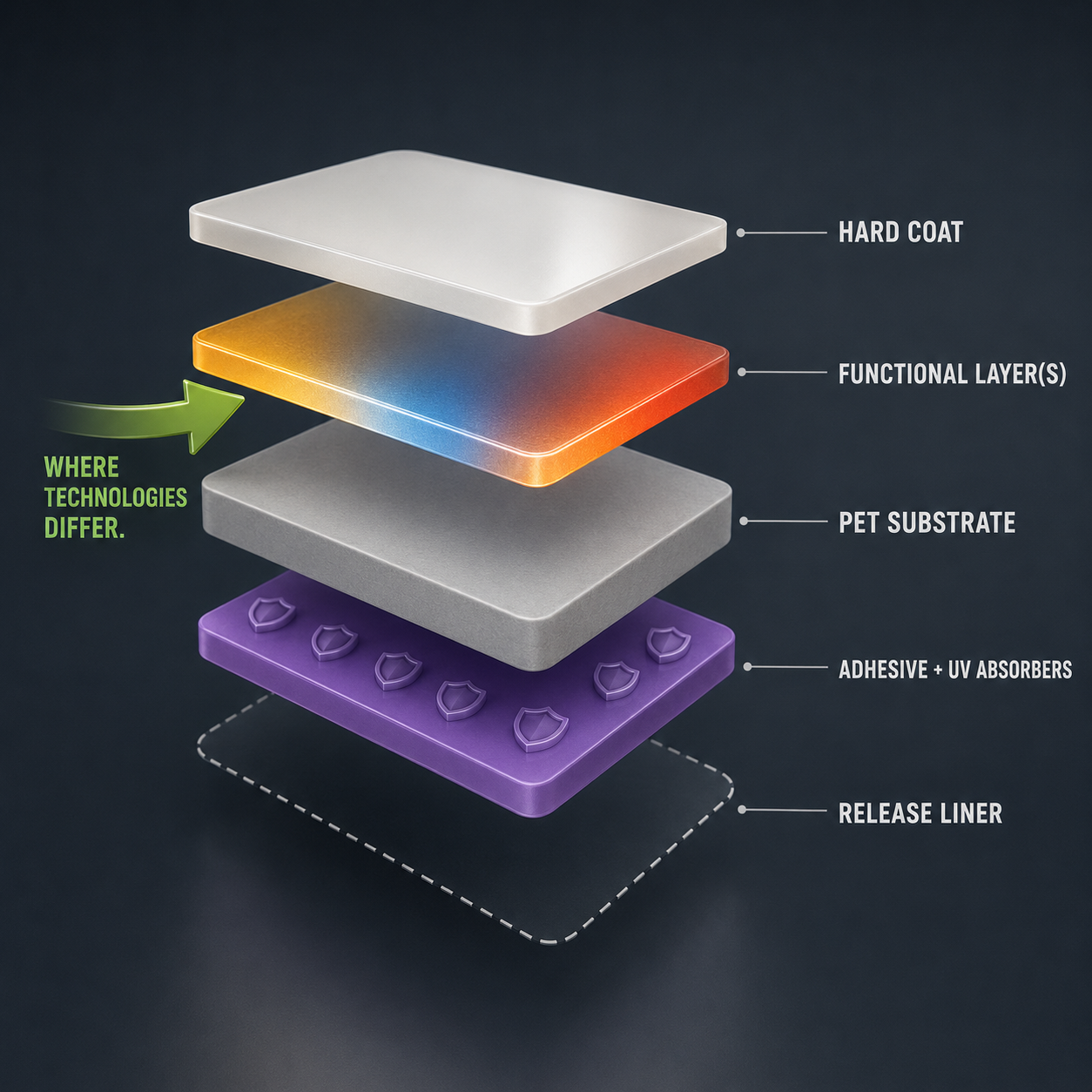
Nearly all window film, regardless of brand, price, or marketing label, shares one basic architecture: a stack of thin layers, each with a specific job.
The structural foundation is the PET substrate — polyethylene terephthalate, a polyester layer that gives the film its body, dimensional stability, and optical base.
Above or within it sit the functional layers — the layers where infrared management, coloring, and spectral behavior actually come from. This is the only part of the stack that meaningfully differs between film technologies; nearly everything else is shared engineering.
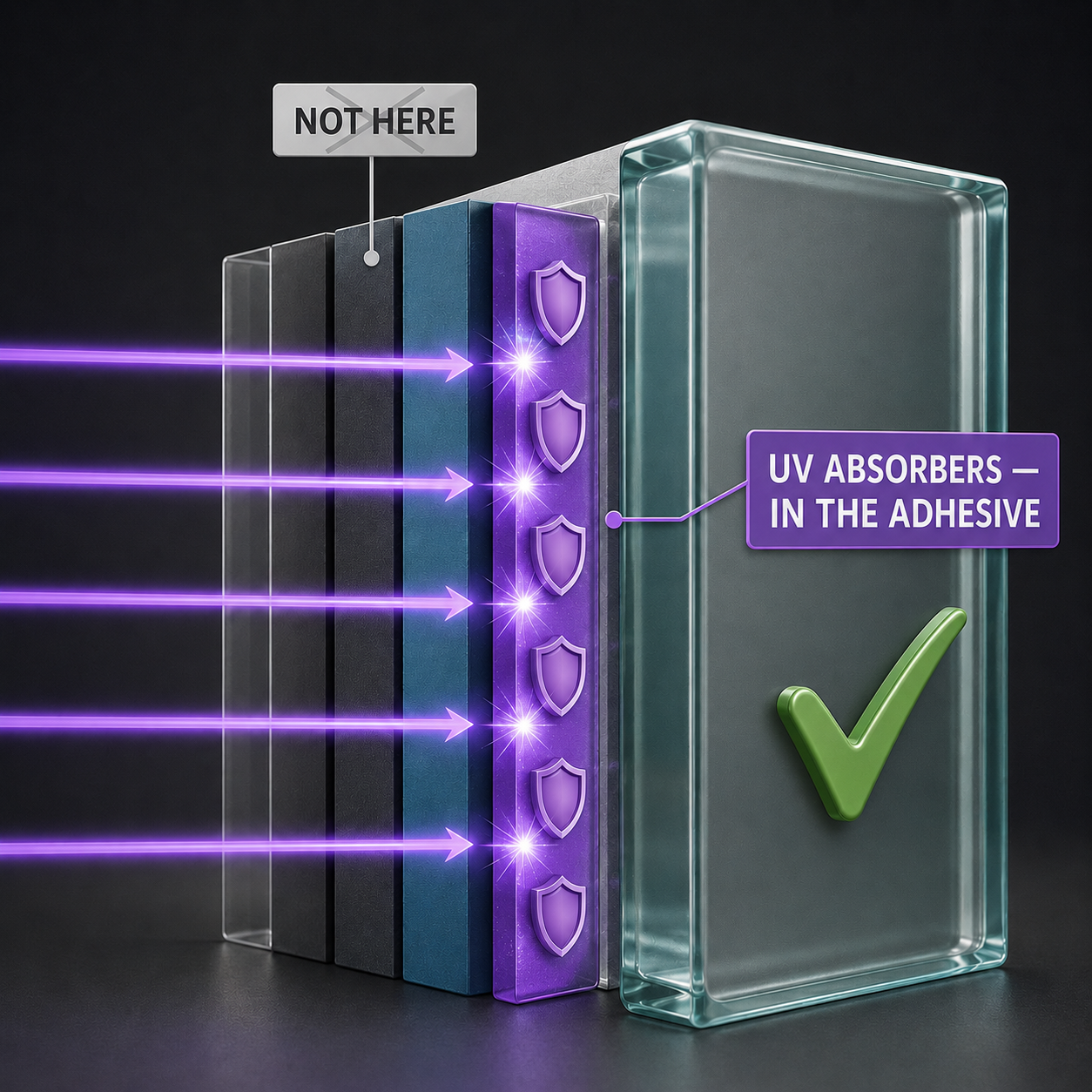
The film bonds to glass through a pressure-sensitive adhesive, and this layer carries a fact that surprises most buyers: in quality films, the dedicated UV absorbers typically live here. As patent literature describes it, the adhesive customarily contains ultraviolet energy absorbers to protect the space beyond from UV damage. A film's UV protection generally resides in the glue, not in the coloring material.
The outer face is protected by a scratch-resistant hard coat, and a release liner covers the adhesive until installation, then is discarded.
Five layers, one of which does the differentiating. When two films perform differently, the difference lives almost entirely in what the functional layer is made of and how it was applied — which is exactly where the next chapter goes.
If you're just finding this page, here's the quick context: our focus is sharing the science behind the sun's energy and how window film actually affects it. This is one chapter in an ongoing series — to see more, visit our page or give us a follow to keep window film and sun's energy facts coming to your feed.