The Atmosphere Filters First
Window film is not the first filter sunlight passes through. The atmosphere acts first, and what it removes shapes everything that arrives at ground level.
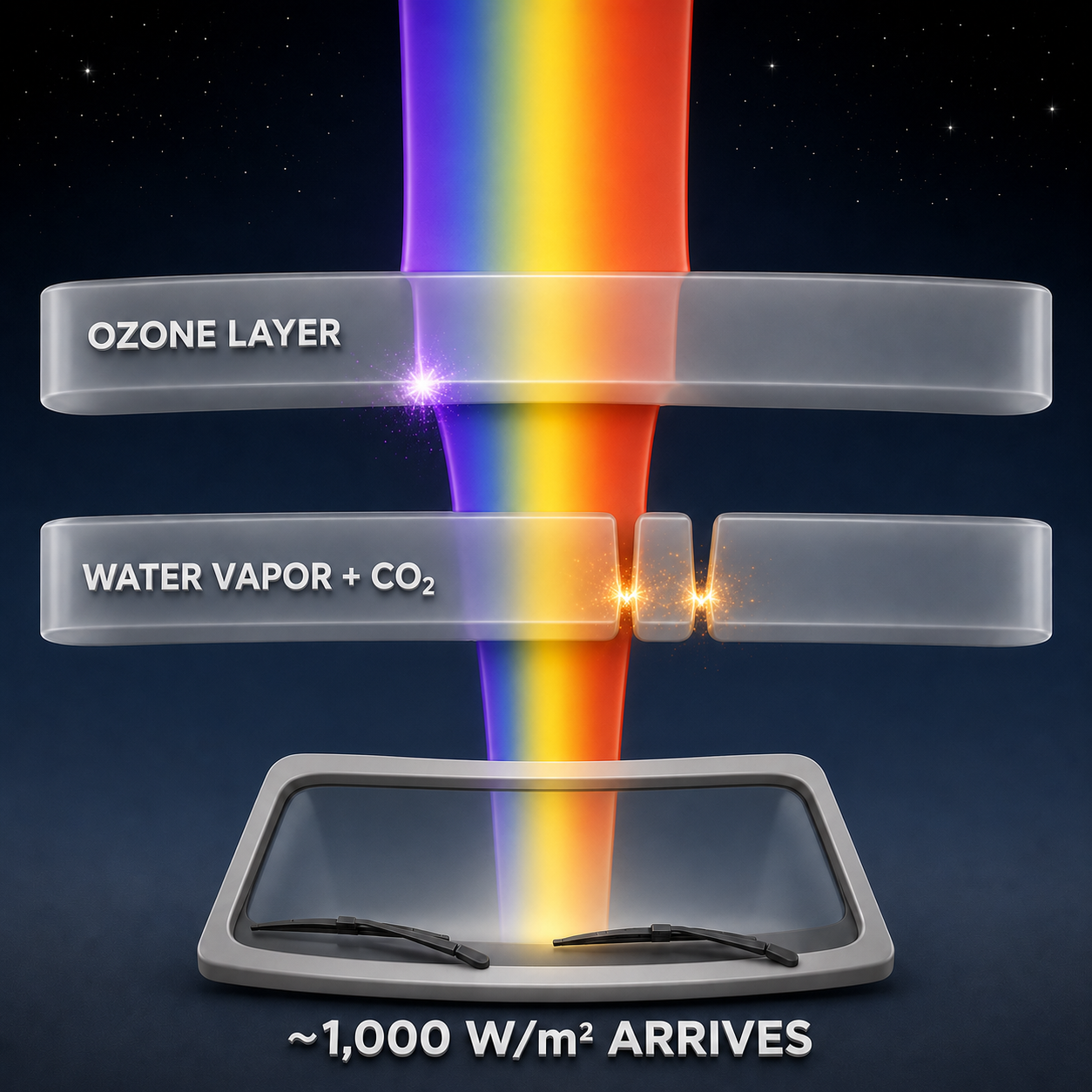
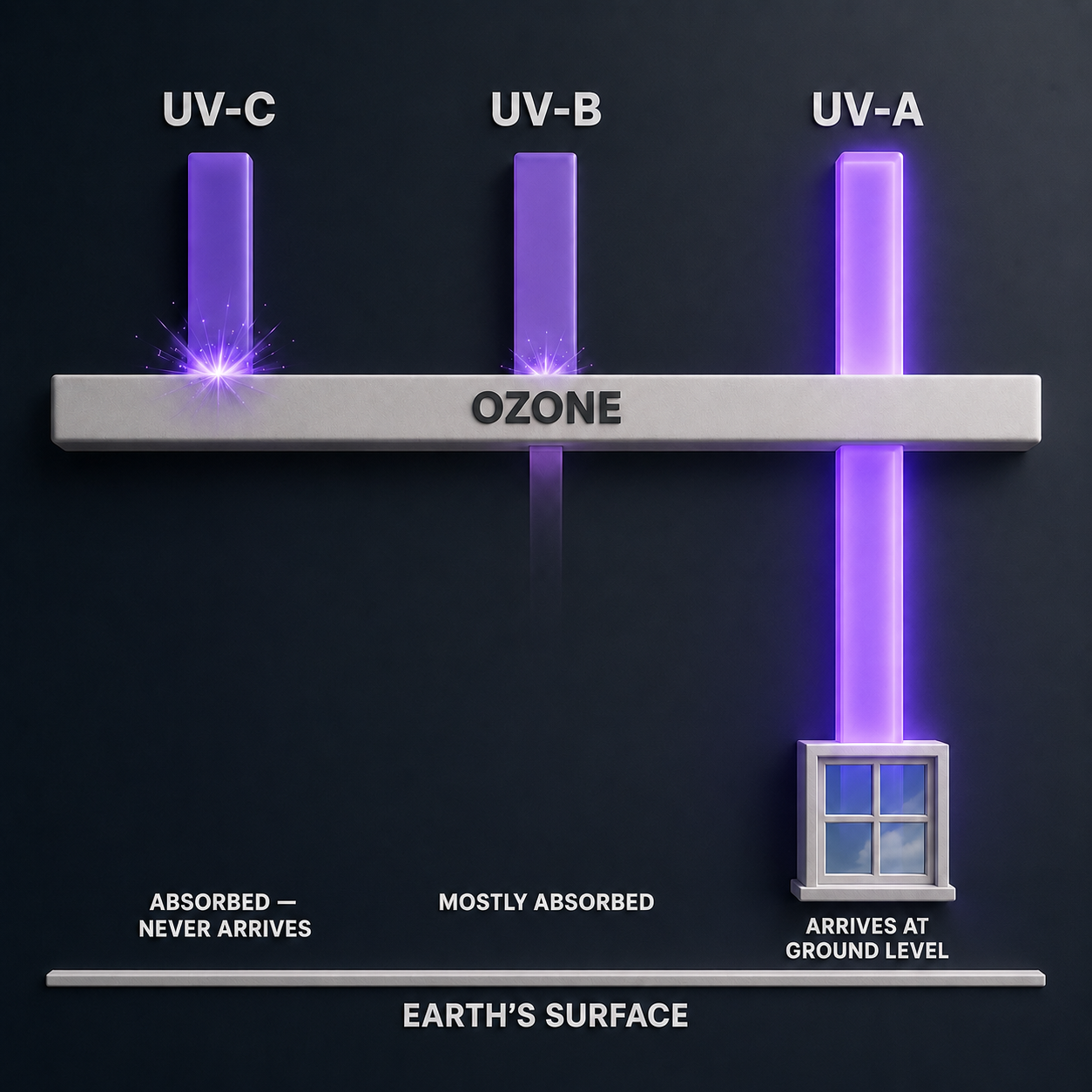
Ozone in the upper atmosphere absorbs UV-C — the most energetic and biologically damaging ultraviolet — almost completely. Effectively none of it reaches the surface. UV-B is mostly absorbed as well, with only a fraction surviving. UV-A largely passes through, which is why ground-level UV protection is fundamentally a UV-A conversation.
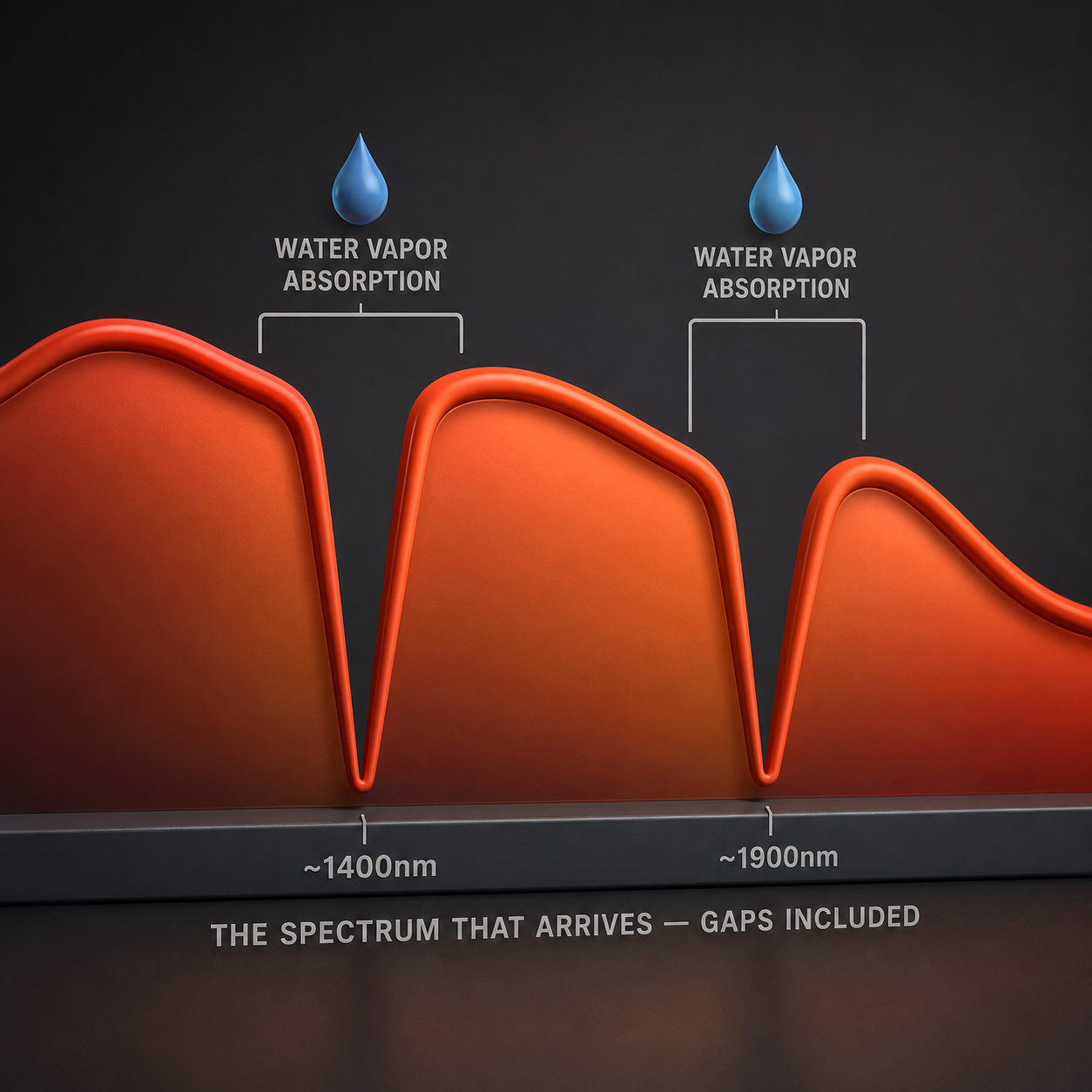
Deeper in the atmosphere, water vapor and carbon dioxide absorb specific infrared wavelengths, cutting characteristic notches into the solar spectrum — gaps that appear clearly in spectral measurements near 1,400 and 1,900 nanometers. Scattering redirects an additional share of energy, turning some direct radiation into diffuse sky light.
What survives this gauntlet is roughly 1,000 watts per square meter on a clear day — per the ASTM G173 reference standard, the integrated hemispherical irradiance at the surface is approximately 1,000 W/m². That is the actual energy budget arriving at any sunlit surface, and it is the input against which all legitimate glazing and film measurement is calculated.
The atmosphere's filtering is already baked into every honest performance number. Whatever a window treatment does, it does to what is left.
If you're just finding this page, here's the quick context: our focus is sharing the science behind the sun's energy and how window film actually affects it. This is one chapter in an ongoing series — to see more, visit our page or give us a follow to keep window film and sun's energy facts coming to your feed.